For a New York City insurance agency, an unanswered phone doesn’t just ring out — it hands a quote-ready buyer to the next agent on the list. In a city that never stops calling, quotes come in at 9 PM, during the lunch rush, and three at once during open enrollment. A human front desk can’t catch all of them, and the buyer on the other end rarely waits. They dial the next agency, and the policy — plus every renewal behind it — binds somewhere else.
This is the operator breakdown for NYC agencies: what a missed or slow-answered call actually costs you, why it happens, what today’s buyers expect, and how a 24/7 AI receptionist closes the gap without adding payroll or breaking TCPA rules.
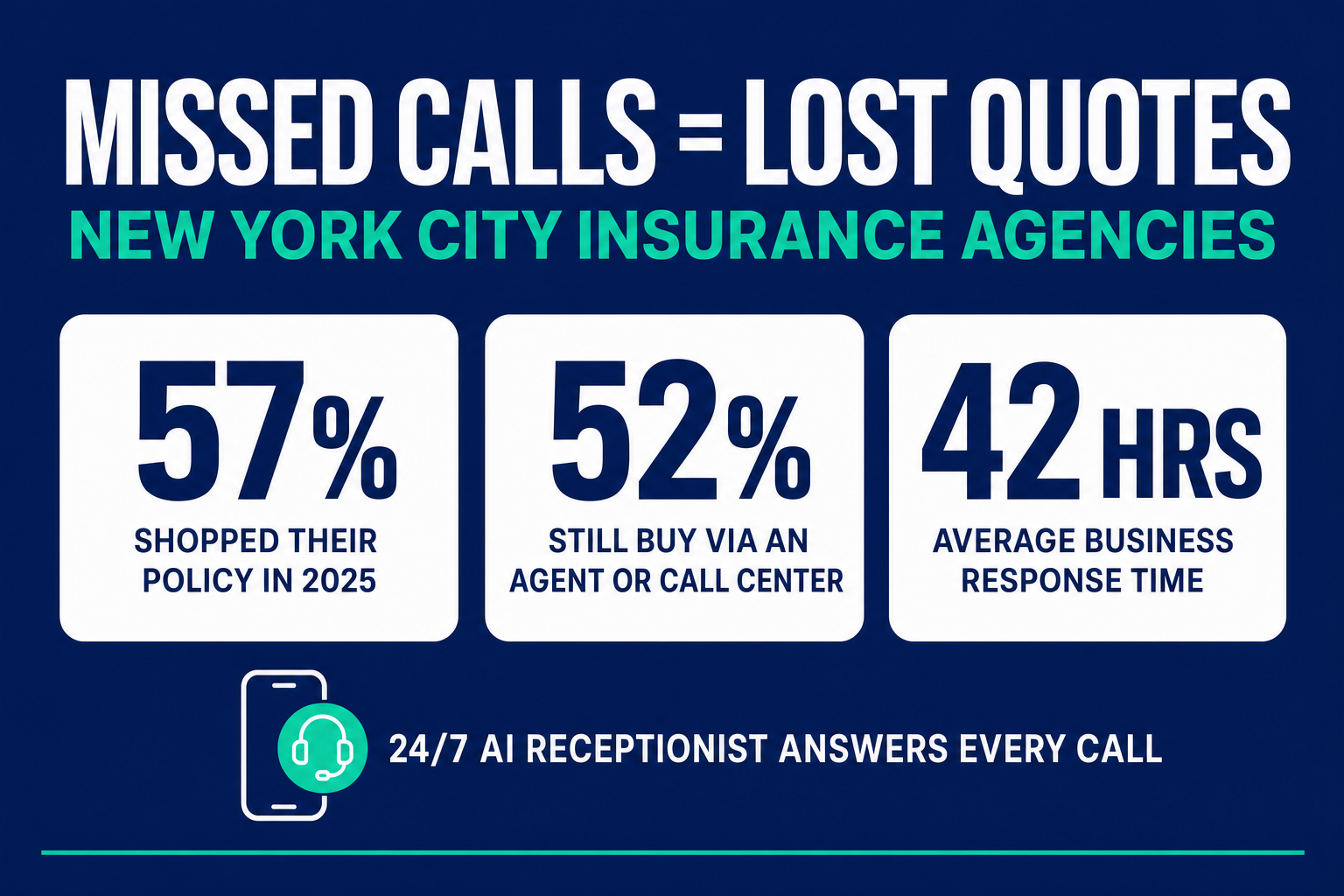
Table of contents
- Why a missed call in New York City is a lost policy
- The real cost of inaction: what an unanswered call actually loses
- Why NYC agencies miss calls in the first place
- What insurance buyers now expect
- The fix: a 24/7 AI receptionist
- Keeping it compliant: TCPA and CMS
- The New York City math
- FAQ
Why a missed call in New York City is a lost policy
Insurance is still a relationship business that runs on the phone — and the data says so. In J.D. Power’s 2025 U.S. Insurance Shopping Study, a record 57% of auto insurance customers shopped their policy in the past year, the highest rate the firm has recorded in nearly two decades (J.D. Power, 2025). More shopping means more inbound calls hitting your agency from people actively comparing carriers and agents.
Here’s the part that makes a missed call so expensive: even as digital buying grows, most people still buy through a human. In the same study, 47% purchased digitally, 35% through an agent, and 17% through a call center — meaning about 52% of purchases still close through an agent or a phone-assisted channel. When a New York City shopper calls your office for a quote and lands in voicemail, you haven’t just missed a message. You’ve missed the single moment they were most likely to bind.
New York City makes this sharper than almost anywhere. It’s one of the densest, most competitive insurance markets in the country, the audience is overwhelmingly mobile, and the pace is 24/7. A prospect comparing renters coverage after a late shift, a new driver getting quotes on the subway home, a small-business owner pricing a BOP before a lease signing — none of them are calling at 10 AM on a Tuesday when your front desk is free. They’re calling when it’s convenient for them, and if you don’t pick up, the next agent will.
The real cost of inaction: what an unanswered call actually loses
The cost of a missed call isn’t the call. It’s the speed you lose, and speed is the most reliable predictor of who wins a quote. The classic Lead Response Management study led by Dr. James Oldroyd (MIT / InsideSales.com), which tracked thousands of inbound leads, found that contacting a lead within 5 minutes instead of 30 makes you about 100× more likely to connect and 21× more likely to qualify that lead (Lead Response Management study). Those are vendor-tracked figures, but the direction is confirmed by independent research.
That independent confirmation comes from Harvard Business Review’s audit of 2,241 U.S. companies, which found the average first-response time to an inbound lead was 42 hours, only 37% of firms responded within an hour, and a staggering 23% never responded at all (Harvard Business Review). Firms that did respond within the first hour were roughly 7× more likely to qualify the lead than those who waited just one hour longer — and 60× more likely than those who waited 24 hours or more.
Now translate that to your book. A single bound auto or home policy in NYC isn’t a one-time sale — it’s a multi-year premium stream plus the cross-sell and referrals attached to that household. Miss the call that starts it, and you don’t lose one quote; you lose the lifetime value of a client who was ready to say yes. Multiply that by the after-hours calls your office never even sees, and the “missed call” becomes the most expensive line item that never shows up on any invoice. We break the lead-value math down further in our guide to what insurance leads really cost.
Why NYC agencies miss calls in the first place
No agency wants to miss calls. They miss them because a human front desk has hard limits that a busy market blows right past:
- After hours and weekends. A meaningful share of quote calls arrive outside 9-to-5 — evenings, Saturdays, holidays — exactly when your office is closed. In a 24/7 city, that window is huge.
- Simultaneous calls. During AEP, a rate shock, or a storm, the phone rings three at a time. One receptionist answers one; the other two hit voicemail.
- Producers are heads-down. Your best closers are on other calls, in binding, or servicing a claim. The quote-ready stranger gets sent to voicemail — and most callers won’t leave one.
- The lunch-and-transit gaps. Coverage dips midday and at shift changes. In NYC, that’s prime “calling between things” time for shoppers.
Hiring your way out is brutally hard and expensive. There are only about 568,800 insurance sales agents in the entire U.S. workforce (U.S. Bureau of Labor Statistics, 2024), and staffing a live phone 24/7 in a high-cost market like New York means multiple salaries, benefits, and turnover for hours that are mostly quiet punctuated by unpredictable spikes. It’s the wrong tool for a coverage problem — which is exactly why more agencies are solving it with automation instead of headcount. Our speed-to-lead playbook covers the follow-up side of the same fight.
What insurance buyers now expect
The bar for “responsive” has moved. Salesforce’s State of the Connected Customer research found that 64% of consumers and 80% of business buyers expect companies to respond and interact with them in real time (Salesforce). “Real time” does not mean a callback tomorrow or a voicemail you return after lunch. To a modern shopper — especially a younger, mobile-first NYC buyer — a call that isn’t answered is a signal that your agency isn’t available, and they move on.
That expectation collides directly with the channel data. Buyers are shopping more, they still close through human channels more than half the time, and they expect an instant response — but the typical agency answers in hours, not seconds. The chart below shows why that mismatch is a leak: more than half of purchases run through exactly the channel a missed call kills.
The fix: a 24/7 AI receptionist
An AI receptionist is a voice-and-chat agent that answers every call and message to your agency — instantly, around the clock — then qualifies the caller and books the quote onto the right producer’s calendar. It’s not a phone tree and it’s not an answering service that just takes a name. It’s a conversational agent that does the front-desk job on the first ring, at 2 AM or during a 3-calls-at-once spike, without anyone lifting a finger.
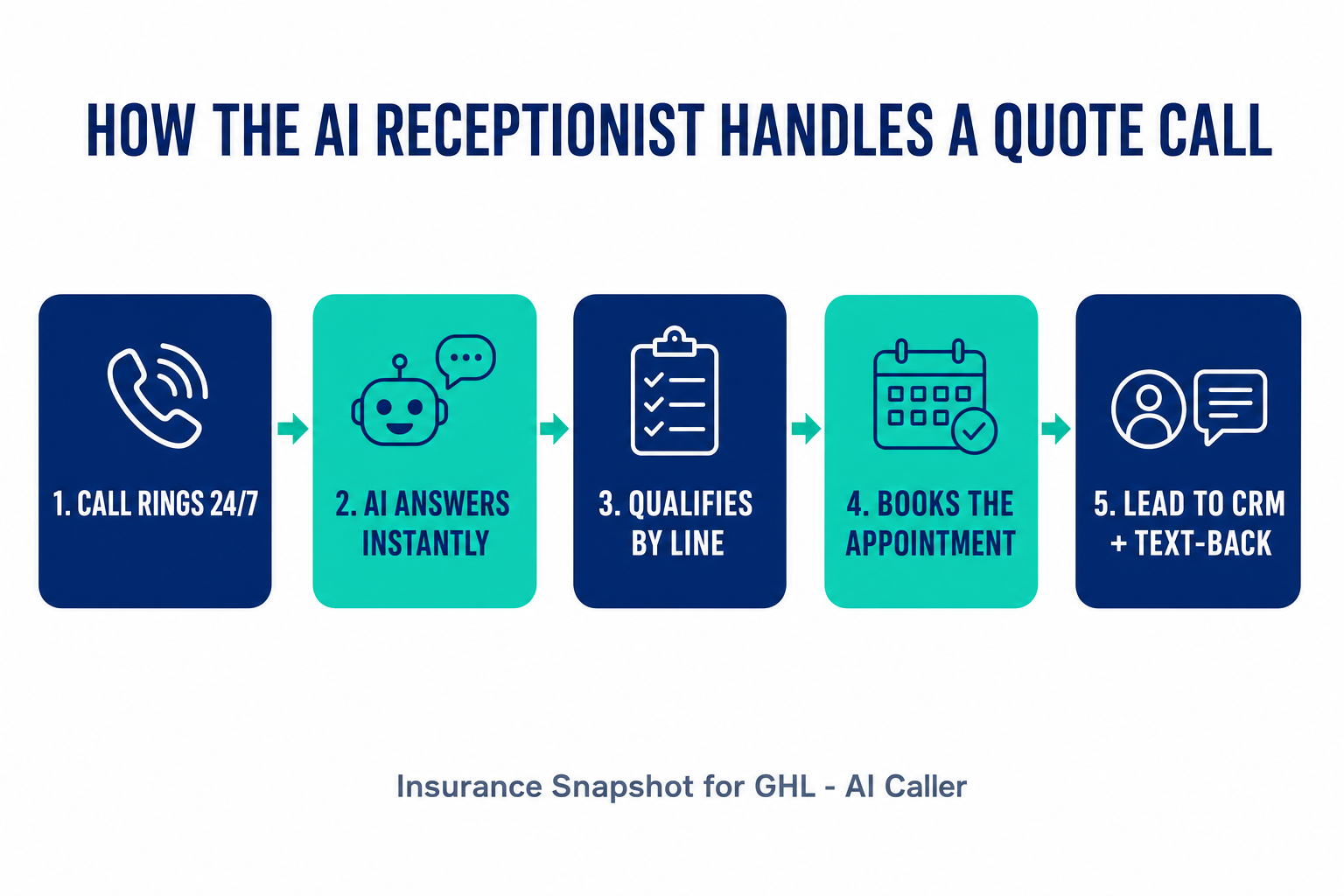
Here’s what the AI caller in the Insurance Snapshot actually does on a live quote call:
- Answers every ring, 24/7. Day, night, weekend, holiday — no voicemail, no hold music, no “please call back during business hours.”
- Qualifies by line of business. It adapts to auto, home, life, health/ACA, Medicare, or commercial — a caller mentioning a new car gets auto intake; a caller turning 65 gets the Medicare path.
- Captures the household basics. Lines of interest, current carrier and reason for shopping, contact details, and preferred callback window — written straight to the CRM so a producer follows up warm.
- Books the appointment. It offers live booking onto the right producer’s calendar, matched by line and availability, so the lead lands with someone who can actually help.
- Runs bilingual EN/ES and recovers missed calls — if a call ever slips through, an instant SMS text-back fires so the lead is recovered instead of lost.
This is the same argument, at machine speed, that the whole AI-receptionist playbook is built on: catch the prospect in the seconds they’re ready, not the hours later when they’ve already bound elsewhere. And it’s why Gartner projected back in 2022 that conversational AI would automate roughly 1 in 10 agent interactions and cut contact-center labor costs by $80 billion by 2026 (Gartner). The economics that drive that shift in big contact centers are the same ones that make an AI receptionist a bargain for a small NYC agency.
Human front desk vs. a 24/7 AI receptionist
| Plan | Front desk only | 24/7 AI receptionist recommended |
|---|---|---|
| Price | 9-to-5 coverage | Answers every ring |
| Feature 1 | Misses after-hours & weekend quote calls | Answers 24/7 — nights, weekends, holidays |
| Feature 2 | One call at a time — spikes hit voicemail | Handles simultaneous calls without dropping any |
| Feature 3 | Pulls a producer off selling to answer | Qualifies by line & books the appointment |
| Feature 4 | Callbacks land hours later, if at all | Instant response + missed-call text-back |
| Feature 5 | Best for: complex service conversations | Best for: catching every quote-ready caller |
| See the AI Caller |
The goal isn’t to replace your team — it’s to make sure your team never loses a quote to an unanswered phone. The AI handles the first-contact catch-and-qualify; your licensed producers do what only they can: advise, quote, and bind.
Keeping it compliant: TCPA and CMS
Automating conversations in insurance means staying inside the lines. A 24/7 AI receptionist should capture and honor consent, handle STOP/HELP on any text follow-up, and — for Medicare — respect CMS marketing boundaries. The snapshot ships with TCPA-safe consent capture and opt-out handling baked into the SMS layer, so the missed-call text-back and follow-up sequences don’t create a compliance headache later. We go deep on this in our guide to TCPA-safe insurance SMS.
The New York City math
Let’s be honest about what we can and can’t measure. There’s no clean public figure for exactly how many calls a given NYC agency misses — so ignore anyone quoting a suspiciously precise “62% of calls go unanswered” number; it doesn’t trace to a real study. But you don’t need it. The verified data is enough to make the decision obvious:
- Shopping is at a record 57%, so more quote calls are hitting your phone than ever.
- About 52% of buyers still close through a human channel — the exact channel a missed call kills.
- The average business takes 42 hours to respond and 23% never do, while responding in 5 minutes makes you 21× more likely to qualify the lead.
- 64% of consumers expect real-time response, and NYC’s mobile, always-on shoppers expect it more.
Put together, the picture is simple: in New York City, quote demand is high, competition is one tap away, and the winner is whoever answers first. A human-only front desk can’t answer first at 9 PM on a Saturday. An AI receptionist can — every time.
If you’d rather see it wired into a full agency setup first — quote funnels, renewal cadences, cross-sell, and the AI receptionist together — start with our auto insurance service page or talk to a real person. The phone is going to ring tonight. The only question is whether your agency answers.
FAQ
What exactly is an AI receptionist for an insurance agency?
It's a voice-and-chat agent that answers every inbound call and message to your agency instantly, 24/7. It greets the caller in your agency's voice, qualifies them by line of business (auto, home, life, health, Medicare, commercial), captures their contact and coverage basics into your CRM, and books a quote appointment onto the right producer's calendar. It handles first-contact catch-and-qualify so a quote-ready caller never lands in voicemail.
Does it really matter if a New York City agency misses a few calls?
Yes, because a missed call is usually a missed sale. About 52% of auto customers still purchase through an agent or call center (J.D. Power 2025), so a call that isn't answered often means the policy binds with a competitor. In a dense, competitive market like NYC where shoppers can get three other quotes in minutes, first-to-answer wins disproportionately — and a single bound policy is a multi-year premium stream, not a one-time sale.
How fast does an AI receptionist respond compared to a human front desk?
Instantly — it answers on the first ring, every time, including nights, weekends, and holidays, and it handles multiple calls at once. That speed is the whole point: responding to a lead in 5 minutes instead of 30 makes you about 21× more likely to qualify it (Oldroyd/MIT Lead Response study), while the average business takes 42 hours to respond and 23% never respond at all (Harvard Business Review).
Will an AI receptionist quote or sell insurance?
No. It answers, qualifies, and books appointments — it does not quote, bind, underwrite, or sell policies. Every policy decision stays with your licensed producers under your own E&O coverage, carrier appointments, and state licenses. The AI simply makes sure the conversation starts instead of dying in voicemail, then hands a warm, qualified lead to your team.
Is an AI receptionist TCPA compliant?
It's built to be. The Insurance Snapshot ships with TCPA-safe consent capture and STOP/HELP opt-out handling in the SMS layer, so the missed-call text-back and any follow-up messages honor consent and opt-outs. For Medicare, it also respects CMS marketing boundaries. Compliance rules ultimately belong to each agency, but the automation is designed to keep you inside the lines rather than create a problem.
How long does it take to install and what does it cost?
The AI receptionist is part of the Insurance Snapshot, which installs into your GoHighLevel account in about 24 hours once we have sub-account access. The snapshot is a done-for-you system that includes the AI caller, AI chatbot, SMS automation, review and booking automations, and the insurance CRM/pipelines. See current pricing on the pricing page, or book a 15-minute demo to see the AI receptionist answer a live test call.
About the author
Andre Bellamy is a GHL Automation Lead for the Insurance Practice at Insurance Snapshot for GHL. He spends his days inside agency accounts wiring the systems that turn a ringing phone into a bound policy — AI callers, quote funnels, pipelines, and the missed-call recovery that decides whether a click or a call becomes a customer. He writes about the operational mechanics of insurance growth, from response times to renewal cadences. Editorial byline only — Andre is not a licensed agent and does not quote, bind, or sell insurance.
Want every quote call answered without adding payroll? See the AI Caller, get the Insurance Snapshot, or book a quick walkthrough.