
For most Atlanta insurance agencies, the honest answer is that you don’t need custom software until off-the-shelf tools start costing you more than they save — and then you need it badly. The tipping point is usually a generic CRM that doesn’t speak lines of business, policy data scattered across three systems your team re-keys by hand, and clients who have nowhere to log in. Custom insurance software fixes exactly those three gaps: a branded policyholder portal so clients self-serve documents and ID cards, a CRM/AMS shaped around renewals and producer splits, and integrations that end double data entry — the work generic tools were never built to do.
This is the operator’s view for an Atlanta agency: what “custom insurance software” actually means, where off-the-shelf tools quietly leak retention and hours, the three builds that pay for themselves, and how to tell whether your shop has hit the point where custom is cheaper than the workaround.
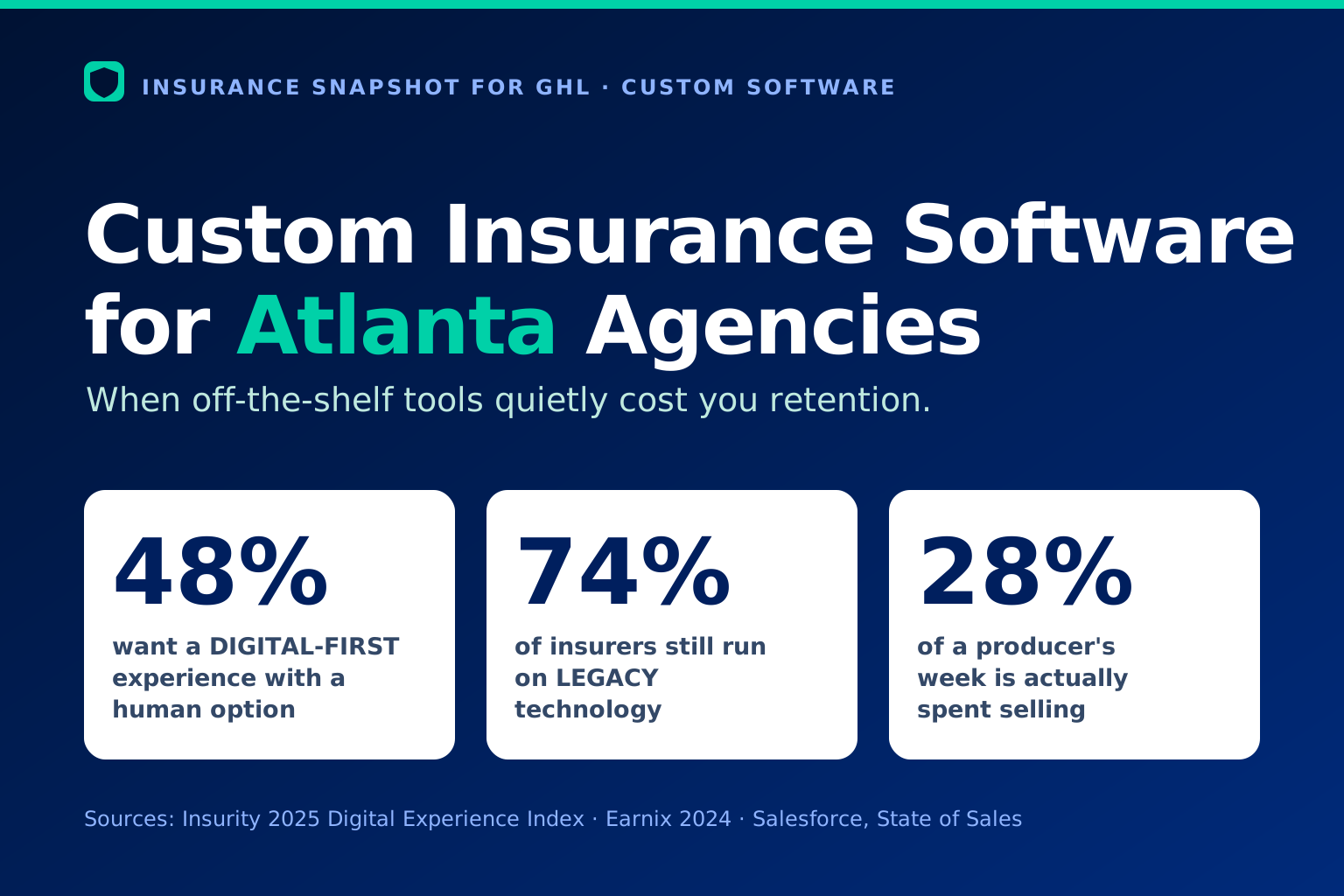
Table of contents
- What “custom insurance software” actually means
- Why Atlanta agencies outgrow off-the-shelf tools
- The hidden cost of generic software and data silos
- What policyholders actually want from you online
- The three custom builds that pay for themselves
- Custom vs off-the-shelf: when each wins
- What it costs and how long it takes
- How to know if your Atlanta agency needs custom software
- FAQ
What “custom insurance software” actually means
“Custom software” gets thrown around loosely, so let’s be concrete. For an insurance agency it usually means one of four things, none of which you can buy off a shelf and have fit:
- A policyholder portal — a branded, secure place where your clients log in to upload documents, download ID cards and certificates, track renewals, e-sign, pay, and message their producer.
- A custom CRM or agency-management system — a management layer built around lines of business, renewal dates, effective dates, producer splits, and carrier appointments instead of the generic “contacts and deals” a horizontal CRM ships with.
- Integrations and data pipelines — the plumbing that connects your AMS or rater (AgencyBloc, Applied Epic, EZLynx, HawkSoft, NowCerts, Vertafore), your accounting (QuickBooks), and your marketing platform so data flows automatically instead of being re-keyed.
- Custom AI agents — a quote-intake, document-extraction, or cross-sell agent trained on your lines and workflow, TCPA- and CMS-aware, working inside the tools you already use.
The common thread is fit. Horizontal tools are built for the average of every industry; an insurance agency is not average. When the software doesn’t match how the agency actually works, you end up duct-taping tools together, paying for seats you don’t use, and re-keying data between systems — which is the exact pain our custom software service exists to remove.
Why Atlanta agencies outgrow off-the-shelf tools
Atlanta is one of the Southeast’s real insurance hubs. The state’s regulator — the Georgia Office of Commissioner of Insurance and Safety Fire — sits in downtown Atlanta, and the metro carries a dense concentration of carriers, underwriters, and independent agencies. That density cuts both ways: there’s plenty of business, and plenty of competitors one “insurance near me” search away. Across the country there are roughly 568,800 insurance sales agents working at a median wage of $60,370 (U.S. Bureau of Labor Statistics), and a healthy share of them are chasing the same Atlanta households you are.
In a market that competitive, the agency that responds fastest and retains hardest wins — and both are operational problems, not talent problems. The catch is that most agencies can’t move fast because their operation is spread across disconnected tools that were never built to work together. About 74% of insurers still run on legacy or outdated technology (Earnix, 2024), and every seam between those systems is a place a lead goes cold or a producer loses time. It shows up in the day: reps spend only about 28% of their week actually selling, with the rest lost to admin, data entry, and internal busywork (Salesforce, State of Sales).
Off-the-shelf tools are fine right up until they aren’t. A generic CRM works for a solo producer with 300 contacts. It starts breaking when you have thousands of households, multiple producers with commission splits, renewal dates that drive your whole calendar, and clients who expect to do business online. That’s the point where an Atlanta agency outgrows the shelf — and where custom software stops being a luxury and starts being cheaper than the workaround.
The hidden cost of generic software and data silos
The cost of the wrong software is rarely a line item. It hides in three places.
Re-keyed data. In a typical agency, one submission gets keyed into the CRM, re-keyed into the AMS, and re-keyed again into the carrier portal — the same data entered by hand three times, each pass a chance to fat-finger a limit or an effective date (Catalyit / IIABA 2024 State of Tech Report). Multiply that by every quote, endorsement, and renewal and you’ve built a full-time job out of copy-paste.
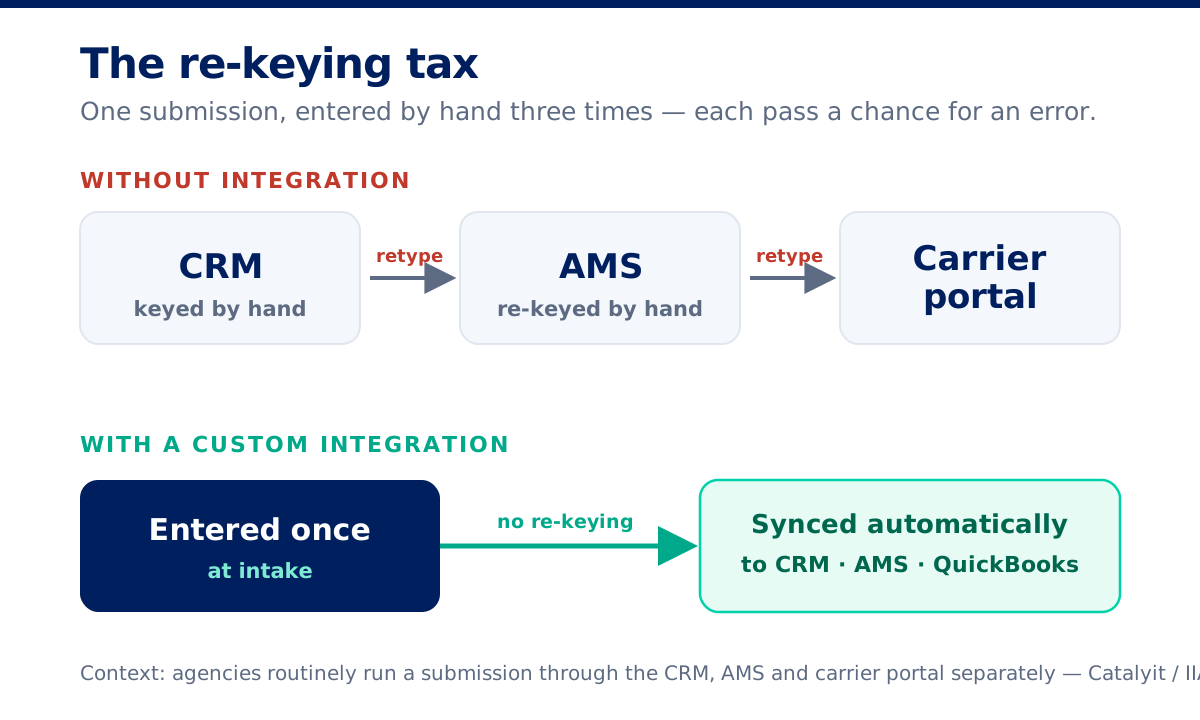
Producer hours. Every one of those re-keying seams is time your most expensive people spend not selling. When only ~28% of the week is real selling (Salesforce), shaving the admin isn’t a nicety — it’s the cheapest capacity you’ll ever add, without hiring into a market where a full-time agent runs $60K+ (BLS).
Silent retention leaks. This is the expensive one. When your data lives in five places, nobody has a clean view of what’s renewing, what’s mono-line, or which household hasn’t heard from you since they bound. Renewals slip, cross-sell never happens, and clients drift. And retention is where the profit is: a 5% reduction in customer defection lifted profits 25–85% across the firms Reichheld studied — 50% at an insurance brokerage specifically (Harvard Business Review). P&C insurers that lead on customer experience outperformed peers by 65 points of total shareholder return from 2017–2022 (McKinsey). Generic software doesn’t cause churn directly — it just makes the churn invisible until it’s already happened. Our retention playbook breaks down how much a single point of retention is worth to a book.
What policyholders actually want from you online
Here’s the nuance that kills a lot of “let’s go all-digital” projects: your clients don’t actually want to be handed a robot. Only 15% of consumers want a fully digital, self-service insurance experience. The largest group — 48% — wants a “digital-first” experience with the option to reach a human when they need one (Insurity 2025 Digital Experience Index). That’s the exact shape of a good policyholder portal: self-serve the routine stuff, one tap to a producer for anything real.
How consumers want to handle their insurance
Consumer preference for handling insurance. “Digital-first with a human option” (48%) and “fully digital” (15%) are reported figures; the middle bar is the remainder who prefer a person. Source: Insurity 2025 Digital Experience Index (survey of 1,000+ U.S. adults).
When Insurity asked what policyholders most value, the answers were mundane and telling: streamlined billing and payments, instant access to policy documents, and the ability to file and track claims online (Insurity, 2025). None of that is exotic. It’s a login where a client can grab their own COI at 9pm instead of emailing your CSR and waiting until morning. And the quality of that experience compounds: in J.D. Power’s 2025 study, customers with a high digital-satisfaction score were far more likely to keep using digital channels than those with a poor experience (J.D. Power 2025 U.S. Insurance Digital Experience Study). A clunky portal is worse than none; a good one is a retention tool.
The part off-the-shelf gets wrong is that a generic “client portal” bolt-on doesn’t know your carriers, your document types, or your renewal logic — so it becomes another silo instead of a front door to your real data. A custom portal is wired to the CRM/AMS behind it, which is why it actually reduces CSR load instead of adding a system to maintain.
The three custom builds that pay for themselves
Not every custom idea is worth building. In practice, three earn their cost the fastest for an agency.
1. A policyholder self-service portal
A branded portal where clients upload documents, download ID cards and certificates, track renewals, e-sign, pay premiums, and message their producer — backed by your CRM/AMS data. It gives the 48% who want digital-first (Insurity) a real front door and takes routine “send me my COI” tickets off your CSRs. This pairs naturally with a clean client onboarding flow so a new policyholder’s first experience is self-serve, not a scavenger hunt through email.
2. An insurance-shaped CRM / AMS
Off-the-shelf CRMs don’t speak lines of business, renewal cycles, producer splits, or carrier appointments, so agencies stuff that data into notes fields where automation can’t see it. A custom CRM/AMS is built around the actual pipeline and fields your agency runs on — the same insurance data model our CRM & workflow automations are built around, but as standalone software you own. That’s what makes renewals, cross-sell, and commission tracking automatable instead of manual.
3. Integrations that end double data entry
The highest-ROI build is often the least glamorous: a connector that syncs your AMS, GHL, and QuickBooks so contacts, policies, renewals, and commissions stay consistent everywhere and nobody re-keys anything. It directly attacks the three-times-entered-submission problem (Catalyit / IIABA 2024) and is the backbone of our GHL development work. If you’re planning a full move onto GoHighLevel first, our migration playbook walks the data steps in order.
A fourth category — custom AI agents for quote intake, document extraction, or cross-sell — is increasingly worth it too, and overlaps with what an AI receptionist or GoHighLevel AI Employee already delivers inside the snapshot. Start there before you commission a bespoke agent.
Custom vs off-the-shelf: when each wins
The decision isn’t “custom or generic” as a philosophy — it’s a per-problem call. Here’s the honest split.
Off-the-shelf tools vs. custom insurance software
| Plan | Custom insurance software recommended | Off-the-shelf CRM / tools |
|---|---|---|
| Price | From ~$3K, scoped | Monthly per seat |
| Feature 1 | Built around your lines, renewals, and producer splits | Fast to start, cheap for a solo producer |
| Feature 2 | Branded policyholder portal wired to your real data | Generic 'contacts & deals' — no insurance data model |
| Feature 3 | Integrations that end re-keying across AMS/GHL/QuickBooks | Client portal (if any) is a disconnected bolt-on |
| Feature 4 | You own 100% of the code and IP, deployed to your accounts | Data siloed; re-keyed between systems by hand |
| Feature 5 | Best for the 20% off-the-shelf can't fit | Best for the 80% a prebuilt snapshot already covers |
| Get a custom software quote |
For most agencies the right answer is both: run the Insurance Snapshot and a solid stack for the 80%, and commission custom software only where a portal, an insurance-shaped CRM, or an integration is the sole path. Spending custom-build money on something a $997 snapshot already does is the most common mistake we talk agencies out of.
What it costs and how long it takes
Custom software has a reputation for being a bottomless money pit. It doesn’t have to be — because we build with Claude Code (Anthropic’s AI-assisted development CLI), timelines and cost run roughly half of a traditional dev shop, and every build ships with full IP transfer and a 30-day bug-fix warranty. Here are the real ranges we scope to:
Typical custom-build delivery windows (weeks)
Upper end of typical delivery windows. Source: Insurance Snapshot for GHL custom software project scoping.
On price, fixed-price quotes start around $3K for small tools and integrations, $5–15K for AI agents and dashboards, $15–40K for a policyholder portal, and $25K+ for a full custom CRM/AMS — or an hourly retainer at $75/hr with no minimums if your requirements are still evolving. Every engagement starts with a free 30-minute discovery call and a written, fixed scope, so there’s no surprise invoice. If you need ongoing help running it after launch, a dedicated GoHighLevel VA starts at $700/month, and a fast prebuilt Astro website can front the whole thing.
How to know if your Atlanta agency needs custom software
Skip custom software if you’re a small shop, your current tools basically fit, and a prebuilt snapshot covers your automation. You almost certainly need it when three or more of these are true:
- Clients keep emailing for documents they should be able to grab themselves — you’re the human API for your own COIs and ID cards.
- The same data gets typed into multiple systems. If a submission lives in the CRM, the AMS, and a carrier portal by hand, you’re paying producer wages for copy-paste.
- Your “CRM” doesn’t know it’s insurance — no real fields for line of business, effective date, renewal/X-date, carrier, or producer split, so that data hides in notes.
- You can’t see retention or commissions without a spreadsheet someone updates by hand.
- You’ve hit the ceiling of off-the-shelf and your next move is either “hire another admin” or “build the thing that removes the admin.”
If that sounds like your agency, the fix isn’t more seats on a generic tool — it’s software shaped like your agency. And in a market as competitive as Atlanta, the operational edge of clean data, a real client portal, and no re-keying is exactly the kind of quiet advantage that compounds into retention.
FAQ
What is custom insurance software for an agency?
It's software built around how an insurance agency actually works, rather than a generic tool you adapt. In practice it's one of four things: a branded policyholder self-service portal, a custom CRM or agency-management system shaped around lines of business and renewals, integrations that sync your AMS, GHL, and QuickBooks so nobody re-keys data, or custom AI agents for quote intake and document extraction. The common thread is fit — it does the ~20% of the job that off-the-shelf tools and a prebuilt snapshot genuinely can't.
Do Atlanta insurance agencies actually need a policyholder portal?
Many do. Only about 15% of consumers want a fully digital, self-service experience, but 48% want a 'digital-first' model with a human option (Insurity 2025) — which is exactly what a good portal delivers: self-serve billing, documents, ID cards, and claims tracking, with one tap to a producer. A portal takes routine 'send me my COI' tickets off your CSRs and, done well, becomes a retention tool. If your clients constantly email you for documents they should be able to pull themselves, that's the signal.
How much does custom insurance software cost?
Fixed-price quotes start around $3K for small tools and integrations, $5–15K for AI agents and dashboards, $15–40K for a policyholder portal, and $25K+ for a full custom CRM/AMS. An hourly retainer is available at $75/hr with no minimums for evolving requirements. Because we build with Claude Code, timelines and cost typically run about half of a traditional dev shop, and full IP transfer plus a 30-day bug-fix warranty are included.
How long does a custom build take?
Simple AI agents run about 2–3 weeks, voice agents 2–4 weeks, dashboards and integrations 3–5 weeks, a policyholder portal 6–8 weeks, and a full custom CRM/AMS 8–12 weeks. Every project starts with a free discovery call and a written fixed scope, and build sprints ship with weekly demos so you see progress every Friday.
Should I buy the Insurance Snapshot or build custom software?
Usually both, in that order. The prebuilt Insurance Snapshot ($997) covers roughly 80% of an agency's automation — quote funnels, renewal cadences, review requests, AI receptionist, TCPA-safe SMS — inside GoHighLevel, fast and cheap. Custom software is for the other 20%: a policyholder portal, an insurance-shaped CRM/AMS, or an integration off-the-shelf tools can't do. Start with the snapshot; commission custom only where it's the sole path.
Do I own the custom software you build?
Yes — 100% of the code and IP transfers to you by default, deployed to your own infrastructure and accounts, and we sign NDAs before anything sensitive is shared. The output is entirely yours; there's no lock-in to us to keep running it, though a dedicated GHL VA or hourly retainer is available if you want ongoing support.
About the author
Andre Bellamy is a GHL Automation Lead for the Insurance Practice at Insurance Snapshot for GHL. He spends his days inside agency accounts mapping how a lead moves from first quote to bound policy to cross-sell, then turning that into the software, workflows, and data models that run without a producer babysitting them. He writes about the operational mechanics of insurance automation — data models, portals, and the build-vs-buy decisions that separate “we have tools” from “the agency actually runs on them.” Editorial byline only — Andre is not a licensed agent and does not quote, bind, or sell insurance.
Wondering whether custom software is worth it for your agency? See our custom insurance software service, book a free discovery call, or talk to a real person.