
For a San Diego insurance agency, the Google local pack — the three-agency map that sits above every “insurance agent near me” search — is won or lost on reviews, and specifically on having more of them, at a higher rating, that are fresher than your competitors’ down the street. Roughly 97% of consumers read online reviews for local businesses before they choose one (BrightLocal), and a San Diego shopper comparing auto or home coverage rarely scrolls past those top three map results. If your agency shows a thin count, a 3.9-star average, or a “last reviewed 8 months ago” profile, you’re not in the running — the quote call goes to whoever looks trusted right now.
This is the operator breakdown for San Diego agencies: why a stale review profile quietly bleeds quote leads, what the local-pack ranking data actually says, why manual “please leave us a review” almost never works, and how an automated review-harvesting engine keeps a steady flow of fresh 5-star Google reviews so you win the map — without a producer remembering to ask.
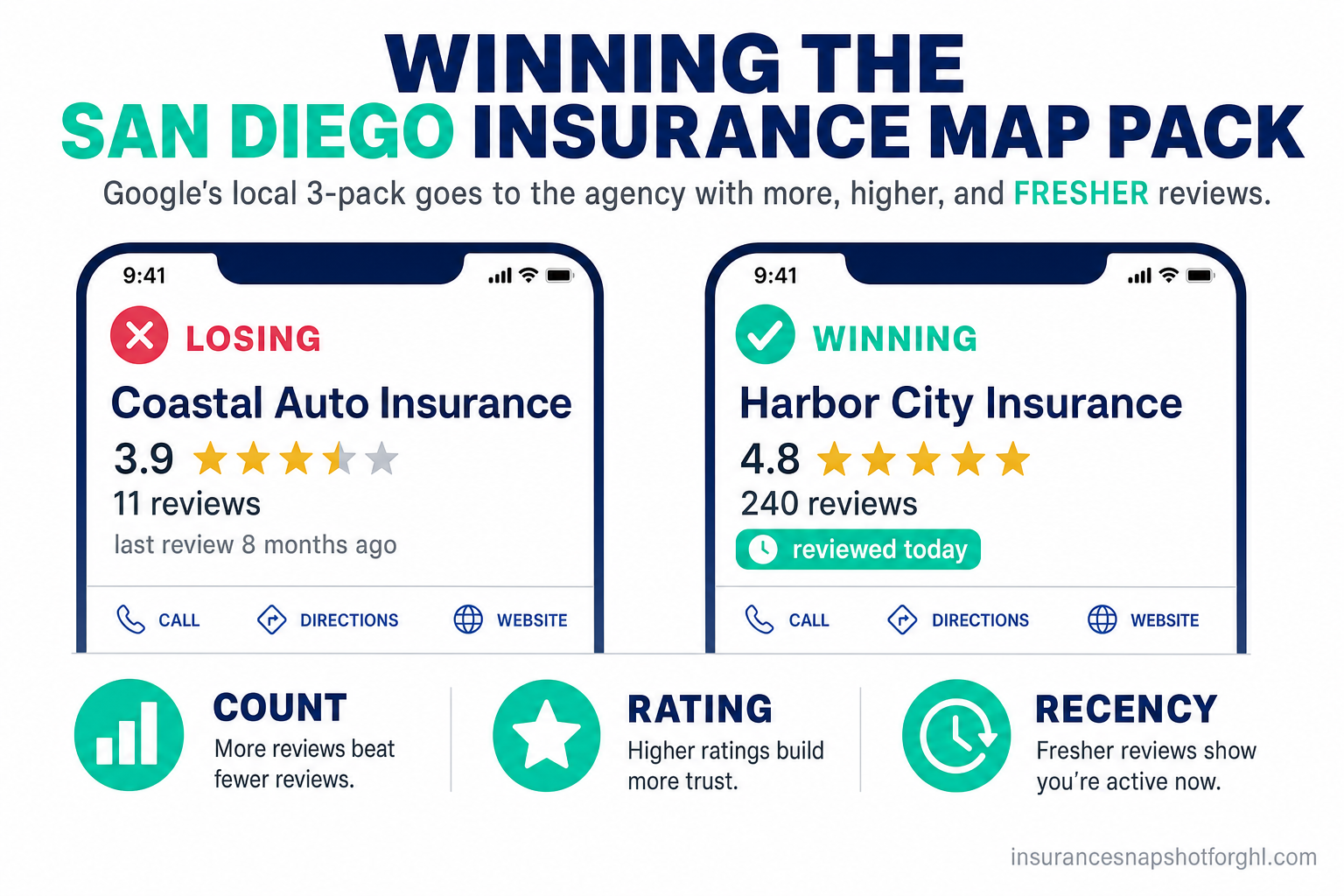
Table of contents
- Why the San Diego map pack is won on reviews
- The three signals Google and shoppers both grade
- The real cost of a stale review profile
- Why manual review asks fail in a busy agency
- The fix: an automated review-harvesting engine
- Manual asks vs. automated harvesting
- Keeping it compliant and honest
- The San Diego math
- FAQ
Why the San Diego map pack is won on reviews
When someone in San Diego searches “insurance agent near me,” “cheap car insurance Chula Vista,” or “home insurance North Park,” Google answers with a local pack: a map and three business listings above the regular results. Those three slots capture the overwhelming majority of clicks and calls for local-intent searches. Everyone below the fold is fighting for scraps.
Getting into that pack isn’t luck. Google ranks local results on a blend of relevance, proximity, and prominence — and reviews are one of the biggest inputs to prominence. In Whitespark’s Local Search Ranking Factors study, review signals account for roughly 16% of local-pack ranking weight, second only to your Google Business Profile itself (Whitespark). Review count, review rating, review keywords, and — increasingly — review recency all feed that signal.
Then there’s the human side of the same three slots. Almost nobody picks an agency blind. About 97% of consumers read online reviews for local businesses (BrightLocal), and reviews are the first proof a San Diego shopper checks that you actually answer the phone, handle claims, and keep the promises a policy makes. So reviews do double duty: they help you rank in the pack, and they decide whether the person who sees you calls you. Lose on either and the lead is gone.
The three signals Google and shoppers both grade
Reviews aren’t one number. Both Google’s ranking systems and a human shopper grade three separate things — count, rating, and recency — and most agencies are strong on none of them.
Count. The number of reviews is both a ranking input and a trust signal. A profile with 12 reviews reads as “barely open”; one with 200 reads as “the agency everyone in the neighborhood uses.” More reviews than your competitors is one of the clearest ways to pull ahead in a crowded pack.
Rating. Your star average is the single most visible number in the pack, and it’s tied directly to revenue. Harvard Business School’s landmark analysis found that a one-star increase in rating drove a 5–9% increase in revenue (Harvard Business School). The gap between a 4.2 and a 4.8 isn’t cosmetic — it’s quote volume.
Recency. This is the one most agencies ignore, and it’s rising fastest. Whitespark now flags review recency as one of the most underrated local ranking factors in 2025 (Whitespark), and shoppers agree: 47% of consumers rate “sort by newest” as a highly useful review feature (BrightLocal). A steady trickle of fresh reviews signals an agency that’s active and trusted today — while a wall of reviews that all stop 18 months ago signals one that may have closed.
The catch: you can’t win recency once and coast. Freshness decays by definition. The only way to stay fresh is a steady, ongoing flow of new reviews — which is exactly what manual asking can’t produce.
The real cost of a stale review profile
Here’s what a thin, stale, or unmanaged review profile actually costs a San Diego agency — none of it shows up on an invoice, which is why it gets ignored.
- You fall out of the pack. Weak review signals mean a competitor with more, higher, fresher reviews outranks you for the “near me” searches that drive the most quote calls. You’re invisible for the exact moment a shopper is ready.
- You lose the click even when you rank. Say you do show up third. Next to a 4.9 with 180 reviews, your 4.0 with 15 gets skipped. Ranking without trust is a billboard nobody reads.
- Unanswered reviews leak revenue. Businesses that reply to at least a quarter of their reviews earn about 35% more revenue than average, yet most businesses reply to none (Search Engine Land / Womply). Silence under a review — good or bad — reads as an agency that isn’t paying attention.
- A bad review sits there and compounds. With no system to catch unhappy clients privately first, frustration goes straight to a public one-star that drags your average down and greets every future shopper.
And this is happening in a market that’s shopping harder than it has in two decades. A record 57% of auto insurance customers shopped their policy in the past year (J.D. Power, 2025), and California drivers in particular have faced some of the sharpest auto-rate increases in the country, keeping them actively comparing agents (Insurance Journal, 2025). More shoppers checking the map pack means a stale profile isn’t a passive weakness — it’s an active, daily leak of quote leads to the agency next door. We break down what those lost leads are worth in our guide to what insurance leads really cost.
Why manual review asks fail in a busy agency
Every agency owner knows they should ask for reviews. Almost none do it consistently — not because they’re lazy, but because manual asking collides with how an insurance office actually runs.
- The producer forgets. Right after a smooth bind is the moment of peak satisfaction — the best time to ask. But your producer is already onto the next quote. By the time anyone remembers, the client has moved on and the window is closed.
- The ask is friction. “Go find us on Google and leave a review” asks the client to open an app, search your name, scroll to the right listing, and type. Every extra step drops response rates. Without a one-tap link, most people mean to and never do.
- It’s inconsistent. A batch of five review requests one slow week, then nothing for two months, produces exactly the lumpy, then-stale profile that kills recency. Google and shoppers both reward a steady drip, not occasional bursts.
- Nobody’s watching the downside. Manual asking has no safety valve. Ask an unhappy client to review you in public and you’ve invited a one-star. There’s no routing, no private-feedback catch, no reply — just hope.
The result is the profile most San Diego agencies actually have: a handful of reviews, a couple of them old and negative, and long stretches of silence. Not because the agency is bad — because asking was left to human memory in a job that never slows down. The same willpower problem sinks renewal and cross-sell follow-up, which is why we argue for systematizing retention instead of relying on reminders.
The fix: an automated review-harvesting engine
Review harvesting is the system that replaces “remember to ask” with an automation that asks every time, at the right moment, with a one-tap link — and protects your rating on the way. Here’s what the review-harvesting engine in the Insurance Snapshot actually does.
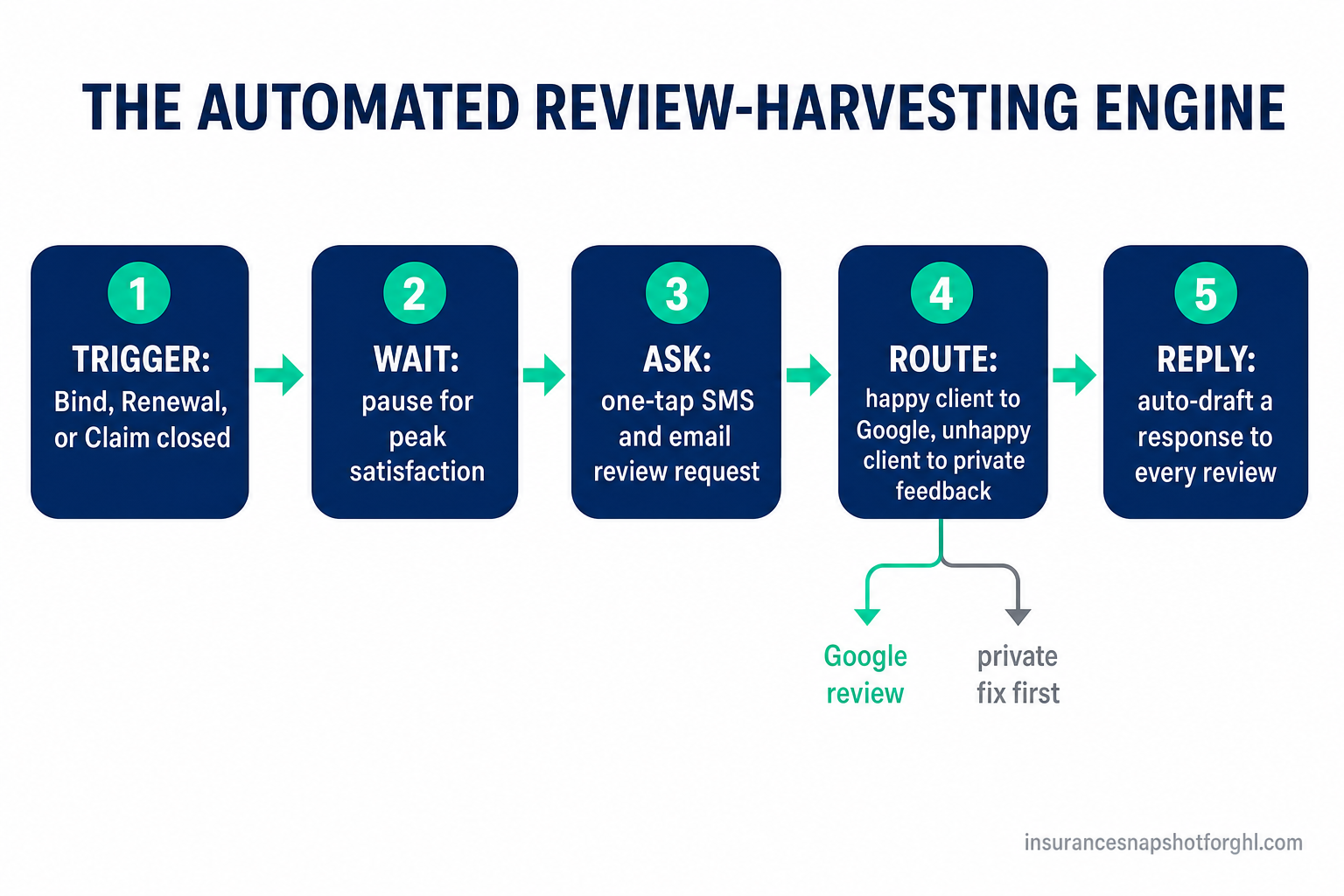
- Triggers on the right moment. The engine fires automatically off a real event in your CRM — a policy bound, a clean renewal, a claim resolved — so the ask lands at peak satisfaction, not at random.
- Sends a one-tap ask. A short, TCPA-safe SMS and email go out with a direct link to your Google review page. No searching, no scrolling — the client taps and types. That’s the whole difference between “meant to” and “did.”
- Routes to protect your rating. Happy clients are pointed straight to Google. Anyone who signals frustration is caught in a private feedback flow first, so you can fix the problem before it becomes a public one-star. That’s how top agencies keep a high average without ever gaming a review.
- Replies to every review. The Google review reply automation drafts a fast, on-brand response to each new review — the move tied to ~35% more revenue that almost nobody does — so your profile reads as active and attentive.
- Keeps the drip steady. Because it runs off every qualifying event across your whole book, reviews arrive in a continuous flow, keeping your recency fresh month after month instead of spiking once and going stale.
The deep, message-by-message version of this sequence — exact ask timing, SMS and email copy, and how to reply to a hard review — lives in our full insurance agency reviews playbook. For the broader “get found in the San Diego map pack” picture, pair it with our local SEO playbook for insurance agents.
Manual asks vs. automated harvesting
Manual review asks vs. an automated review-harvesting engine
| Plan | Manual asking | Automated harvesting recommended |
|---|---|---|
| Price | Runs on memory | Runs on triggers |
| Feature 1 | Producer has to remember after every bind | Fires automatically at peak satisfaction |
| Feature 2 | "Go find us on Google" — high friction, low response | One-tap SMS + email link to your Google page |
| Feature 3 | Lumpy: a burst, then months of silence | Steady drip keeps recency fresh year-round |
| Feature 4 | No safety valve — unhappy clients post publicly | Routes unhappy clients to a private fix first |
| Feature 5 | Reviews go unanswered | Auto-drafts a reply to every review |
| See review harvesting |
The goal isn’t to manufacture reviews — it’s to make sure the happy clients you already have actually leave the review they’d gladly give, and to catch the unhappy ones before they vent in public. You do the good work; the system makes sure San Diego can see it.
Keeping it compliant and honest
Automating reviews in insurance means staying inside two sets of lines: the platforms’ rules and the law.
The snapshot ships with TCPA-safe consent capture and opt-out handling baked into the SMS layer, so the review ask honors consent from the first message — we go deep on that in our guide to TCPA-safe insurance SMS. And to be clear about the boundary: review harvesting collects and manages feedback about your service. It doesn’t quote, bind, underwrite, or sell — every policy decision stays with your licensed producers under your own E&O, appointments, and state licenses.
The San Diego math
You don’t need a made-up “reviews get you X more leads” figure to make this decision. The verified data already makes it obvious:
- 97% of shoppers read reviews before choosing a local business (BrightLocal) — so your review profile is your first impression in San Diego.
- Reviews are ~16% of local-pack ranking (Whitespark), and recency is a rising factor — so more, fresher reviews literally move you up the map.
- A one-star increase is worth 5–9% more revenue (HBS), and replying to reviews adds ~35% (Womply) — so rating and responses are money, not vanity.
- 57% of customers shopped last year (J.D. Power), with California drivers hit by steep rate hikes — so more San Diegans than ever are looking at your pack right now.
Put together: quote demand is high, competition is one map result away, and the tie-breaker is the review profile a shopper sees in the first two seconds. A manual, remember-to-ask approach can’t keep that profile fresh. An automated engine can — every bind, every renewal, every claim.
If you’d rather see it wired into a full agency setup first — quote funnels, renewal cadences, cross-sell, and the review engine together — start with our reviews playbook, turn happy clients into your best lead source with a referral program, or talk to a real person. Someone in San Diego is checking your star rating right now. The only question is what they see.
FAQ
What is review harvesting for an insurance agency?
Review harvesting is an automated system that asks your clients for a Google review at the right moment — right after a policy binds, a renewal completes, or a claim is resolved — using a one-tap SMS and email link. Instead of a producer remembering to ask, the automation fires off a real event in your CRM, points happy clients to your Google review page, catches unhappy clients in a private feedback flow first, and drafts a reply to every review. The result is a steady flow of fresh 5-star reviews that lifts your count, rating, and recency.
Why does my San Diego agency keep losing the Google local pack?
The local pack — the three-agency map above 'insurance agent near me' results — ranks heavily on review signals, which make up about 16% of local-pack weight, second only to your Google Business Profile (Whitespark). If a competitor has more reviews, a higher star average, and fresher reviews than you, they'll typically outrank you and win the click, since roughly 97% of shoppers read reviews before choosing (BrightLocal). A thin or stale profile keeps you out of the pack or gets you skipped even when you rank.
How fresh do my reviews need to be?
Freshness matters more than most agencies realize. Whitespark now lists review recency as one of the most underrated local ranking factors, and 47% of consumers rate 'sort by newest' as a highly useful review feature (BrightLocal), meaning shoppers actively look at your most recent reviews. Because recency decays over time, the only way to stay fresh is a steady, ongoing flow of new reviews — which is exactly what an automated engine produces and manual asking can't.
Is automating review requests allowed by Google?
Yes, when done honestly. Google allows you to ask customers for reviews and to automate that ask. What's prohibited is 'review gating' (selectively soliciting only happy customers to suppress negatives), buying reviews, or offering incentives in exchange for reviews. A compliant engine asks every qualifying client for honest feedback; the private-feedback step is service recovery, not a filter that blocks anyone from posting publicly. Any SMS ask must also follow TCPA consent and STOP/HELP rules.
Will review harvesting hurt my rating if I ask unhappy clients?
No — that's the point of the routing step. The engine sends a light satisfaction check first. Clients who signal they're happy are pointed to Google; clients who signal frustration are routed into a private feedback flow so your team can fix the issue directly before it becomes a public one-star. You never block anyone from leaving a public review, but you do get the chance to resolve problems privately, which is how top agencies keep a high average honestly.
How long does it take to install and what does it cost?
The review-harvesting engine is part of the Insurance Snapshot, which installs into your GoHighLevel account in about 24 hours once we have sub-account access. The snapshot is a done-for-you system that also includes the AI receptionist, AI chatbot, SMS automation, appointment booking, and the insurance CRM and pipelines. See current pricing on the pricing page, or book a 15-minute demo to watch the review engine send a live test ask.
About the author
Priya Raman is an Insurance Agency Growth Strategist at Insurance Snapshot for GHL. She works with independent and captive agencies on the growth side of automation — turning an existing book into reviews, referrals, and recurring cross-sell revenue. She writes about the strategy layer: which automations actually pay for themselves, how to sequence an ask so it doesn’t feel like a pitch, and how to measure whether any of it is working. Editorial byline only — Priya is not a licensed agent and does not quote, bind, or sell insurance.
Want a steady flow of fresh 5-star reviews without chasing them? See review harvesting, get the Insurance Snapshot, or book a quick walkthrough.