For a Philadelphia insurance agency, YouTube is the highest-leverage marketing channel almost nobody in the market is working — and the fastest way to build one is a repeatable seven-step system: film short answers to the questions your prospects already ask, publish them as Shorts and long-form, and route every comment and DM straight into a booked quote inside GoHighLevel. You do not need a studio, an on-camera producer, or a viral hit. You need a system that turns a few hours of filming into weeks of content, and automation that catches the interest that content creates before it goes cold.
This is the operator’s playbook: why YouTube works for a Philly agency, exactly what to film, the seven steps to run it on autopilot, and how to convert views into bound policies without hiring a video team.
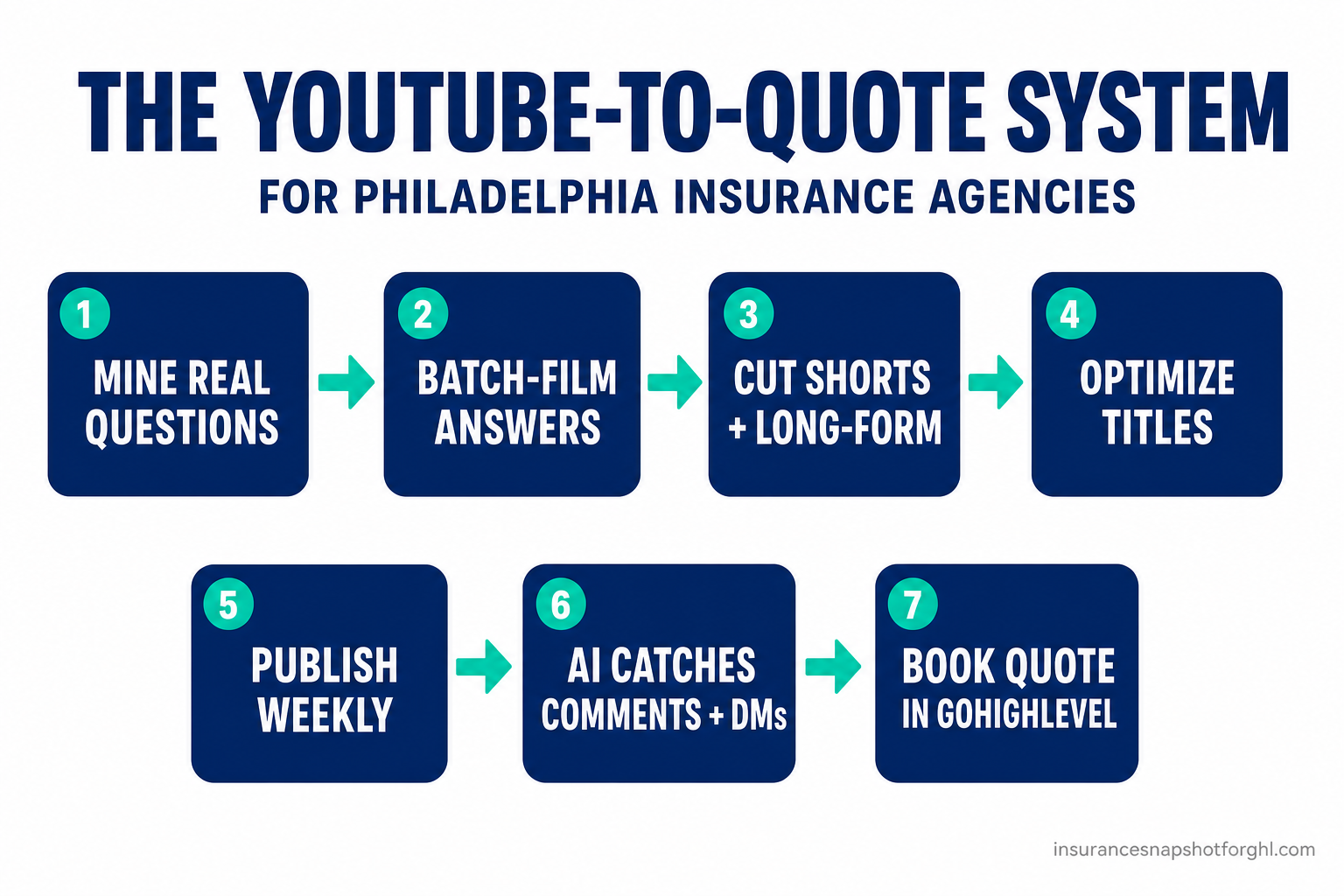
Table of contents
- Why YouTube works for a Philadelphia insurance agency
- What the data says about video and buying decisions
- The 7-step done-for-you YouTube playbook
- What to actually film: content pillars for insurance
- Turning views into booked quotes
- Compliance: what an insurance agency can and can’t say on video
- How to measure whether it’s working
- FAQ
Why YouTube works for a Philadelphia insurance agency
Philadelphia is a dense, competitive insurance market — auto rates in Pennsylvania have moved sharply since 2022, and the city’s neighborhoods each have their own mix of carriers, captives, and independents fighting for the same households. In a market like that, the agencies that win attention early in the shopping journey win the quote. And the shopping journey has moved to video.
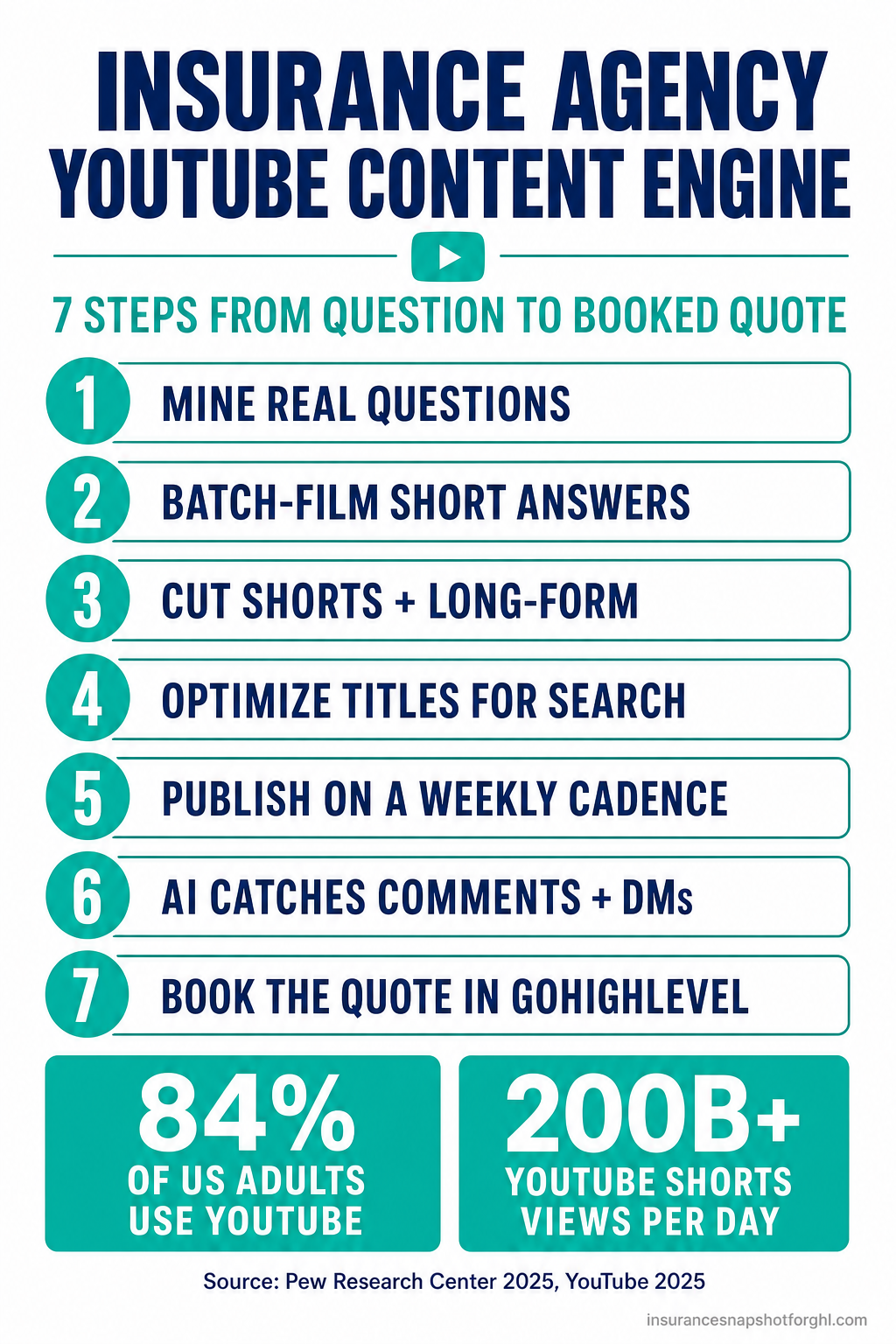
Start with reach. 84% of US adults say they use YouTube — the single most widely used online platform in the country, ahead of Facebook (Pew Research Center, Americans’ Social Media Use 2025). YouTube is also the world’s second most-visited website behind Google (Similarweb), and it is now the largest single distributor of US TV viewing time — around 12–13% of everything Americans watch on the living-room screen (Nielsen, The Gauge, 2025). Your prospects are there on their phones on the SEPTA platform and on the TV at home.
Now layer in intent. Insurance shopping hit record highs: 57% of auto customers shopped their policy in the prior year, and 47% now buy through digital channels — more than buy through an agent (35%) (J.D. Power, 2025 US Insurance Shopping Study). A Philadelphia household comparing renters, auto, or life coverage isn’t only calling around anymore — they’re searching, watching, and deciding who to trust before they ever pick up the phone.
What the data says about video and buying decisions
Video isn’t a vanity channel. It maps to how people decide to buy — especially for a considered, trust-driven purchase like insurance. The most recent Wyzowl State of Video Marketing 2026 survey found that 85% of people say they’ve been convinced to buy a product or service by watching a video, that 63% would rather watch a short video to learn about a product or service than read about it, and that 89% say the quality of a brand’s video content affects how much they trust that brand. For an insurance shopper choosing who will handle their family’s coverage, that trust signal is the whole ballgame.
The takeaway for an agency: a prospect who watches you explain a deductible, walk through a claim, or break down what renters insurance actually covers has already met you. When they’re ready to quote, you’re not a stranger with a form — you’re the person from the video. That’s a warmer lead than any cold click, and it’s why 82% of marketers say video delivers a good return (Wyzowl 2026).
The 7-step done-for-you YouTube playbook
Here’s the system. The goal is to make YouTube a repeatable operation, not a burst of motivation that dies after three uploads. Each step is designed so a small agency — or a done-for-you partner running it for you — can sustain it every week.
Step 1 — Mine the real questions your prospects ask
Your best video topics are already sitting in your inbox and call logs. Every “does my policy cover…”, “why did my premium go up”, and “how much coverage do I need” is a video. Pull 30–40 of these questions from producer calls, your AI chat and receptionist transcripts, and Philadelphia-specific searches (flood and basement water in older row homes, uninsured-motorist realities on I-95, renters insurance for Center City apartments). Each question becomes one short, answer-first video.
Step 2 — Batch-film short answers
Do not film one video at a time. Block two hours, set up a phone on a tripod with a clip mic, and record 8–12 short answers back to back — one question each, 30–90 seconds, answer in the first sentence. Batching is what makes weekly YouTube survivable for a busy agency. One filming session becomes two to three weeks of content.
Step 3 — Cut long-form plus Shorts from the same footage
Each answer becomes a vertical Short (the discovery engine — Shorts average over 200 billion daily views, per YouTube, 2025). Then group five related answers into one long-form video (“7 renters insurance questions every Philly tenant asks”). Long-form builds authority and watch time; Shorts get discovered. You publish both from a single filming session.
Step 4 — Optimize titles and descriptions for search
YouTube is a search engine as much as a feed. Put the real query in the title (“How much renters insurance do I need in Philadelphia?”), write a description that answers it in the first two lines, add your service-area and line-of-business terms, and link to your quote page and calendar. This is the same answer-first structure that wins AI search — clear questions, clear answers, easy for both YouTube and AI assistants to surface.
Step 5 — Publish on a cadence you never miss
Consistency beats intensity. A sustainable rhythm is a few Shorts a week plus one long-form video, cross-posted to your other channels. This is exactly where a done-for-you social engine earns its keep: the same reel that goes to YouTube Shorts also goes to Instagram, TikTok, Facebook, and the rest — one filming session, every channel, published five days a week without you touching a scheduler.
Step 6 — Capture every comment and DM automatically
This is the step agencies skip, and it’s where the money leaks out. Someone comments “how do I get a quote?” on your Short at 9pm — if nobody replies until Monday, that lead is gone. An AI comment-and-DM agent replies in seconds, answers the basic question inside compliance guardrails, and moves the conversation toward a booking. Speed matters everywhere in insurance; our speed-to-lead playbook shows why the first five minutes decide the bind.
Step 7 — Book the quote in GoHighLevel
The final step closes the loop: the AI agent hands a qualified, interested viewer straight to your calendar and drops them into a GoHighLevel pipeline with instant SMS/email follow-up. Now a YouTube view isn’t a metric — it’s a booked quote consultation with a producer. Everything before this step is marketing; this step is revenue.
What to actually film: content pillars for insurance
Blank-page paralysis kills more agency YouTube channels than anything else. Use four repeatable pillars so you never wonder what to record:
Four content pillars that consistently earn insurance views
| Plan | Answer questions recommended | Explain the confusing | Localize it | Show the human |
|---|---|---|---|---|
| Price | Discovery | Trust | Relevance | Connection |
| Feature 1 | One real prospect question per video | Deductibles, riders, umbrella, coinsurance | Philadelphia-specific risks & rules | Meet-the-team, claims stories, day-in-the-life |
| Feature 2 | Answer in the first sentence | Plain-English, no jargon dumps | Row-home water, PA minimum limits, parking | Why families switch to a local agent |
| Feature 3 | "Does renters insurance cover water damage?" | "What an auto deductible actually means" | "Renters insurance for Center City apartments" | "What happens when you actually file a claim" |
| Feature 4 | Best for Shorts + YouTube search | Builds you as the local expert | Signals you serve this market | Turns viewers into callers |
| Feature 5 | Highest volume — film these weekly | Great long-form material | Wins local + AI search intent | Sprinkle in — don't overdo |
Rotate through the four and you’ll never run dry. The bulk of your volume should be the first pillar — real questions, answered fast — because that’s what gets discovered and what a shopper is actively searching for. The other three build the trust that turns a viewer into a quote request.
Turning views into booked quotes
A YouTube channel that gets views but books nothing is a hobby. The difference between a hobby and a lead engine is the automation layer underneath it — and it’s the part most agencies never build.
Here’s the mechanism. When a viewer comments or DMs, an AI agent responds instantly, qualifies the interest (“What line are you shopping — auto, home, renters, life?”), and offers a booking link. Interested prospects land on your calendar; everyone else drops into a nurture sequence. Every conversation is logged in GoHighLevel, so no lead sits unanswered overnight and no producer has to babysit the comment section.
This is precisely what our done-for-you social service is built to run. Alongside the content, it deploys three AI agents — for comments, DMs, and web chat — that reply in your agency’s voice and book quote consultations straight to your calendar. It’s the same follow-up discipline behind Facebook and Instagram DM automation, applied to your YouTube audience too.
Compliance: what an insurance agency can and can’t say on video
Video doesn’t get a pass on the rules — if anything, it raises the stakes because it’s public and permanent. A few guardrails to keep your Philadelphia agency clean:
- Don’t quote or bind on camera. Educate and explain, but never state a specific premium as a promise or imply a policy is bound. All actual quoting and binding stays with your licensed producers under their own appointments and E&O.
- No guarantees or misleading comparisons. Avoid “cheapest in Philadelphia” or savings promises you can’t substantiate. Pennsylvania DOI advertising rules and the FTC both frown on unsubstantiated claims.
- Medicare content follows CMS marketing rules. If you touch Medicare Advantage or supplements, the CMS Medicare-marketing guidelines apply to video just like any other channel — including required disclaimers and prohibited language.
- Automated replies need consent and opt-out. When your AI agent moves a commenter to SMS, TCPA still governs: capture consent, honor STOP/HELP, and keep the disclosures in place. Our TCPA-safe SMS guide covers the mechanics.
Compliance-aware content isn’t a constraint on growth — it’s what lets you scale video without creating a problem your E&O carrier will ask about later.
How to measure whether it’s working
Ignore vanity metrics. For an insurance agency, three numbers tell you if YouTube is earning its place:
- Booked consultations from social/video. The only metric that maps to revenue. Tag them in GoHighLevel so you can see quotes sourced from YouTube and social separately.
- Comment/DM response rate and speed. Are you actually catching the interest your content creates? With an AI agent, this should be near 100% and near-instant.
- Watch time and retention on long-form. Rising retention means your content is genuinely useful — which is what compounds discovery over the next 3–6 months.
Organic video is a compounding asset, not an on/off ad. Expect meaningful traction in roughly three to five months as YouTube learns who to show your content to. Because you’re publishing consistently across every channel, a single breakout Short can pull that timeline forward — and every video you post keeps working long after you upload it.
If you’d rather not build and run this yourself, that’s exactly what the done-for-you social service is for — the content engine and the AI follow-up, insurance-specific and white-label, so your producers stay focused on writing and renewing policies while your YouTube channel quietly fills the pipeline. Pair it with a fast agency website and every viewer who wants to learn more lands somewhere that loads instantly and converts.
FAQ
Does YouTube marketing actually work for a local insurance agency in Philadelphia?
Yes, when it's run as a system. 84% of US adults use YouTube (Pew Research Center, 2025), and 47% of insurance shoppers now buy through digital channels (J.D. Power, 2025), so your Philadelphia prospects are watching and deciding online. Most local agencies ignore YouTube, which leaves the channel open. The agencies that win film short answers to the exact questions prospects search, publish consistently as Shorts and long-form, and automate the follow-up so views turn into booked quotes.
How often do I need to post on YouTube to see results?
Consistency matters more than volume. A sustainable rhythm is a few Shorts per week plus one long-form video, published on a schedule you never miss. Organic video compounds over roughly 3–5 months as YouTube learns who to show your content to. Batching — filming 8–12 short answers in one session — is what makes a weekly cadence realistic for a busy agency, and a done-for-you service can run that cadence for you across all 9 channels.
Do I have to be on camera to do YouTube for my agency?
It helps for the trust-building videos, because 89% of people say video quality affects how much they trust a brand (Wyzowl, 2026), and a real local face stands out. But not every video needs your face — explainer and answer videos can use screen recordings, simple graphics, captions, and voiceover. A practical mix is a handful of on-camera pieces plus a steady stream of faceless answer videos.
How do YouTube views turn into actual insurance quotes?
Through the follow-up layer. When a viewer comments or DMs, an AI agent replies instantly, qualifies the line they're shopping, and offers a booking link that drops them onto your calendar and into a GoHighLevel pipeline with automated SMS and email follow-up. Without that layer, interested viewers go cold overnight. With it, a YouTube view becomes a booked quote consultation with a producer.
What can an insurance agency legally say in a YouTube video?
Educate freely, but don't quote or bind on camera, don't make guarantees or unsubstantiated 'cheapest' claims, and follow CMS marketing rules for any Medicare content. All actual quoting and binding stays with your licensed producers. When an automated reply moves a commenter to text, TCPA consent and STOP/HELP handling still apply. Compliance-aware content lets you scale video without creating an E&O problem later.
Can you run the whole YouTube and social channel for my Philadelphia agency?
Yes. Our done-for-you social service plans, writes, edits, and publishes insurance content 5 days a week across all 9 channels — including YouTube Shorts — and deploys 3 AI agents for comments, DMs, and web chat that book quote consultations straight to your calendar. It's insurance-specific, TCPA-aware, and white-label, starting at $397/mo per brand.
About the author
Priya Raman is an Insurance Agency Growth Strategist at Insurance Snapshot for GHL. She works with independent and captive agencies on the growth side of automation — turning organic content and an existing book into recurring quote requests and cross-sell revenue. She thinks in premium written, retention by line, and producer capacity rather than vanity metrics, and writes about the marketing systems that actually pay for themselves. Editorial byline only — Priya is not a licensed agent and does not quote, bind, or sell insurance.
Want your agency’s YouTube and social channels run for you, with the follow-up automated? See the done-for-you social service, book a quick call, or talk to a real person. Related reading: the 2026 organic social playbook, getting more 5-star Google reviews, and local SEO for insurance agents.