
You finally got the regional underwriter on the phone. You pitched your shop, your clean book, your plans. Then came the question that ends most of these calls: how much premium did you place with carriers like us last year? Your number was not big enough, the call wrapped up short, and you were left with three carriers while the agency across town quotes nine.
Here is the answer up front. Getting appointed is no longer about wanting the carrier. The carrier sets the terms. You have three ways in: a direct appointment, an agency network or aggregator, or a wholesaler. Every carrier wants active licenses, E&O coverage, a real book or a credible plan to build one, and a loss ratio it can trust. Once you are in, you keep the appointment by hitting a production minimum and controlling losses. This post is the whole path, how each route breaks, and the math for a solo agent, a five-producer shop, and an established agency.
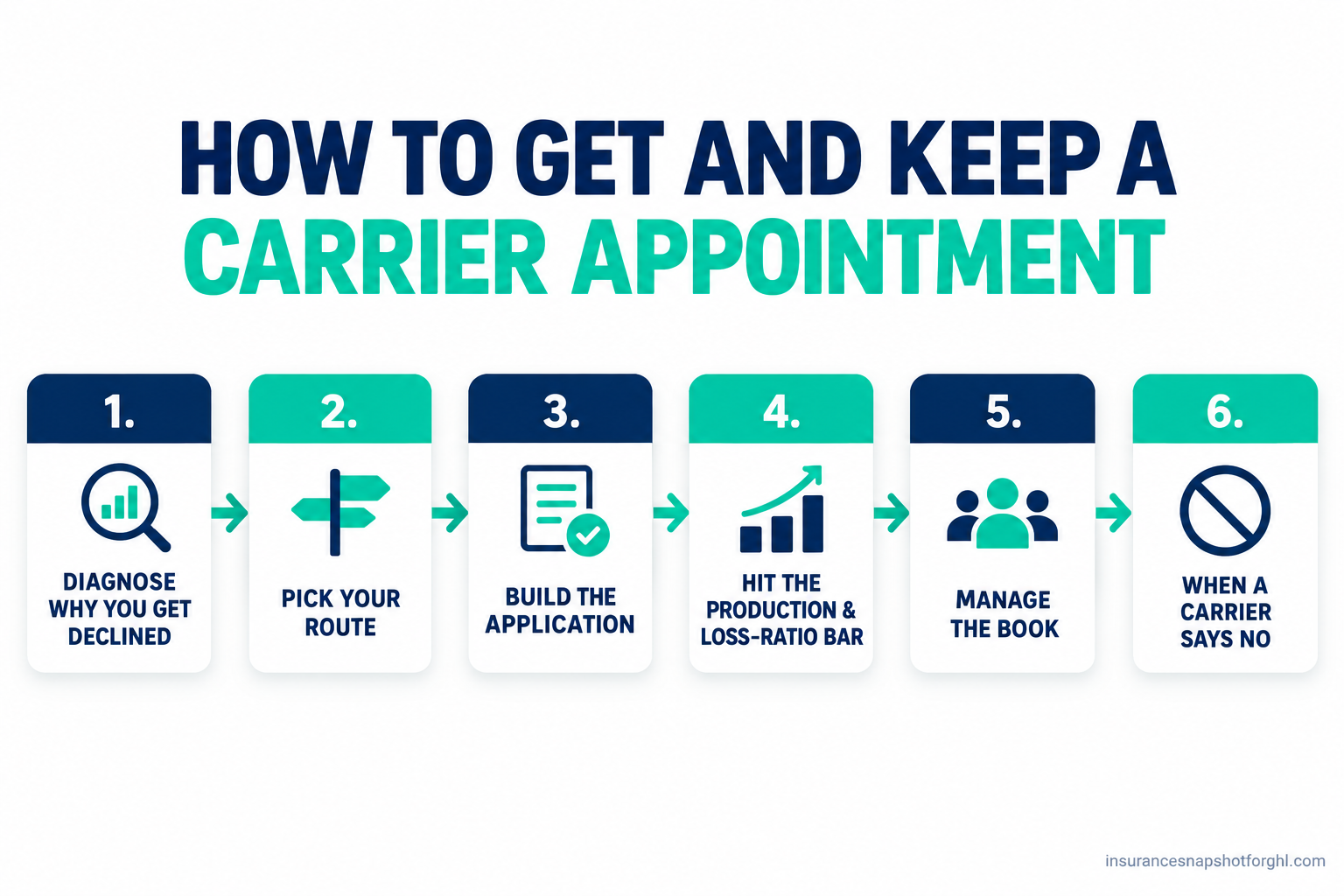
Table of contents
- Why carrier appointments got so much harder
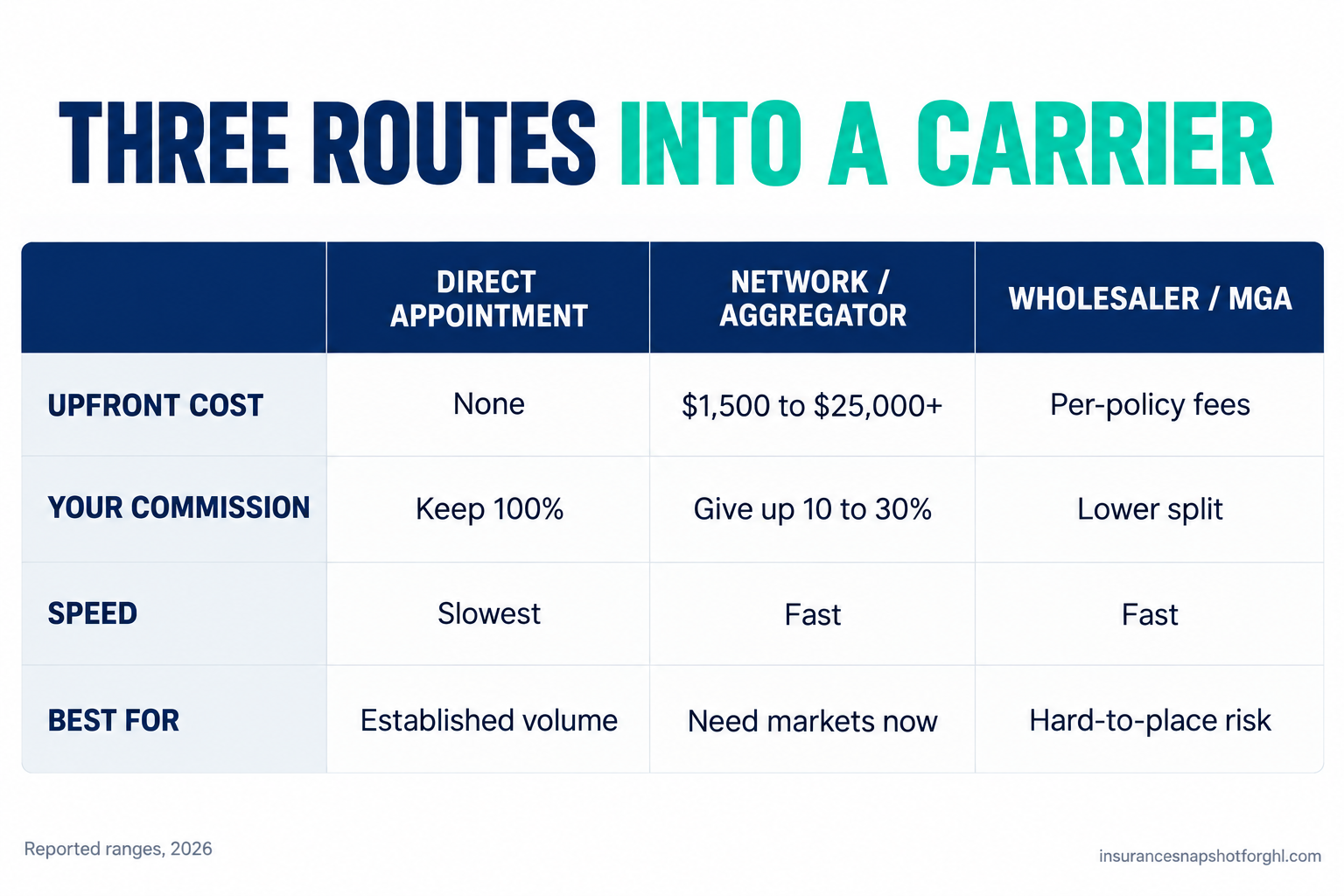
- The three ways into a carrier
- Stage 1: Diagnose why you keep getting declined
- Stage 2: Pick your route
- Stage 3: Build an application that gets a yes
- Stage 4: Hit the production and loss-ratio bar
- Stage 5: Manage the book so carriers keep saying yes
- Stage 6: When a carrier still says no
- Solo, five-producer, and established: who picks what
- The compliance and E&O layer
- Objections
- FAQ
Why carrier appointments got so much harder
For years a new agency could collect appointments one letter at a time. That changed. When insurers lose money they tighten underwriting, cut commissions, and limit new appointments (SIA of NC). After several hard years in property and auto, the small shop with no established volume was the first one carriers stopped calling back.
The carrier decides whether you fit, which is why agencies that could not land direct appointments turned to networks (Insurance Business). The barriers are standard now: a minimum premium or policy count, steady new-business production, a loss-ratio standard, geographic limits, and a cap on how many agencies a carrier appoints per territory (EZLynx).
A thin lineup costs you every week. Independent agents place 61.5% of all U.S. property-and-casualty premium, per the Big “I” 2025 Market Share Report with Future One (Insurance Journal), and that book moves on price and fit. Quote two carriers when a prospect needs a third and you hand the deal to the shop with nine. The upside: auto and homeowners results improved through 2025 and carriers are reopening, judging whether you fit their classes and bring quote and bind flow. The question is whether you show up looking like an agency a carrier wants.
The three ways into a carrier
Most agencies use all three doors over time.
| Criterion | Direct appointment | Network / aggregator | Wholesaler / MGA |
|---|---|---|---|
| Upfront cost | None | Reported $1,500 to $25,000+ to join | None (per-policy fees) |
| Your commission | Full, you keep 100% | Give up roughly 10% to 30%, or pay fees | Lower, split with the wholesaler |
| Speed of access | Slowest, carrier by carrier | Fast, many carriers at once | Fast for hard-to-place risk |
| Book ownership | Yours | Varies by contract, read it | Yours, placed through them |
| Best for | Established in-appetite volume | A shop that needs markets now | Risks admitted carriers decline |
| The catch | You meet every minimum alone | Fees and splits add up | Not for your everyday book |
Fee and split figures are reported ranges, not audited contracts, so confirm each in writing (Insurance Pro Agencies, HawkSoft). Direct keeps all your commission but makes you clear the bar alone. A network clears it for you and takes a cut.
Stage 1: Diagnose why you keep getting declined
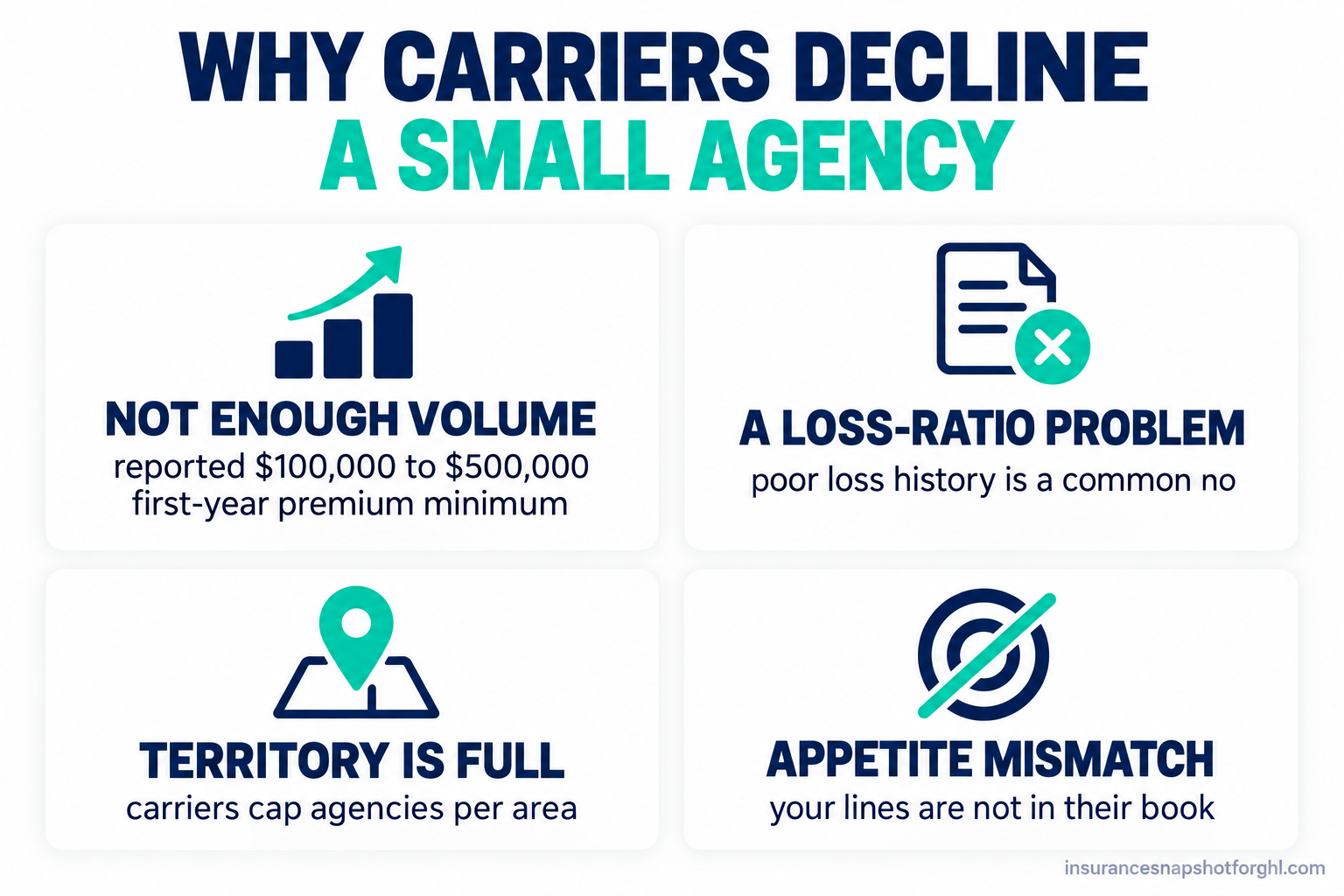
Before you apply anywhere, figure out why the last carrier passed. The reasons fall into four buckets, each with a different fix.
Not enough volume. The big one, and why direct appointments are hardest at the start. Many carriers want an established book or a credible first-year plan, and reported minimums run from about $100,000 to $500,000 in written premium (Agentero).
A loss-ratio problem. Carriers judge new agencies partly on loss history, and poor losses are a common flat no (AIBME). If you are moving a book, be ready with a clean three-year loss run.
Territory is full. Carriers cap how many agencies they appoint in an area, so you can be strong and still get a no because the carrier already has its shelf space in your ZIP codes.
Appetite mismatch. You write coastal homeowners and the carrier is running from them. That is about their book, not you.
How it breaks: agencies spray applications everywhere and collect declines that teach them nothing. Ask each rep, point blank, which bucket you fell into, because the fix for volume is nothing like the fix for a loss ratio.
Stage 2: Pick your route
If your only problem is that you are new with no volume, a network or aggregator is usually fastest, because it pools your production with hundreds of agencies so carriers see scale you do not have alone.
The trade is commission, and reported splits vary a lot. Smart Choice is described as roughly 70/30 with the agent keeping 70%, while SIAA is described as roughly 90/10 at the alliance level before a local master agency takes its own share (Insurance Pro Agencies). Some groups advertise 80/20 or even 100% splits, but pair those with higher fees or an equity stake (Smart Choice).
Reported share of commission the agency keeps by route, before fees and master-agency splits. Indicative figures, not audited contracts. Sources: Insurance Pro Agencies, Smart Choice.
Then there is the cost to join. Aggregators are reported at roughly $1,500 to $10,000 to start, larger networks about $5,000 to $25,000 or more plus dues, and many also keep 10% to 20% of commission or charge a flat fee (HawkSoft). Ownership is the term that bites: some groups grant full book ownership from day one, others keep a lien or require a buyout to leave (Agentero).
How it breaks: agencies join the first network a friend recommends and never read the ownership and exit terms. Years later they want out, and the buyout or the lien turns a simple move into a fight. Read both before you sign.
Stage 3: Build an application that gets a yes
Whichever door you pick, the reviewer wants the same package, so have it ready. Table stakes: active licenses in every state you will write, a registered entity with your NPN linked in NIPR, and E&O coverage, commonly $1 million per claim and $1 million aggregate (Renegade Insurance). What moves the decision is the business plan: your target lines, your first-year premium projection, where your leads come from, and, if you are moving a book, a clean three-year loss run.
It names the appetite match up front, leads with premium and loss ratio because those two numbers decide, and ends with a plan, not a plea. A rep forwards that email to underwriting.
How it breaks: the projection is a fantasy with nothing behind it. Carriers have seen a thousand agencies promise $500,000 and write $80,000. Tie your number to real lead sources, and if you cannot name where the premium comes from, lower it. A believable $150,000 beats an unbelievable $500,000.
Stage 4: Hit the production and loss-ratio bar
An appointment is a trial, not a trophy. Carriers monitor volume and loss performance after they sign you, and agencies that consistently fall short risk the contract. The job after “yes” is to hit two numbers at once: enough premium, and losses the carrier can live with.
The easy way to hit a minimum is to write anything that moves, and anything that moves wrecks a loss ratio. Many carrier profit-sharing schedules pay a bonus only while your loss ratio stays under about 60% (Agentero). Write junk to hit volume and you lose the bonus and, eventually, the appointment.
The way out is consistent, in-appetite new business plus the retention that protects it. New business covers the minimum; retention keeps the premium you already earned so you are not re-writing the same volume every year. The average independent agency sits near 84% client retention (Liberty Mutual and Safeco), and the shops that move it treat follow-up as a system: a fast quote response, a tight renewal cadence, and steady cross-sell, all without a 20-person team. Our renewal cadence that actually works and auto-to-home cross-sell playbooks have the mechanics.
How it breaks: the agency chases the production number and ignores the loss ratio until a carrier letter arrives. Watch both every quarter, and fix the mix before the carrier fixes it for you.
Stage 5: Manage the book so carriers keep saying yes
Keeping appointments is quieter work than getting them. Treat each appointment like a relationship you review every quarter.
Know your numbers per carrier: premium written, loss ratio, and where you stand against the minimum. If one book runs hot, re-market the worst accounts before renewal rather than letting it drag the whole appointment down. If you are coasting below a minimum, decide on purpose whether to feed that carrier more or let it go, instead of being surprised by a termination notice.
Spread your risk, too. An agency with 70% of its premium in one carrier is one appetite change away from a crisis, the exact scenario in our playbook for when a carrier drops your book.
Managing the book
One carrier holds 70% of the premium, nobody tracks loss ratio by carrier, and the first sign of trouble is a termination letter.
Premium spread across a balanced lineup, loss ratio reviewed per carrier each quarter, hot accounts re-marketed early.
How it breaks: the agency watches total revenue and never breaks it down by carrier, so a single appointment quietly rots while the top line looks fine. Carriers see their own loss ratio, and they act on it.
Stage 6: When a carrier still says no
Sometimes you do everything right and the direct door stays shut. That is where the other two routes earn their keep.
If the problem is scale, a network or aggregator gives you the carrier through their contract today, and the commission you give up is cheaper than the premium you lose with a thin shelf. Giving up 20% of commission on business you can now write beats keeping 100% of business you cannot.
If the problem is the risk itself, a wholesaler or MGA places what admitted carriers decline: the older coastal home, the contractor with a rough claim, the specialty exposure. You earn less per policy, but you keep the client instead of sending them down the street.
How it breaks: agencies treat a no as personal and stop building. The lineup is a portfolio: direct where you can, network where you cannot yet, wholesale for the odd risk, and you quote almost everyone who calls.
Solo, five-producer, and established: who picks what
The solo operator or brand-new shop. With no volume, direct appointments are mostly closed. Start with a network or aggregator to get a working shelf fast, and read the ownership and exit terms closely. Your whole job this year is clean production, because volume earns the direct appointments later. Watch out for: a long contract with a steep buyout before you know the network fits.
The five-producer agency. You likely have some direct appointments and some network access, so the game is optimization. Chase direct appointments where you already clear the minimum, since every point of commission you stop sharing drops to the bottom line. Watch out for: letting a loss ratio slide on one appointment while you grow another.
The established agency. You have the volume and the relationships, so your focus is negotiating power and risk. Review every appointment yearly, drop or renegotiate the underperformers, and keep any single carrier from owning too much of your book. Watch out for: exit terms on a network you joined when you were small, which can make leaving cost more than staying.
The compliance and E&O layer
The rules bite in two places.
E&O documentation. Document every coverage recommendation, every rejection of higher limits, and every quote you present, because a thin paper trail is how a routine claim becomes an E&O claim. Our guide to how much E&O a small agency needs covers the limits.
Marketing that drives your volume. The new business you use to hit a minimum comes from texts and campaigns, and those carry rules. Every automated text needs prior express consent, a working opt-out, and a registered A2P 10DLC number, or carriers filter your messages before a prospect sees them. Do not let anyone tell you the FCC “one-to-one consent” rule applies: it was vacated by the Eleventh Circuit on January 24, 2025, and the FCC removed the language later that year, so consent reverts to the prior standard. Our TCPA-safe SMS field guide has the setup. Anti-rebating rules also cap client gifts: Florida limits them to $100 per client per year, Texas to $25. Set the gift value by state, and if you sell life or annuity, disclose any paid endorsement under NAIC Model 570. The compliant gifts and reviews guide has the detail.
Objections
“I’ll just join a network and skip the headache.” Often the right first move for a new shop. Just price the real cost: the split and fees are forever, and the buyout or lien can trap your book if you ever leave. Read the exit terms first.
“We’re too small to get appointed directly, so why bother?” Small is temporary if you produce. Build volume through a network now, keep your loss ratio clean, and the appointment you were denied becomes the one you qualify for in two years.
“Carriers only look at volume, and I can’t fake volume.” They look at volume and loss ratio, and you can influence both honestly through consistent in-appetite new business and strong retention. That is a system problem, which is solvable, not a size problem, which is not.
“Do I need fancy software to do this?” No. You need a repeatable way to respond fast, follow up on quotes, and renew the book. The carrier does not care how you do it, only that the premium is there and the losses are not.
FAQ
What does a carrier require to appoint a small agency?
Active licenses in the states you write, a registered entity with your NPN in NIPR, E&O coverage (commonly $1M per claim and $1M aggregate), and either an established book or a credible first-year premium plan. Many carriers also set a production minimum, reported from roughly $100,000 to $500,000 in written premium, plus a loss-ratio standard and territory limits.
How much premium do I need to get appointed?
It varies. Reported first-year minimums run from about $100,000 to $500,000 in written premium, and some carriers want an established book first. If you cannot hit a direct minimum, a network or aggregator pools your volume with other agencies so you can access the carrier now and build toward a direct appointment later.
What is the difference between an aggregator, a network, and a cluster?
All three give agencies access to carriers they could not reach alone; the terms separate them. Aggregators and networks typically charge an upfront fee (reported from about $1,500 to $25,000 or more) and keep a slice of commission or charge dues. What matters most is the split, the monthly fee, book ownership, and the exit terms. Read the contract before you join.
Will joining a network cost me my book of business?
It can. Some groups grant full book ownership from day one; others keep a lien or require a buyout to leave. Never sign without confirming in writing that you own your book, that you can take your clients and data if you leave, and what exit fees apply.
How do I keep a carrier appointment once I have it?
Hit the production minimum with in-appetite business and keep your loss ratio under control, often below about 60% for profit-sharing. Carriers monitor volume and losses and terminate agencies that fall short. Review each appointment quarterly, re-market hot accounts before renewal, and avoid concentrating too much premium with one carrier.