
It is a Tuesday and the email lands at 4:15pm. The carrier is exiting a segment, and 214 of your homeowners policies will not renew as they come due over the next twelve months. No warning, no appeal. The book you spent a decade building just got a countdown timer.
Here is the answer up front, before the panic sets in: a carrier non-renewal is a re-marketing project, not a funeral. Triage the affected policies fast, line up replacement markets before you make a single client call, and run every household through a fixed re-placement sequence, and you keep the large majority of that book. The agencies that lose those clients are not the ones with fewer markets, they are the ones who move slowly, notify badly, and let policies lapse.
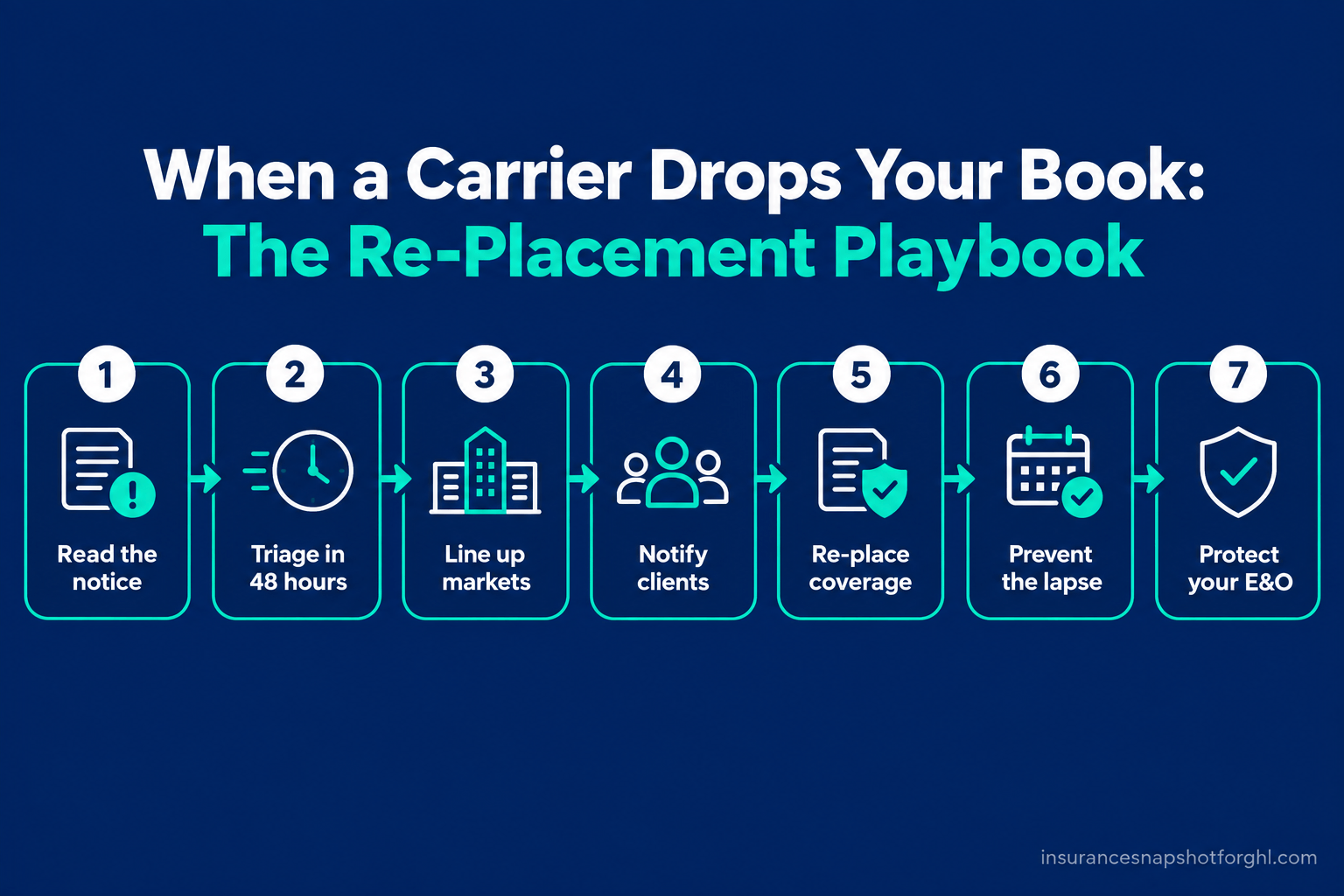
Table of contents
- Why carriers drop books, and why it is happening more
- What a lost book actually costs you
- Stage 1: Read the non-renewal notice correctly
- Stage 2: Triage the book in 48 hours
- Stage 3: Line up replacement markets first
- Stage 4: Notify clients (steal this copy)
- Stage 5: Re-market and re-place the coverage
- Stage 6: Prevent the lapse
- Stage 7: Protect your E&O and close the loop
- Solo, five-producer, and large: who runs what
- The compliance layer you cannot skip
- Objections
- The book you kept
- FAQ
Why carriers drop books, and why it is happening more
Carriers non-renew for reasons that have nothing to do with you: a state goes unprofitable, a line gets cut, or a reinsurance treaty falls through and the company sheds exposure fast. This is not rare anymore. The U.S. Senate Budget Committee, using data from 23 insurers covering about two-thirds of the homeowners market, found more than 1.9 million policies were dropped or non-renewed between 2018 and 2023 (Insurance Journal). And the pullbacks are not hypothetical: in May 2023 State Farm General stopped accepting new personal-lines property applications in California, and Allstate had paused new California homeowners business the year before (California Department of Insurance).
The flip side is your advantage. Independent agents place 61.5% of all U.S. property and casualty premium (Insurance Journal), and you are appointed with multiple carriers for exactly this reason. A captive agent whose company drops a book has nowhere to send those clients. You do.
What a lost book actually costs you
Run the math first. At an average homeowners premium of $1,800 and 12% commission, that is $216 per policy per year, or about $46,000 across the 214, and you lose it every year, not once. Worse, those clients have to move, the most winnable prospects your competitors get all year. A record 57% of auto insurance customers shopped their policy in the past year, up from 49% a year earlier, the highest rate J.D. Power has recorded in 19 years (J.D. Power). A client who hears nothing for three weeks will Google “home insurance near me” and land in a competitor’s funnel.
Share of U.S. auto-insurance customers who shopped their policy in the prior year; 2025 is the highest in the study’s 19-year history. A non-renewed client is a guaranteed shopper. Source: J.D. Power 2025 U.S. Insurance Shopping Study.
A non-renewal is a stress test of your retention rate, which averages about 84% at independent agencies and 95% or higher at the top performers (2026 Independent Agency Growth Study, Liberty Mutual).
Stage 1: Read the non-renewal notice correctly
Read the notice like a lawyer. Three things decide the timeline:
Block roll or scattered? A block roll means the carrier is exiting a segment and every affected policy is non-renewed as it hits expiration, spread across the year. Scattered non-renewals hit individual policies for underwriting reasons (roof age, a claim, a lapse). Block rolls you can schedule; scattered ones you handle case by case.
The effective dates. In a block roll your 214 policies expire across twelve months, not on the same Tuesday. Sort by renewal date and you know who is urgent and who has runway.
Your state’s notice period. Most states require 30 to 60 days advance written notice of non-renewal for personal lines; New York requires 45 to 60 days before expiration (NY Department of Financial Services). That is your minimum runway per client.
Failure mode: treating the carrier’s notice date as your start date. The client often gets their own copy the same week; if you have not reached them first, they hear catastrophic news with no reassurance. Be the first call, not the cleanup.
Stage 2: Triage the book in 48 hours
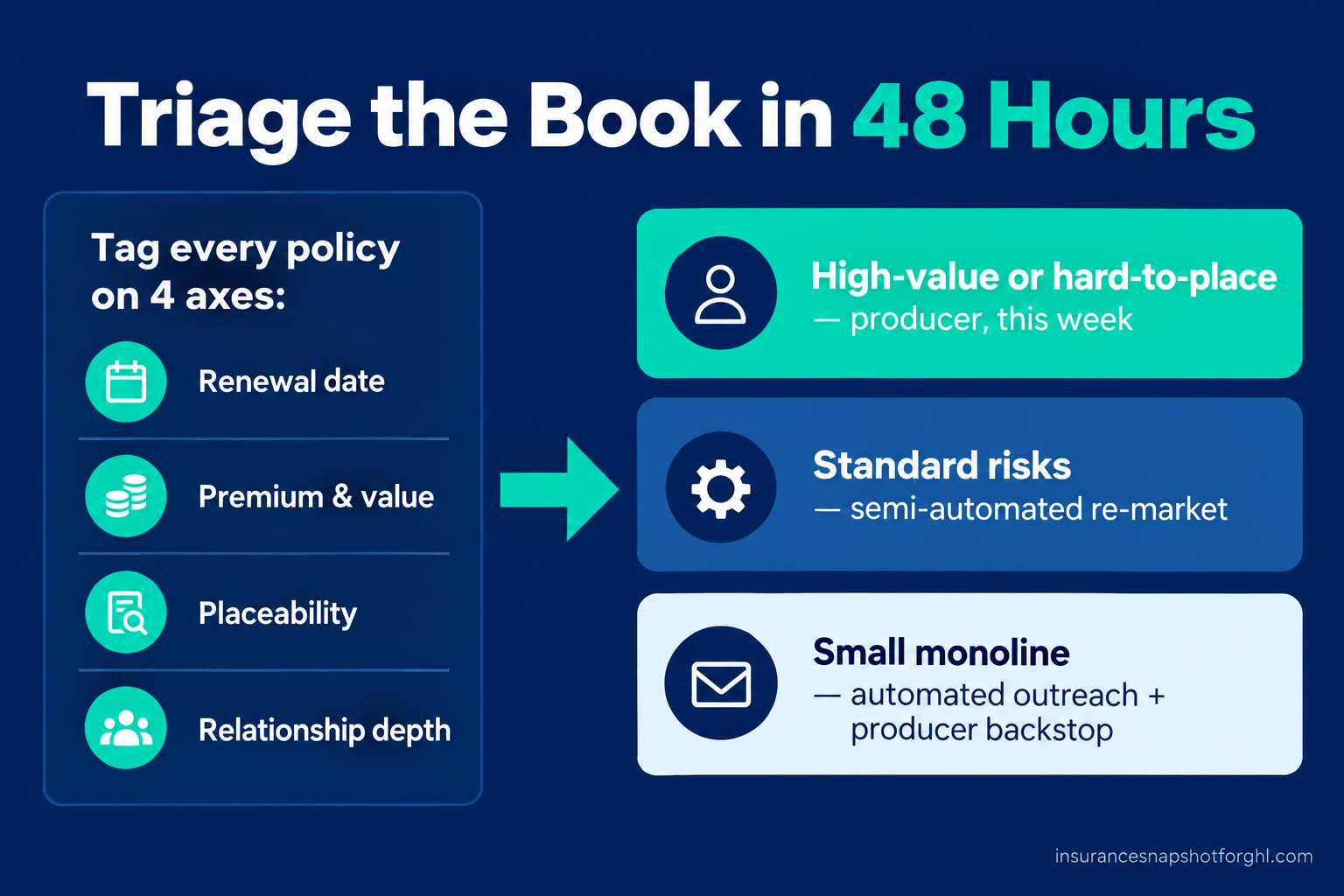
You cannot save 214 households at once. You save them in priority order, built in the first two days. Pull the list into your CRM and tag every policy on four axes:
- Renewal date. The ones due in 45 days are today’s work.
- Premium and household value. A $4,200 policy that is also a cross-sell opportunity gets a producer; a $600 renter’s policy gets the automated track.
- Placeability. Will this place easily with your appointments, or is it a hard risk (older roof, prior claims, coastal, brush zone) needing a specialty or surplus-lines market? Flag the hard ones now.
- Relationship depth. Multi-line households, long-tenured clients, and referral sources are your keep-at-all-costs tier.
That gives you three lanes: high-value or hard-to-place accounts straight to a producer this week; standard risks on a semi-automated re-market; small monoline policies on automated outreach with a producer backstop.
Failure mode: working in renewal-date order and burning two weeks on easy $600 policies while a $5,000 hard-to-place account quietly shops itself. Triage by value and difficulty, not the calendar.
Stage 3: Line up replacement markets first
This is the stage most agencies skip, and it is how books get lost. Do not call a single client until you know where their coverage is going. Map which of your appointed carriers can absorb this business: confirm your two or three go-to replacement markets have appetite for the volume, and open the door with a specialty carrier or surplus-lines broker early for the hard risks, whose quotes take longer. Solve the capacity problem in week one, not when you have 40 unplaced policies and 30 days left.
Failure mode: promising a client “we’ll take care of it” and then finding none of your markets want the risk. That client remembers the over-promise at every renewal. Confirm appetite before you reassure anyone.
Stage 4: Notify clients (steal this copy)
The client is about to feel dropped, so reframe it: this is not a problem they have to solve, it is one you are already solving. Email first for the paper trail, follow with a text, and route high-value accounts to a producer call. Steal this copy:
Failure mode: the “we regret to inform you” tone. If your notification reads like the carrier’s non-renewal letter, you have handed the client a reason to shop. Every message leads with the plan, never the bad news alone.
Stage 5: Re-market and re-place the coverage
For each policy: pull the current dec page, re-quote with the replacement carriers, compare coverage line by line, and bind the best fit.
Match the coverage, not just the price. Moving a client to a cheaper policy that quietly drops a coverage they had, then having a claim land in the gap, is the fastest way to create an E&O problem. Compare dwelling limits, deductibles, water backup, ordinance-or-law, and endorsements. If the new policy differs, say so in writing and get the client’s acknowledgment.
Failure mode: silence during the quoting gap. To the client, silence looks like nothing is happening, and that is when they shop. Automate a “still on it, options by Thursday” touch at the halfway point so human effort goes into placement.
Stage 6: Prevent the lapse
The most dangerous moment is the seam between the old policy ending and the new one starting. Get it wrong and three things happen at once: a coverage gap, mortgage force-placement, and an E&O exposure.
Set the new effective date to the day the old one ends, with no gap, and confirm the bind in writing. Then handle two landmines:
The mortgage and escrow. For any mortgaged home, the new evidence of insurance has to reach the mortgage company before the old policy lapses, or the lender force-places coverage that costs the client a fortune and takes months to unwind. Send it to the mortgagee the same day you bind.
Payment and autopay. Autopay on the old carrier does not carry over, so set it up on the new policy or a missed first payment cancels the coverage you placed.
Average homeowners claim per incident, lowest-risk vs highest-risk ZIP codes, 2018-2022. A single claim landing in a coverage gap dwarfs a year of premium, which is why the lapse seam is the most dangerous moment in a re-placement. Source: U.S. Treasury Federal Insurance Office, January 2025.
Failure mode: binding the new policy but forgetting the mortgagee. The client is covered, but the lender does not know it and force-places coverage, so the client is furious at you for a problem you actually solved. Notifying the mortgagee is part of the bind.
Stage 7: Protect your E&O and close the loop
A re-placement done at speed is exactly the kind of event that produces an E&O claim months later. Failure to procure the coverage a client asked for, or to procure it correctly, is the single most frequent agency E&O claim type, roughly one in four (Big “I” Professional Liability).
Document, for every re-placed policy: the date you learned of the non-renewal, the date you notified the client, the options presented, any coverage differences, and the bind, effective, and mortgagee-notification dates. If a client declines a coverage they used to have, get it in writing, and log it all in your agency management system so it lives with the account.
Then close the loop: update the record with the new carrier, retire the old one, and drop the household into your normal renewal cadence. The client who was almost lost is now a re-earned relationship, and re-earned clients are the most loyal you have.
Solo, five-producer, and large: who runs what
The playbook is the same. Who runs it changes with your size.
The solo operator. You are triage, market-lining, and producer, so every hour counts. Automate the notifications, status touches, and booking link so the machine handles outreach while your hours go to placement and the hard risks. Try to personally call 214 households and you lose half to slowness.
The five-producer agency. A coordination problem. One person owns the triage list and market-lining so producers take assigned lanes instead of each calling the same carriers. Automate the outreach centrally so every household gets the same fast first touch. Your risk is inconsistency: one producer moving fast, another sitting on their list.
The large agency. Your constraint is visibility. Build the triage into a pipeline with named stages (notified, quoting, presented, bound, mortgagee-confirmed) so a manager can see where the 214 are stuck, and assign a coordinator to lapse prevention. At scale, the accounts you lose are the ones that quietly stall where nobody is watching.
The compliance layer you cannot skip
Speed is the whole game, but it does not excuse the rules.
Texting is regulated. If you follow the notification with SMS, you need A2P 10DLC registration, prior express consent, and a working STOP opt-out on every message. One note on what you may have heard: the FCC’s one-to-one consent rule was vacated by the 11th Circuit on January 24, 2025, and the FCC removed the rule text later that year, so consent reverts to the prior standard. Keep genuine consent and clean opt-out handling. Our field guide to TCPA-safe SMS walks the setup.
Non-renewal notice rules are the carrier’s job. The carrier owes the statutory notice period. Your outreach is separate and should never imply you are the one non-renewing.
Anti-rebating still applies. If you are tempted to sweeten a re-placement with a gift card, remember the limits vary by state (Florida caps client gifts at $100 per year, Texas at $25). Our insurance marketing compliance guide covers those rules.
Objections
“I don’t have enough markets to absorb a whole book.” Then Stage 3 is your most important stage, and you solve it in week one: confirm appetite with your appointments, add a wholesale or aggregator relationship for the overflow, and route the hardest risks to surplus lines early.
“Won’t the automated texts feel cold during a stressful moment?” Only if they are generic. The Stage 4 copy leads with reassurance and a plan and uses the client’s name and real renewal date, then hands high-value accounts to a human, so all 214 households hear from you fast, not just the 30 you could call by hand.
“This might not happen again, so why build all this?” It will happen again. Between climate-driven pullbacks and capacity crunches, book rolls are now a recurring feature of the channel, so build the playbook once and the next notice is a Tuesday project. And no, you cannot wait for the client to call: by then they have usually already called a competitor.
The book you kept
Six weeks after that 4:15pm email, your report looks different than you feared. The automated first touch reached every household within a day, producers re-placed nearly all of the top-value accounts, and the small monoline policies mostly re-placed themselves. A handful left. But the book and the commission are mostly still yours, and the clients who watched you show up when their carrier walked away are the ones who send referrals for years.
A carrier dropping your book is not what loses you clients. Moving slowly and letting policies lapse is. Build the playbook once and the next notice is just another Tuesday. Read the 2026 customer retention playbook and the renewal cadence that actually works next.
What should I do first when a carrier non-renews my book?
Read the notice to confirm whether it is a block roll or scattered non-renewals and note each policy's renewal date and your state's notice period. Then triage the affected policies by renewal date, premium, and placeability. Do not call any client until you have started lining up replacement markets.
How long do I have to re-place a client's coverage after a non-renewal?
It depends on your state and each policy's renewal date. Most states require carriers to give 30 to 60 days advance written notice for personal lines; New York requires 45 to 60 days. In a block roll, policies non-renew on their individual renewal dates across the year, so work the soonest first.
What is the biggest risk when moving a client to a new carrier?
The lapse gap between the old policy ending and the new one starting. It creates a coverage hole, triggers mortgage force-placement, and exposes you to an E&O claim. Set the new effective date to the day the old policy ends, notify the mortgagee the day you bind, and set up autopay.
How do I protect my E&O during a fast re-placement?
Match coverage, not just price, and document everything: when you learned of the non-renewal, when you notified the client, the options presented, any coverage differences, and the bind and effective dates. Failure to procure the requested coverage is the single most common agency E&O claim.
Can I text clients about a carrier non-renewal?
Yes, with the right setup: A2P 10DLC registration, prior express consent, and a working STOP opt-out on every message. Keep it accurate and never imply your agency is the one non-renewing. Lead with the email for the paper trail and route high-value accounts to a producer call.