
It is the third week of the month and your CSR just found a homeowners policy that lapsed 11 days ago. Nobody called. The dec page renewed with a 14% rate bump, the mortgage company kicked back the escrow, and now you are doing damage control on an account you already owned. The renewal date was sitting in your agency management system the whole time. It just did not tell anyone, because storing a date and acting on a date are two different jobs, and your AMS only does the first.
Here is the answer up front: you do not need to upgrade your AMS to fix this. You need a thin automation layer that reads renewal dates out of the system you already run and fires a fixed sequence of reminders at 120, 60, 30, and 7 days. It costs a fraction of an AMS tier bump, it works the same on EZLynx, HawkSoft, Applied Epic, or Momentum AMP, and you can have the first version live this week. This post is the build.
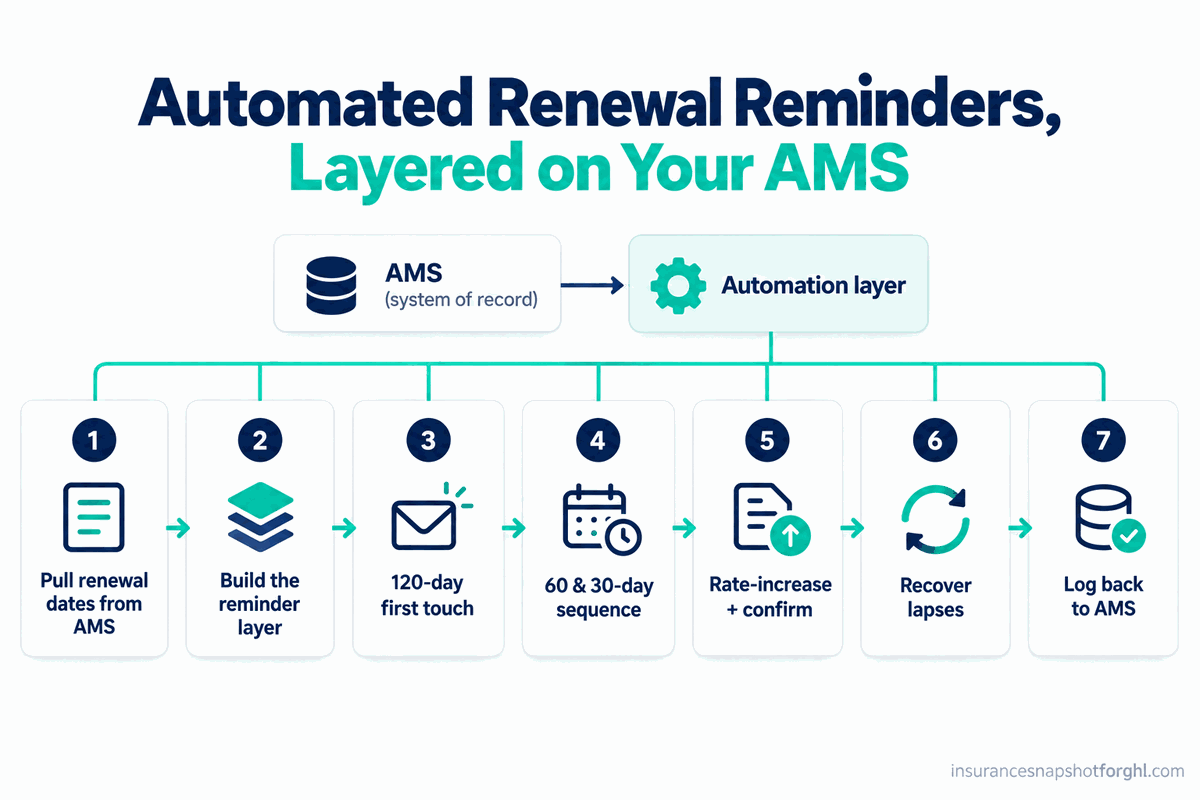
Table of contents
- What losing a renewal actually costs you
- Stage 1: Get renewal dates out of your AMS
- Stage 2: Build the reminder layer on top
- Stage 3: Map the 120/60/30/7 sequence
- Stage 4: Write the messages (steal these)
- Stage 5: Handle the rate-increase renewal
- Stage 6: Recover lapses and failed payments
- Stage 7: Close the loop back to the AMS
- Solo, five-producer, and large: who runs what
- The compliance layer you cannot skip
- Objections
- The renewal that does not slip
- FAQ
What losing a renewal actually costs you
Retention is the highest-payoff number in the agency. The classic Bain & Company work by Fred Reichheld found that lifting retention by just five points can raise profit by 25% to 95% (Bain & Company). In insurance the effect is even sharper, because a renewed policy carries almost no acquisition cost: you already paid to win that household, and every year it stays, the commission compounds.
Now put that against the market. A record 57% of auto customers shopped their policy in the past year, up from 49% the year before, the highest rate J.D. Power has recorded in 19 years (J.D. Power). Independent agents place 61.5% of all U.S. property and casualty premium (Insurance Journal), much of it in small shops where the renewal process is whoever remembers to call. Industry consultancies put average agency retention near 84%, with the best shops at 93% to 95% (Agency Performance Partners). That 10-point gap is almost entirely process: top agencies contact every renewing household on a schedule, and that schedule is what you are about to automate.
Share of U.S. auto-insurance customers who shopped their policy in the prior year. 2025 is the highest on record. Source: J.D. Power 2025 U.S. Insurance Shopping Study.
Stage 1: Get renewal dates out of your AMS
The whole build is seven stages: two of plumbing you do once, three that make up the reminder engine, and two that close the loop (the diagram above is the map). It starts with one field: the renewal date, the x-date. Get that field, plus the client name and cell number, out of the AMS and into the layer that does the texting. Three ways:
Native integration. If your AMS has a documented API or a supported connector, use it. It updates in near real time.
Scheduled export. Every AMS worth running can export a policy report to CSV. Set a recurring export of all policies renewing in the next 130 days, with name, cell, email, line of business, premium, and x-date. A weekly export is enough, because your earliest touch is 120 days out.
A bridge tool. If there is no connector and the export is painful, a middleware tool like Zapier or Make can sit between the AMS and the reminder layer. We break down the options in our guide to GoHighLevel integrations for your AMS, dialer, and rater.
How it breaks: the export goes stale. It runs for a month, then a software update changes a column header and the import silently fails. The system looks alive but no dates are flowing. Fix it with one check: a weekly alert counting how many new renewals imported. If that is zero two weeks running, something broke.
Stage 2: Build the reminder layer on top
This is the decision that saves the most money. Your AMS can probably send renewal emails, but that usually lives in a higher tier or a paid marketing add-on, and it is rarely built for two-way texting or a real drip sequence.
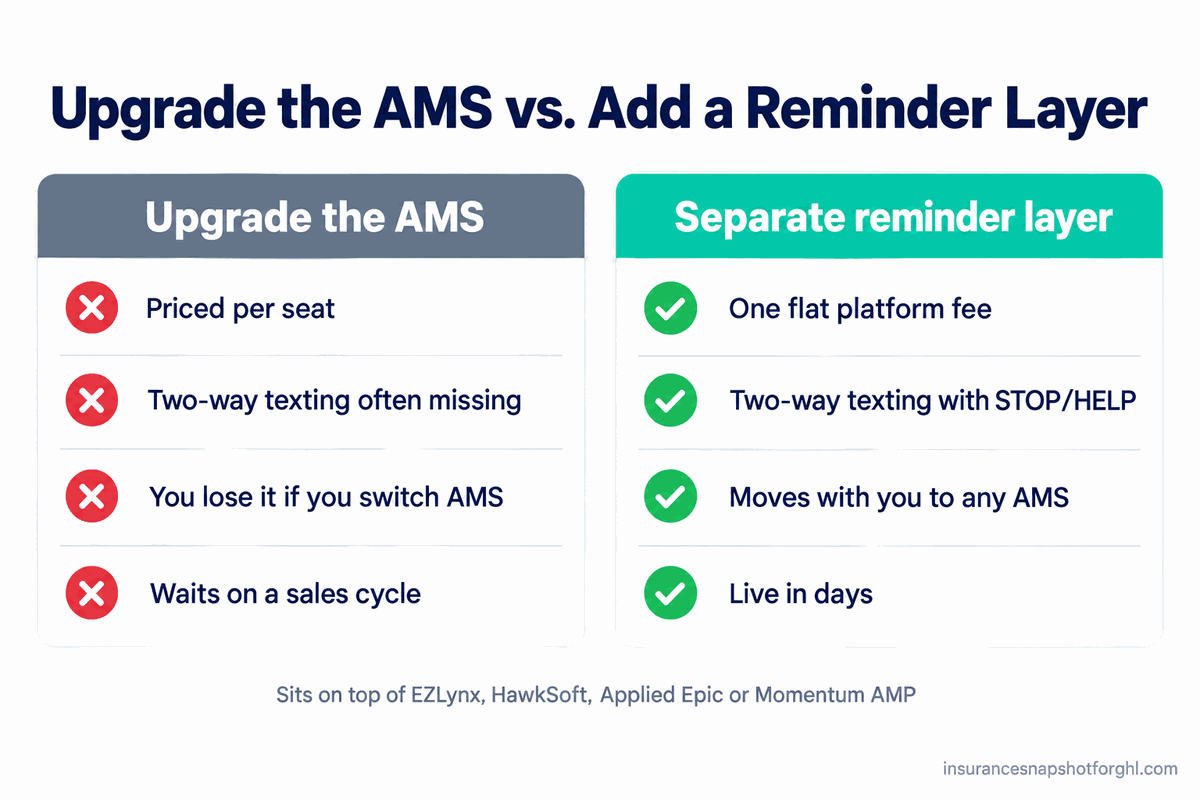 Upgrading the whole AMS to unlock messaging is the expensive way to solve a cheap problem. The cheaper way is a separate automation platform that reads the export and does nothing but run the sequence: send the text and email, book the call, log the reply. You are not replacing the system of record, you are adding the muscle it never had. A dedicated layer is a flat platform fee, texts two ways with STOP/HELP built in, and moves with you if you ever switch AMS. An AMS upgrade is per seat, waits on a sales cycle, and you lose it the day you leave.
For what the underlying systems cost, we did the full teardown in what agency management software actually costs in 2026: Momentum AMP publishes tiers from about $99 a month, HawkSoft runs near $250 plus roughly $94 per user, and Applied Epic hides its price behind a demo. Bumping any of those a tier just to get messaging costs more than a dedicated layer that does it better.
How it breaks: you try to make the AMS do the marketing anyway, because it is one login. Six weeks later the templates are clunky, texting is one-way, and producers stop trusting it. Keep the two jobs separate.
Stage 3: Map the 120/60/30/7 sequence
The timing is early enough to shape the renewal, and spaced so you are present without being a pest. The reasoning is in the renewal cadence that actually works. Map each touch to a channel and an owner:
- 120 days: email. A soft heads-up, no ask beyond “we are already looking at your renewal.” This separates you from every agency that shows up at day 20.
- 60 days: SMS with a booking link. One job: get an annual review on the calendar while there is time to remarket.
- 30 days: email plus a producer task. The plain-English renewal summary, with a task dropped on the producer for any account over a premium threshold.
- 7 days: SMS. Confirm the bind, check autopay, give one last easy way to reply.
The rule that makes it work: automation handles the routine touches so the producer has time for the dozen renewals that need a real conversation.
How it breaks: you automate the call, not just the reminder. A renewal with a big increase or a coverage gap needs a person, so use the automation to surface those early, then get out of the way.
Stage 4: Write the messages (steal these)
This is the part people skip. Below is copy you can paste in and edit; bracketed placeholders are merge fields. Keep it plain, and always identify the agency, because an unbranded text from an unknown number gets ignored or reported.
120-day email (subject: A quick heads-up on your [line] renewal)
Hi [first name],

Your [auto/home] policy with [agency] renews on [renewal date]. We look at
renewals early, while there is time to check for savings or coverage gaps.

Nothing to do right now. If anything changed this year, a new car, a teen
driver, a home project, just reply and let me know.

[producer name], [agency]
60-day SMS (annual review booking)
Hi [first name], it's [producer] at [agency]. Your [line] renews [renewal
date]. Want a quick 10-minute review to make sure you're not overpaying?
Grab a time: [booking link]. Reply STOP to opt out.
30-day email (the plain-English summary)
Hi [first name],

Your [line] policy renews [renewal date]. Premium is [amount], which is
[up/down/flat] from last year because [reason]. Coverage stays the same
unless we change it.

If that works, you're all set. To talk through options, book here:
[booking link].
7-day SMS (confirm and autopay check)
Hi [first name], [agency] here. Your [line] renews in 7 days on [renewal
date]. You're all set. Is the card on file still current for autopay?
Reply YES or CALL. Reply STOP to opt out.
Write these once and the system reuses them across every renewal.
How it breaks: you send the same text to a Medicare client and an auto client. Line of business changes the tone and the rules. Segment the sequence by line, and if you sell Medicare or ACA, keep those in a separate track with the extra CMS-marketing care they require. We cover the boundary in TCPA-safe SMS for insurance agencies.
Disclosure: the GoHighLevel link above is an affiliate partner link; you pay the same price.
Stage 5: Handle the rate-increase renewal
The hard-market renewal is where accounts leave, so it gets its own handling. When the premium jumps, silence reads as a bill you sprung on them. For any account over a premium threshold or with an increase above, say, 10%, the system drops a producer task instead of the automated summary. A person makes that call: lead with the why and give them a choice. Our renewal scripts for the rate-increase conversation go word by word.
How it breaks: the flag fires too late. If your export only looks 30 days ahead, a producer cannot remarket a tough account in time. That is why Stage 1 pulls 120-plus days of renewals.
Stage 6: Recover lapses and failed payments
Not every renewal fails at the sale. Plenty fail at the payment. A card expires, an autopay bounces, and a policy the client meant to keep lapses on a technicality. Those are the cheapest saves in the agency, because the client never chose to leave. Build one more short track: when a payment fails or the policy enters its grace period, the system sends an immediate, calm text and creates a same-day task.
Hi [first name], [agency] here. We got a notice that the payment on your
[line] policy didn't go through. Easy fix and there's still time. Reply or
call [phone] and we'll sort it in a few minutes. Reply STOP to opt out.
How it breaks: you treat a payment problem like a sales problem and wait. Reinstatement windows are short, so this track has to fire same-day. If your setup runs weekly, carve out the payment track to run daily.
Stage 7: Close the loop back to the AMS
The last stage keeps your AMS honest. When a renewal is confirmed, a review is booked, or a client opts out, that outcome belongs back in the system of record, so the next person sees the whole picture and a client who texted STOP never gets another message. This is also where you measure: tag every renewal that ran the full sequence and compare its retention against the ones that did not. Within a couple of quarters you have your own number, not an industry average, for what the reminders are worth. With 572,600 insurance agents competing for the same households (BLS), the agency that can prove its retention lift keeps growing. The broader system this plugs into is in our insurance customer retention playbook.
How it breaks: the loop stays open and the two systems drift apart. A client renews by phone, the producer logs it in the AMS, but the automation never hears and keeps texting reminders for a renewed policy. Sync outcomes both directions, or at minimum suppress the sequence the moment a renewal is marked done in either system.
Solo, five-producer, and large: who runs what
The framework is the same. What changes is who touches the exceptions.
The solo agent. You are the automation’s best friend, because you are the bottleneck it removes. Automate all four touches and the payment track, and set the producer-task threshold high so only your biggest or ugliest renewals interrupt you. The goal: 90% of renewals need zero manual effort, and you spend your time on the 10% that pay for the month. Do not overbuild.
The five-producer shop. Now routing matters. The export has to assign each renewal to the right producer, and tasks have to land on the person who owns the relationship, not a shared queue nobody checks. Add a manager view showing renewals with no activity inside 45 days. This is the size where that 10-point retention gap is won or lost.
The larger or multi-location agency. Segment hard. Personal and commercial lines need different sequences and owners, and commercial renewals often need a 150- or 180-day start because remarketing takes longer. Push outcomes back to the AMS religiously, because at your scale the reporting shows which office is leaking retention.
The compliance layer you cannot skip
Texting clients is regulated, and the rules are not suggestions. Get these right before the first message goes out.
A2P 10DLC. Business texts over a 10-digit number require registering your brand and campaigns through The Campaign Registry, or the carriers filter and block the traffic (Microsoft Learn). Register before you launch.
TCPA consent and opt-out. You need prior express consent and a working opt-out on every message. One thing trips people up: the FCC’s one-to-one consent rule never took effect. The Eleventh Circuit vacated it on January 24, 2025, and the FCC removed the rule text effective August 29, 2025 (FCC). Consent reverts to the prior standard, so do not read the vacatur as a green light to text cold lists.
Anti-rebating and endorsements. If reminders drift into referral gifts or client-appreciation offers, watch your state’s anti-rebating limits (Florida caps client gifts near $100 a year, Texas near $25). If you sell life or annuities and use testimonials, NAIC Model 570 requires them to be genuine and to disclose any paid endorsement (NAIC). Automation sends a lot of messages fast, which is why the guardrails belong in the templates, not in someone’s memory.
Objections
“Won’t clients find the automated texts annoying?” They find surprises annoying. A short, branded, useful text that saves them a lapse or an overpayment is the opposite of spam. Annoyance comes from the wrong message at the wrong time, which is a copy problem, not an automation problem.
“I already pay for Applied Epic. Why add another tool?” Your AMS is a system of record, not a marketing engine. Epic stores the renewal date beautifully, but it does not text a client back or run a four-touch retention sequence. The layer does one job the AMS was never built for, far cheaper than upgrading the AMS to attempt it.
“What if a client renews by calling us? Won’t they still get texts?” Only if you skip Stage 7. Close the loop, suppress the sequence the moment a renewal is marked done, and the client who called in never hears from the automation again. That two-way sync is the difference between a system clients trust and one they mute.
The renewal that does not slip
Go back to the homeowners policy that lapsed 11 days ago. With this system running, that client got a heads-up at 120 days, a booking text at 60, a summary at 30, and a confirm-and-autopay check at 7. When the card failed, a same-day text caught it inside the grace window. The AMS held the date, and the layer on top did what the AMS never could: it acted on it. You can have the first version live this week without touching your AMS.
FAQ
Can I automate renewal reminders without upgrading my agency management system?
Yes. Your AMS already stores renewal dates. You add a separate, cheaper automation layer that reads those dates on a schedule and sends the reminders. It works on top of EZLynx, HawkSoft, Applied Epic, or Momentum AMP without changing your AMS tier.
How do I get renewal dates out of my AMS?
A native integration if your system has one, a recurring CSV export of all policies renewing in the next 130 days, or a middleware bridge like Zapier if there is no connector. A weekly export is enough because the first touch is 120 days out.
What is the right renewal reminder sequence?
A 120/60/30/7-day cadence: a soft email at 120 days, a booking text at 60, a plain-English renewal summary at 30, and a bind-and-autopay confirmation at 7. Automate the routine touches and route high-increase accounts to a producer.
Is texting clients about renewals legal?
Yes, with the right setup: A2P 10DLC registration, prior express consent, and a working opt-out on every message. The FCC one-to-one consent rule was vacated by the 11th Circuit on January 24, 2025, and the FCC removed the rule text effective August 29, 2025, so consent reverts to the prior standard.
How much does a reminder layer cost versus an AMS upgrade?
A dedicated automation layer is typically a flat platform fee, not per seat or per policy. Upgrading an AMS tier or adding its marketing module is usually per-user and pricier, and you lose it if you switch systems. The layer moves with you.