
It is 7:52am and the renewal packet is already on your desk. The premium is up 19%, the client has not called, and a competitor’s text is probably already on their phone. What you say in the next 48 hours decides whether that policy stays on your book or becomes a lost renewal you find out about three weeks later. This post gives you seven word-for-word scripts for the moments that actually lose policies, each with its timing and how it breaks. Steal them, put your agency’s name on them, and stop losing renewals to silence.
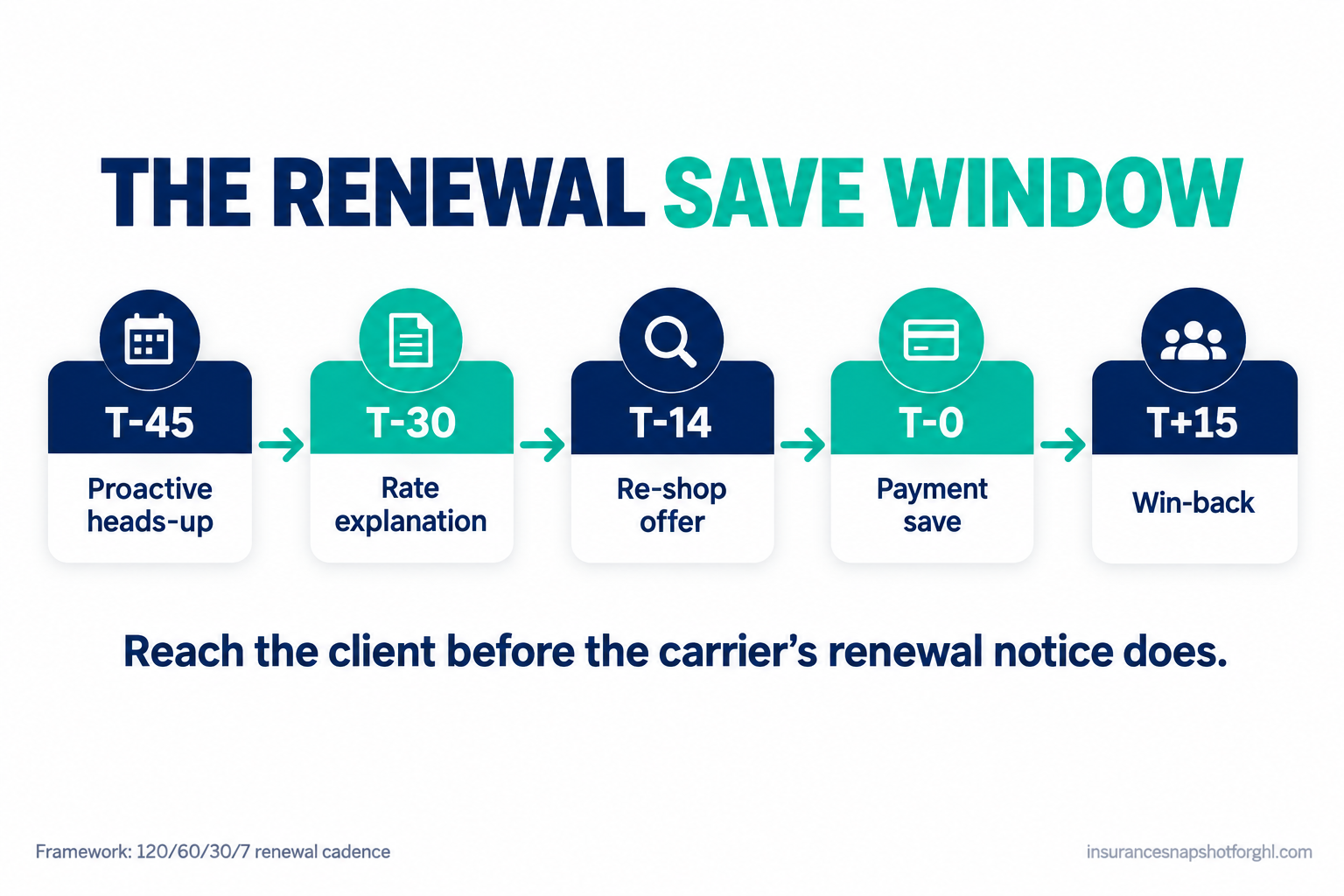
Table of contents
- Why renewals leak, and why price is not the reason
- The save window: when each script fires
- The seven scripts, word for word
- Running the scripts at every agency size
- The compliance line you cannot cross
- Objections
- FAQ
Why renewals leak, and why price is not the reason
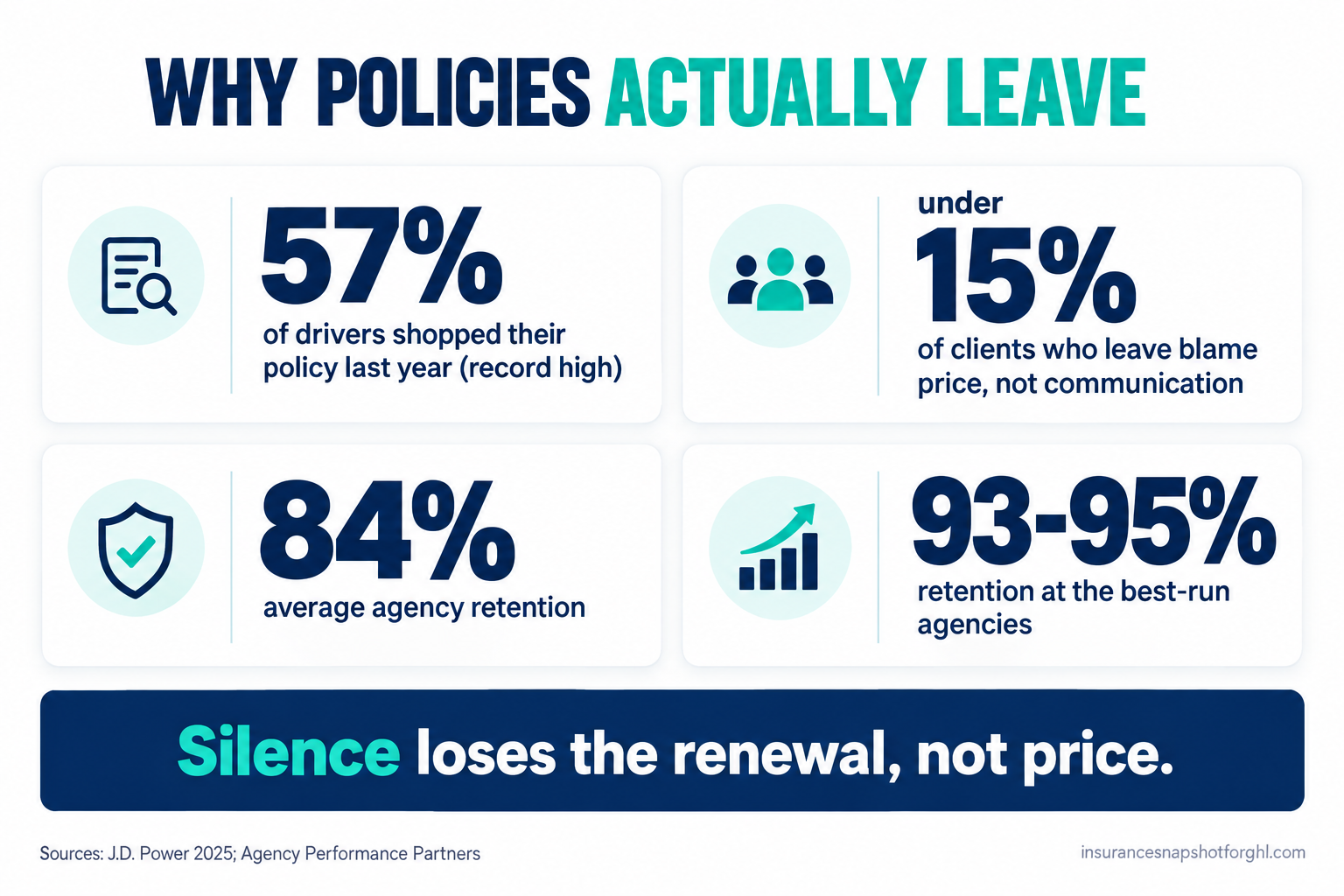
A record 57% of auto insurance customers shopped their policy last year, up from 49%, the highest rate in the 19 years J.D. Power has run the study (Insurance Journal). Shopping is not leaving, but it is the on-ramp. Once a client has a competing quote in hand, you are defending a price, not a relationship, and that is the fight you lose.
Here is the part agencies get backwards. When a policy walks, the owner blames the premium. The research says otherwise: fewer than 15% of clients who leave cite price as the primary reason, and the overwhelming driver is a lack of communication (Agency Performance Partners). They left because the renewal came in higher, nobody explained it, and the competitor who did looked like the one who cared.
So this is a scripts problem, not a pricing problem. The average agency retains 84% of its book; the best-run shops hold 93% to 95%. The gap is whether someone says the right thing at the right moment, every time, without depending on a producer’s memory on a busy Tuesday. With 572,600 agents (U.S. Bureau of Labor Statistics) chasing the same households, the one who calls first keeps the policy.
The save window: when each script fires
Timing is half the script. The window runs from about 45 days before the renewal date to about 15 days after a lapse, and the principle underneath is simple: reach the client before the carrier’s renewal notice does the talking. Carriers mail a number with no context. If your voice is first, you frame the increase instead of reacting to it.
Days from the renewal date when each retention script should fire (payment save shown at ~3 days inside the grace window). Framework based on the 120/60/30/7 renewal cadence used across independent agencies.
The seven scripts, word for word
Each script is written to be read aloud or dropped into a text with your agency name swapped in. Use the SMS versions only for opted-in clients. “How it breaks” is the mistake that turns a save into a cancellation.
Script 1: The proactive heads-up (T-45, before they shop)
The one that matters most and the one almost nobody runs. You reach out before the renewal hits, on your terms.
Call or voicemail: “Hi [First Name], it’s [Your Name] at [Agency]. Your [auto/home] policy renews on [date], and I wanted to get ahead of it before the paperwork lands. Rates moved across the board this year, so I’m reviewing your account now to make sure you’re still in the right spot. I’ll have options for you before your renewal date. Call me at [number] if anything’s changed with your vehicles, drivers, or home.”
How it breaks: Promising options you never deliver. If you say “I’ll have options,” you have to actually shop or re-rate it, or you have advertised that you dropped the ball.
Script 2: The rate-increase explanation (T-30)
The renewal is out and the number is higher. This is the call that keeps a shopper from becoming a switcher.
Call: “Hey [First Name], your renewal came through and I want to walk you through it, because it’s up about [amount] and you deserve to know why, not just get a bill. Two things drove it: [reason one, e.g. ‘claims costs in [state] pushed a base-rate increase’] and [reason two, e.g. ‘the standard inflation adjustment on your dwelling coverage’]. Neither is anything you did, and I’ve already re-rated you and looked at [X]. Do you have five minutes now, or should I call after [time]?”
How it breaks: Vague reasons and a defensive tone. If you cannot name why this policy moved, the client assumes you did not look, and that is when they open the competitor’s quote.
Script 3: The re-shop offer (T-14)
For the client whose increase is real and whose carrier will not budge, re-market inside your own house before they do it outside.
Call or email: “[First Name], I ran your renewal against the other carriers I’m appointed with. Honest picture: [Carrier A] renews at [$X]. I found [Carrier B] at [$Y] with [difference, e.g. ‘the same limits but a $500 deductible instead of $250’]. My read is [recommendation and one-sentence why]. I’m not pushing you to move, I just want you deciding with real numbers. Want me to start the switch, or hold you where you are for another term?”
How it breaks: Re-shopping without naming the coverage difference. Quote a cheaper premium and skip the higher deductible, and you have trained the client to trust the lowest number, which next time is someone else’s.
Script 4: The missed-payment / lapse save (T-0, inside the grace window)
A missed payment is a silent cancellation waiting to happen, and the cheapest policy you will ever save because the client never meant to leave.
SMS (opted-in clients): “[First Name], this is [Agency]. Your [carrier] payment didn’t go through and your policy is in the grace period until [date]. That’s usually an expired card or a bank change, not a decision to cancel. Reply here or call [number] and we’ll fix it in two minutes so you don’t have a coverage gap. -[Your Name]”
How it breaks: Sounding like a collections notice. “Your policy will be CANCELLED unless you pay immediately” gets ignored, and the gap becomes a real cancellation.
Script 5: The “I already found cheaper” rebuttal
The client calls to cancel because they found a lower number online. You have one conversation to turn price into value.
Call: “I appreciate you calling me before you switched, that means a lot. Two things before you decide. First, does that quote match your current coverage exactly, same limits, same deductibles, same endorsements? A lot of online quotes come in lower because they’ve quietly dropped [example, e.g. ‘your uninsured-motorist limits or roof coverage’]. Second, if a claim happens at 9pm on a Sunday, who’s picking up, them or me? If the coverage really is identical and the savings are real, I’ll help you make the smart move. But let’s compare the actual policies, not just the two numbers.”
How it breaks: Badmouthing the competitor or begging. “Those direct carriers are terrible” sounds defensive and the client stops listening. Name a specific coverage gap and let the details argue.
Script 6: The cross-sell at renewal
Renewal is the highest-trust moment you get all year. A client who just renewed just re-chose you, which is exactly when a second line lands.
Email or call: “[First Name], now that your [auto] renewal is squared away, one quick thing while I’m in your account. Households with both auto and home usually save through a multi-policy discount, and it lets us see the whole picture. Mind if I run a [home/umbrella/life] quote alongside your renewal? No obligation, I just don’t want you leaving a discount or a gap on the table.”
How it breaks: Pitching before the renewal is settled. If the client is still annoyed about a rate increase and you open with an upsell, you look like you are working an angle. Close the renewal, then cross-sell.
Script 7: The win-back (T+15, after they leave)
They left. Do not delete the record. A departed client at T+15 is warmer than any cold lead you will buy this month.
SMS or email (opted-in): “[First Name], no hard feelings on the move, I hope the new coverage is treating you right. One favor: about a month before your new policy renews, let me run a quick comparison. New-customer rates have a way of climbing at the first renewal, and I’d rather earn your business back with real numbers than watch you overpay. I’ll set a reminder and reach out. Take care. -[Your Name]”
How it breaks: Reaching out with nothing to offer, or too soon. A win-back text the week after they leave feels needy. Wait, set the reminder for their new renewal, and come back with a reason.
Running the scripts at every agency size
The words are the same. What changes is how you make sure they go out on every renewal, not just the ones someone remembers.
Solo operator. You are the whole retention department, so the risk is the day getting away from you. Run one weekly block, every Monday: pull the renewals 45 days out and make the Script 1 calls first. Automate the two that do not need your voice, the missed-payment text (Script 4) and the win-back reminder (Script 7). Everything else you do by phone, because at your size the personal call is your edge over a direct carrier.
Five-producer shop. The failure mode is inconsistency: one producer runs the rate call beautifully, another forgets it exists. Standardize it. The seven scripts become your renewal playbook, the timed ones (1, 4, and 7) run as an automated cadence, and producers handle the judgment calls (2, 3, and 5) live. A renewal pipeline showing which stage every renewal is in tells you which policies have gone dark, the difference between an 84% shop and a 92% one.
Large agency (15+ staff). At scale, the scripts are infrastructure. Every timed touch is automated and personalized with merge fields, so clients hear the heads-up and the payment save without a human starting either, and account managers spend their time on the re-shop and the price rebuttal. The measurement gets serious too: retention by producer, carrier, and line, so a dip tells you whether the problem is a script, a rate, or a carrier making your book uncompetitive.
Illustrative retention by renewal process, anchored to the industry benchmark (84% average, 93 to 95% for top performers). Consistency, not the words alone, closes the gap. Source: Agency Performance Partners.
For the cadence mechanics, our renewal cadence guide breaks down the 120/60/30/7 timing, and the full customer retention playbook covers how scripts, cross-sell, and win-back fit across a year. For clients who already left, the database reactivation playbook is the long game on Script 7.
The compliance line you cannot cross
Automating retention is where marketing rules bite, because the scripts that scale best are texts, and texts are regulated. Three things to keep straight, none of which should stop you.
Texting requires consent. Automated marketing SMS needs prior express written consent, with STOP and HELP handling on every number, so use the SMS versions of Scripts 4 and 7 only for opted-in clients. And ignore anyone who says a “one-to-one consent” requirement applies: that FCC rule was vacated by the 11th Circuit on January 24, 2025 in Insurance Marketing Coalition v. FCC, and the FCC removed the language later that year (Justia). Standard TCPA consent still applies. Our TCPA-safe SMS guide covers the language.
Retention gifts are capped by state. Sweetening a renewal with a gift card runs into anti-rebating law, and the limits are local. Florida caps promotional gifts at $100 per client per year; many states, and by common practice Texas, sit at $25 (Paylode). Know your state’s number before you automate a reward. We go deep on this in the insurance marketing compliance guide.
Testimonials have rules. If you dress up Script 7 with a client quote, life and annuity advertising under NAIC Model 570 requires testimonials to be accurate, unedited, and to disclose a paid endorsement. None of this blocks a single script above. You automate the message, not a gift, and you get consent before you text.
Objections
“Won’t a proactive rate call just remind them to shop?” Backwards. The client finds out about the increase either way. The only question is whether they hear it from you with context or from a carrier envelope with none. Silence does not prevent shopping, it guarantees you are not in the conversation when it starts.
“I don’t have time to call every renewal.” You do not have to. You have to make sure every renewal gets the right touch, and most of those (the heads-up, the payment save, the win-back) run automatically with your name on them. You spend your phone time on the two or three conversations a week that need judgment.
“Automated texts feel impersonal.” Which is why the automation has to sound like you and come from your name. The impersonal move is the one you make now: letting a renewal pass with no contact because the day got busy. Clients do not experience a missing call as restraint. They experience it as being forgotten.
The bottom line
Renewals do not leak because your rates are too high. They leak because a client got a higher number, heard nothing from you, and someone else picked up the phone. The average agency keeps 84% of its book; the shops that keep 95% are the ones that say the right thing at the right moment, every time. Take the seven scripts above, put your name on them, run the timed ones automatically, and keep the compliance line clean. The policy you save is one you already sold, and it is the cheapest growth in the business.
FAQ
What should I say to a client when their insurance rate goes up?
Reach out before the renewal notice lands, name the two or three specific drivers (carrier base-rate change, inflation adjustment, claims activity in the state), and show what you have already done, like re-rating it or checking other carriers. Going silent, or saying only 'everybody's rates went up,' is the mistake. Fewer than 15% of clients who leave actually cite price.
When should I contact a client about their insurance renewal?
The highest-impact contact is about 45 days before the renewal date, before the carrier's notice arrives and the client starts shopping. A common framework is the 120/60/30/7 cadence: a heads-up 45 to 60 days out, a rate explanation around 30 days, a re-shop offer around 14 days, a payment save inside the grace period, and a win-back about 15 days after a lapse.
How do I keep a client who found a cheaper quote elsewhere?
Do not argue the price, audit the comparison. Ask whether the cheaper quote matches their coverage exactly, since many online quotes come in lower only because they drop limits or endorsements or raise the deductible. Then make a local agent's value concrete: who handles a claim at 9pm on a Sunday. If the coverage truly matches and the savings are real, help them move.
Is it legal to text insurance clients about their renewal?
Yes, with consent. Automated marketing texts require prior express written consent under the TCPA, plus STOP and HELP handling, so only text opted-in clients. The FCC's 'one-to-one consent' rule was vacated by the 11th Circuit on January 24, 2025 and later removed, so that specific requirement does not apply, but standard TCPA consent still does.
Can I give a gift card to clients who renew?
Only within your state's anti-rebating limit, which is strict and local. Florida caps promotional gifts at about $100 per client per year; many states, including Texas by common practice, sit at $25. Confirm your own state's number before you automate any 'thanks for renewing' reward, because a $50 card can be a violation where the cap is $25.
About the author
Priya Raman is an Insurance Agency Growth Strategist at Insurance Snapshot for GHL. She came up running marketing for a multi-line agency, so she thinks in premium written, retention by line, and producer capacity rather than open rates. She writes about the strategy layer of automation: which touches actually keep a policy, and how to sequence a renewal conversation so it does not feel like a pitch. Editorial byline only. Priya is not a licensed agent and does not quote, bind, or sell insurance.
Working on your renewals? See how the Snapshot runs your renewal cadence, book a 30-minute demo, or talk to a real person.