
A GoHighLevel integration connects GHL to the systems your Seattle insurance agency already runs on — your AMS or rater, your dialer, your quoting tools, and QuickBooks — so a new applicant, a policy change, or a renewal date is entered once and flows everywhere automatically. Built correctly, it kills double data entry, keeps your renewal cadence firing on accurate X-dates, and gives you one clean view of the book instead of five systems that quietly disagree. For an agency, that’s not a nice-to-have. It’s the difference between automation that actually runs and a CRM full of stale contacts nobody trusts.
This is the operator’s playbook for a Seattle agency: what a GoHighLevel integration really is, why disconnected systems cost you more than you think, and the exact 7-step process we use to wire GHL into your existing insurance stack — cleanly, compliantly, and without losing a renewal.
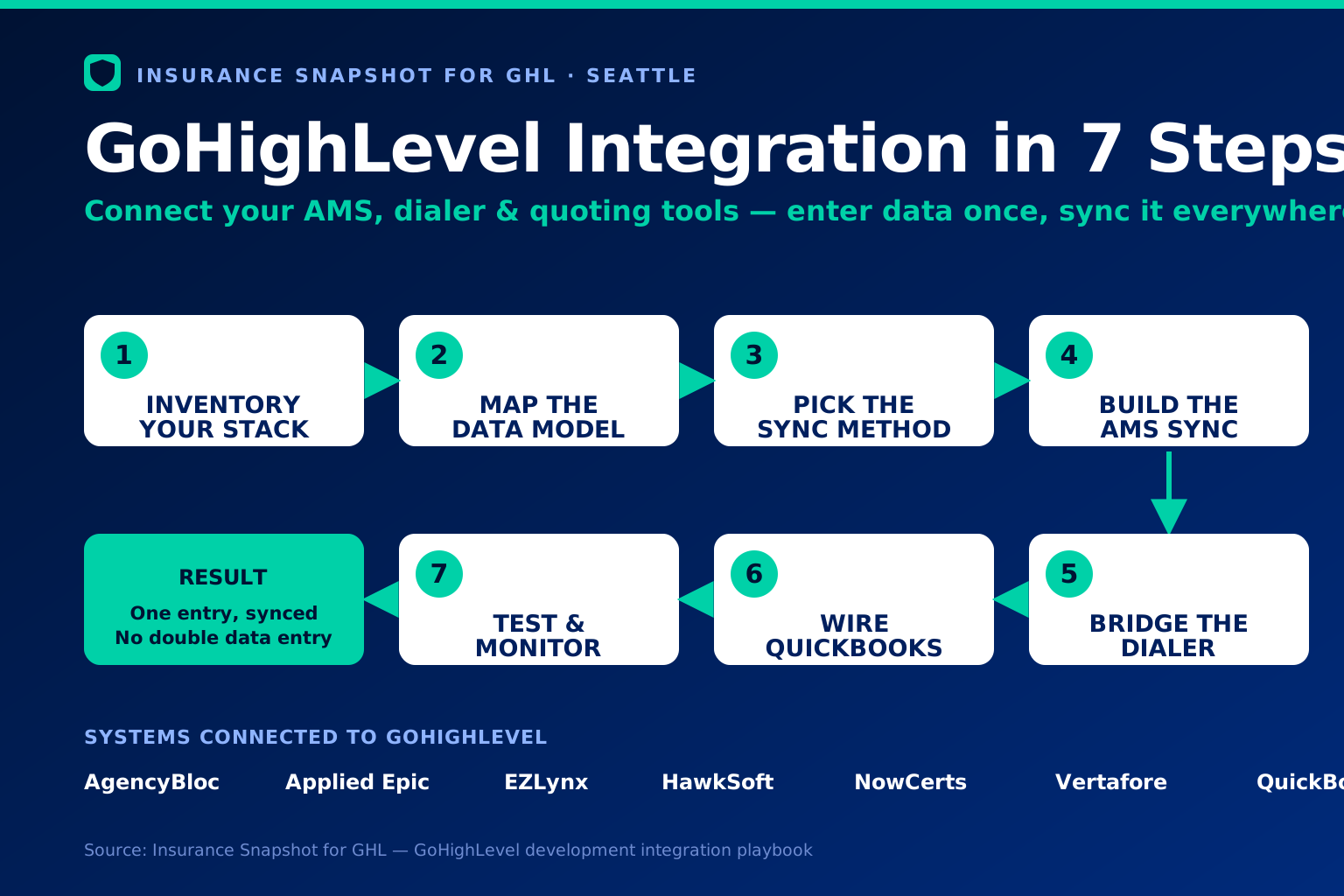
Table of contents
- What a GoHighLevel integration actually means
- Why Seattle agencies feel the disconnect more
- The real cost of leaving your systems disconnected
- The 7-step GoHighLevel integration playbook
- Done-for-you vs Zapier vs DIY
- What it costs and how long it takes
- How to know your agency is ready
- FAQ
What a GoHighLevel integration actually means
For an insurance agency, “GoHighLevel integration” is the work of connecting GHL to the other software that holds your real data, so information moves between them without a human copying and pasting. In practice it covers four connections:
- AMS / rater ↔ GHL. Your agency-management system or rater — AgencyBloc, Applied Epic, EZLynx, HawkSoft, NowCerts, or Vertafore — holds policies, effective dates, and renewals. A connector pushes new applicants and policy changes into GHL contact records (tagged by line of business, with renewal/X-date custom fields) so your marketing automation runs on live data.
- Dialer / voice AI ↔ GHL. Every inbound quote call gets recorded, transcribed, and logged against the right GHL contact, routed by line of business to the right producer.
- Quoting / carrier tools ↔ GHL. Quote requests and status flow into the pipeline so a shopper who started a quote doesn’t fall through a crack between systems.
- QuickBooks ↔ GHL. Bound-policy stages trigger commission records, and payment status flows back to the contact — no month-end reconciliation by hand.
The key idea: you don’t replace your AMS or rater. You keep the tools that already work and connect them to GHL so the whole stack behaves like one system. That’s the core of our GoHighLevel development work — and it’s different from a full migration onto GoHighLevel, which moves your book into GHL as a one-time event.
Why Seattle agencies feel the disconnect more
Washington is a big, competitive insurance market — 8,653 insurance agencies and brokers, generating about $4.6 billion in revenue in 2025 (IBISWorld). Most of them are independent shops, and nationally independent agents place 61.5% of all U.S. property-casualty premium (Big “I” 2025 Market Share Report). Independence is the strength — you can place a Seattle household with the right carrier — but it’s also why your stack is fragmented: multiple carrier portals, a rater, an AMS, and a CRM that were never designed to sync.
That fragmentation hurts most in a market where shoppers move fast. A Seattle prospect comparing auto and home quotes online expects a same-day response, and speed-to-lead is decided by whether the right producer sees the lead the moment it lands — which only happens if your intake tools feed GHL in real time. When they don’t, leads sit in one system while your follow-up automation runs in another, blind to them. (We break down the revenue math of slow response in the speed-to-lead playbook.)
The real cost of leaving your systems disconnected
Disconnection feels free because nobody sends you an invoice for it. But it shows up three ways:
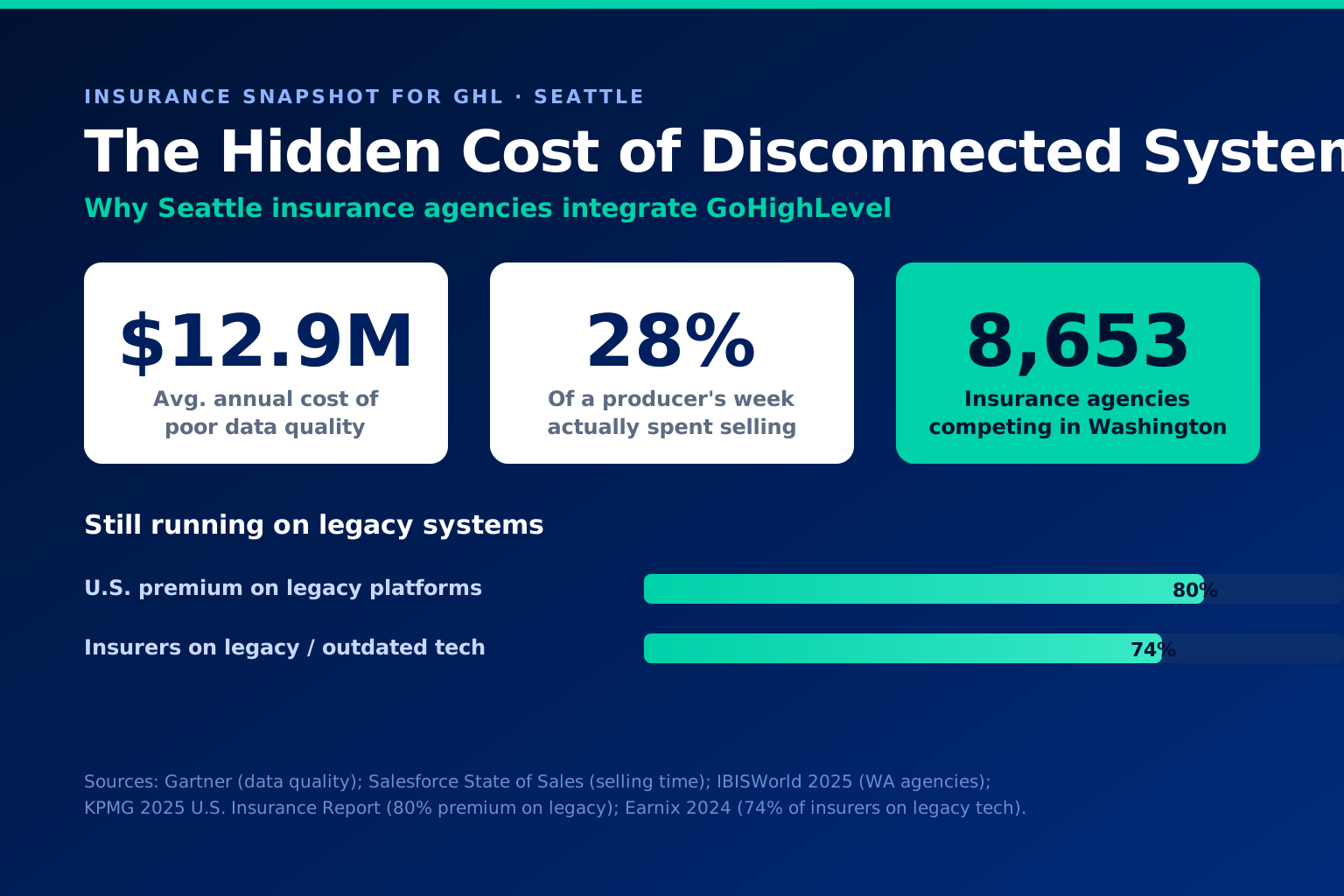
1. Re-keying eats producer time. When a submission lives in the rater, the AMS, a carrier portal, and the CRM — each entered by hand — you’re paying licensed-producer wages for copy-paste. Across the profession, reps spend only about 28% of their week actually selling (Salesforce); the rest is admin, and manual re-entry is a big slice of it. The 2024 industry tech research from Catalyit and the Big “I” found agencies routinely enter the same submission data into three or more systems (2024 Agency Technology Report).
2. Bad data breaks your automation. A renewal cadence is only as good as the X-date it fires on. If your AMS updates a renewal date and GHL never hears about it, your 120/60/30/7-day sequence goes out on the wrong day — or not at all. Gartner puts the average cost of poor data quality at $12.9 million a year per organization (Gartner); at an agency scale, “poor data quality” is exactly this: two systems that disagree about when a policy renews.
3. You can’t see the book. With 80% of U.S. premium still sitting on legacy systems (KPMG 2025) and 74% of insurers on legacy or outdated tech (Earnix), most agencies can’t answer “what’s my retention by line?” without a spreadsheet someone updates by hand. Integration is what turns scattered data into one dashboard you can actually run the agency on.
The 7-step GoHighLevel integration playbook
Here’s the exact sequence we follow to connect GHL to an agency’s stack without losing data or breaking TCPA consent.
Step 1 — Inventory your stack and pick the system of record
List every tool that touches a contact or a policy: AMS, rater, dialer, carrier portals, QuickBooks, and GHL. For each critical field (contact info, line of business, effective date, X-date, producer, pipeline stage), name the one system that owns the truth. This map is the whole project — everything else is plumbing.
Step 2 — Map the insurance data model
GHL’s contact record needs custom fields that mirror how insurance actually works: line of business, carrier, policy number, effective date, renewal/X-date, premium, and producer. If those fields don’t exist (or live in a notes field where automation can’t see them), your sync has nowhere to land. This is the same insurance-shaped data model that makes renewal and cross-sell automation possible in the first place — the reason a generic CRM struggles where a purpose-built one shines, as we cover in custom insurance software.
Step 3 — Choose the sync method
There are three honest options, in order of durability:
- Native / marketplace integration — if your tool has a real GHL integration, start here.
- iPaaS glue (n8n, Make, Zapier) — fast to stand up for simple one-way pushes; fine for low volume.
- Custom API connector (GHL API v2 + webhooks) — the durable choice for two-way sync, volume, and insurance-specific logic like LOB routing and X-date reconciliation.
Most agencies need a mix: native where it exists, a custom connector where the data is business-critical.
Step 4 — Build the AMS / rater ↔ GHL sync
This is the backbone. A webhook-driven connector pushes new EZLynx (or HawkSoft, NowCerts, Applied Epic, AgencyBloc, Vertafore) applicants and policy changes into GHL in real time, tagged by line of business, with renewal-date fields kept in sync. Two-way where it earns its keep; one-way where that’s safer. Done right, nobody re-keys a contact again.
Step 5 — Bridge the dialer / voice AI
Wire your dialer or voice-AI receptionist so every inbound quote call is recorded, transcribed, and logged on the matching GHL contact — routed by line of business to the right producer, with live-transfer rules for quote-ready callers. Now a call and a web lead live in the same record instead of two systems.
Step 6 — Wire QuickBooks / commissions
When a policy hits the “bound” stage in GHL, push a commission record into QuickBooks and flow payment status back to the contact. Month-end reconciliation stops being a manual chore, and you can finally see premium written by source and commission by producer.
Step 7 — Test, dedupe, and monitor
Before go-live: dedupe contacts, verify field mapping against the system-of-record map from Step 1, and — critically — confirm TCPA consent and opt-out status survive the sync so a STOP in one system is honored everywhere. Then add monitoring so a failed sync alerts you instead of silently drifting. Integrations aren’t “set and forget”; they’re “set and watch.”
Typical GoHighLevel integration delivery windows (weeks)
Upper end of typical delivery windows for each build. Source: Insurance Snapshot for GHL GoHighLevel development project scoping.
Done-for-you vs Zapier vs DIY
You have three ways to connect GHL. The right one depends on volume, how critical the data is, and whether the logic is insurance-specific.
How to connect GoHighLevel to your insurance stack
| Plan | Done-for-you custom integration recommended | Zapier / Make (DIY) |
|---|---|---|
| Price | From ~$3K, scoped | Monthly per task |
| Feature 1 | Two-way AMS/rater ↔ GHL sync with LOB routing | Fast to stand up for simple one-way pushes |
| Feature 2 | Insurance logic: X-date reconciliation, TCPA opt-out sync | Fine for low volume and non-critical fields |
| Feature 3 | Webhook-driven, real-time, built on GHL API v2 | Struggles with two-way sync and dedupe |
| Feature 4 | Monitored — a failed sync alerts you, not drifts silently | No insurance logic — you build every rule by hand |
| Feature 5 | You own the connector and the data model | Task limits and silent failures at scale |
| Get a GHL integration quote |
For a solo producer pushing a handful of leads a day, a Zapier zap is genuinely fine. The moment your renewal cadence, commissions, or two-way policy data depend on it, you want a durable connector — because a silent Zapier failure on your X-date field breaks retention automation you can’t see failing.
What it costs and how long it takes
GoHighLevel integrations have a reputation for being a bottomless project. They don’t have to be. Because we build with Claude Code (Anthropic’s AI-assisted development CLI), timelines and cost run roughly half of a traditional dev shop, and every build ships with a fixed written scope and a bug-fix warranty. The real ranges:
- AMS / rater → GHL connector: 2–4 weeks
- Quote-intake chatbot or dialer bridge: 3–4 weeks
- Renewal / commission dashboard or portal: 6–10 weeks
- Full book migration into GHL: 1–3 weeks, depending on data quality
On price, fixed quotes start around $3K for small connectors and plugins, $5–15K for integrations and chatbots, and $15–40K for full dashboards and portals — or an hourly retainer at $75/hr with no minimums if requirements are still evolving (GoHighLevel development). Every engagement starts with a free scoping call, so there’s no surprise invoice. If you’d rather someone run GHL day-to-day after it’s wired up, a dedicated GoHighLevel VA can operate it for you.
How to know your agency is ready
You don’t need custom integration if you’re a solo shop and your tools basically fit. You almost certainly need it when three or more of these are true:
- The same data gets typed into multiple systems — a submission lives in the rater, the AMS, a carrier portal, and the CRM, all by hand.
- Your renewal automation misfires because GHL doesn’t know a policy’s real X-date.
- You can’t see retention or commissions without a spreadsheet someone updates manually.
- Leads sit in one system while your follow-up automation runs blind in another.
- A STOP or opt-out in one tool isn’t reflected everywhere — a TCPA risk hiding in your disconnection.
If that’s your agency, the fix isn’t another seat on another tool — it’s the connective tissue that makes the tools you already pay for behave like one system. In a market as busy as Seattle, that quiet operational edge is what keeps every policy on the books and every quote-ready caller from dialing the next agent on the list. Most agencies get 80% of this handled by the prebuilt Insurance Snapshot; custom integration closes the last, agency-specific 20%.
FAQ
What is a GoHighLevel integration for an insurance agency?
It's the work of connecting GoHighLevel to the other software your agency runs on — your AMS or rater (AgencyBloc, Applied Epic, EZLynx, HawkSoft, NowCerts, Vertafore), your dialer or voice AI, your quoting tools, and QuickBooks — so a new applicant, policy change, or renewal date is entered once and flows everywhere automatically. You keep your existing tools; the integration makes them behave like one system, which ends double data entry and keeps automation running on live data.
How is a GHL integration different from migrating to GoHighLevel?
A migration is a one-time move of your whole book — contacts, pipelines, tags, notes, renewal history — into GoHighLevel. An integration keeps your other systems (like your AMS and rater) in place and connects them to GHL for ongoing two-way data flow. Many Seattle agencies do a migration first to get onto GHL, then build integrations so their rater, dialer, and QuickBooks stay in sync afterward.
Can I just use Zapier to connect my AMS to GoHighLevel?
For simple, low-volume, one-way pushes, yes — Zapier or Make is genuinely fine and fast to set up. Where it struggles is two-way sync, deduplication, insurance-specific logic (line-of-business routing, X-date reconciliation, TCPA opt-out syncing), and volume, where task limits and silent failures start breaking business-critical automation. When your renewal cadence or commissions depend on the sync, a durable custom connector on the GHL API is the safer choice.
Which insurance systems can you connect to GoHighLevel?
Two-way integrations are possible with AgencyBloc, Applied Epic, EZLynx, HawkSoft, NowCerts, and Vertafore, plus QuickBooks, Stripe, dialers and voice-AI platforms, and effectively anything with an API via webhooks, polling, or scheduled jobs. The connector syncs contacts, policies, renewal dates, and pipeline stages so nothing is re-keyed by hand.
How do you keep TCPA consent intact across an integration?
Consent and opt-out status are treated as first-class data in the sync: a STOP or revoked consent captured in one system is propagated to the others, and the integration is tested before go-live to confirm opt-outs are honored everywhere. This prevents the common failure where a client opts out in the AMS but keeps receiving texts from GHL — a TCPA risk that hides inside disconnected systems.
How much does a GoHighLevel integration cost in Seattle?
Fixed-price quotes start around $3K for small connectors and plugins, $5–15K for integrations and quote-intake chatbots, and $15–40K for full dashboards and portals. An hourly retainer is available at $75/hr with no minimums for evolving requirements. Because we build with Claude Code, timelines and cost typically run about half of a traditional dev shop, and every project starts with a free scoping call and a written fixed scope.
About the author
Andre Bellamy is a GHL Automation Lead for the Insurance Practice at Insurance Snapshot for GHL. He spends his days inside agency accounts mapping how a lead moves from first quote to bound policy to cross-sell, then wiring the AMS, rater, dialer, and CRM together so that journey runs without a producer babysitting it. He writes about the operational mechanics of insurance automation — data models, integrations, and the build-vs-buy decisions that separate “we have tools” from “the agency actually runs on them.” Editorial byline only — Andre is not a licensed agent and does not quote, bind, or sell insurance.
Ready to connect GoHighLevel to your stack? See our GoHighLevel development service, book a free scoping call, or talk to a real person.