
For most Houston insurance agencies, done-for-you social media wins — not because in-house is “wrong,” but because the thing social media actually rewards is consistency, and a producing agency almost never has the time to post five days a week, every week, with real Reels. The choice isn’t “good content vs bad content.” It’s “content that ships on schedule vs a feed that goes quiet the first busy renewal week.” In a market the size of Houston, the agency that shows up every day quietly takes the households the silent one never knew it lost.
This is the operator comparison: what running social in-house really costs a Houston agency, what a done-for-you team does differently, and how to decide which one fits your shop — backed by the current numbers on how insurance shoppers actually research and buy.
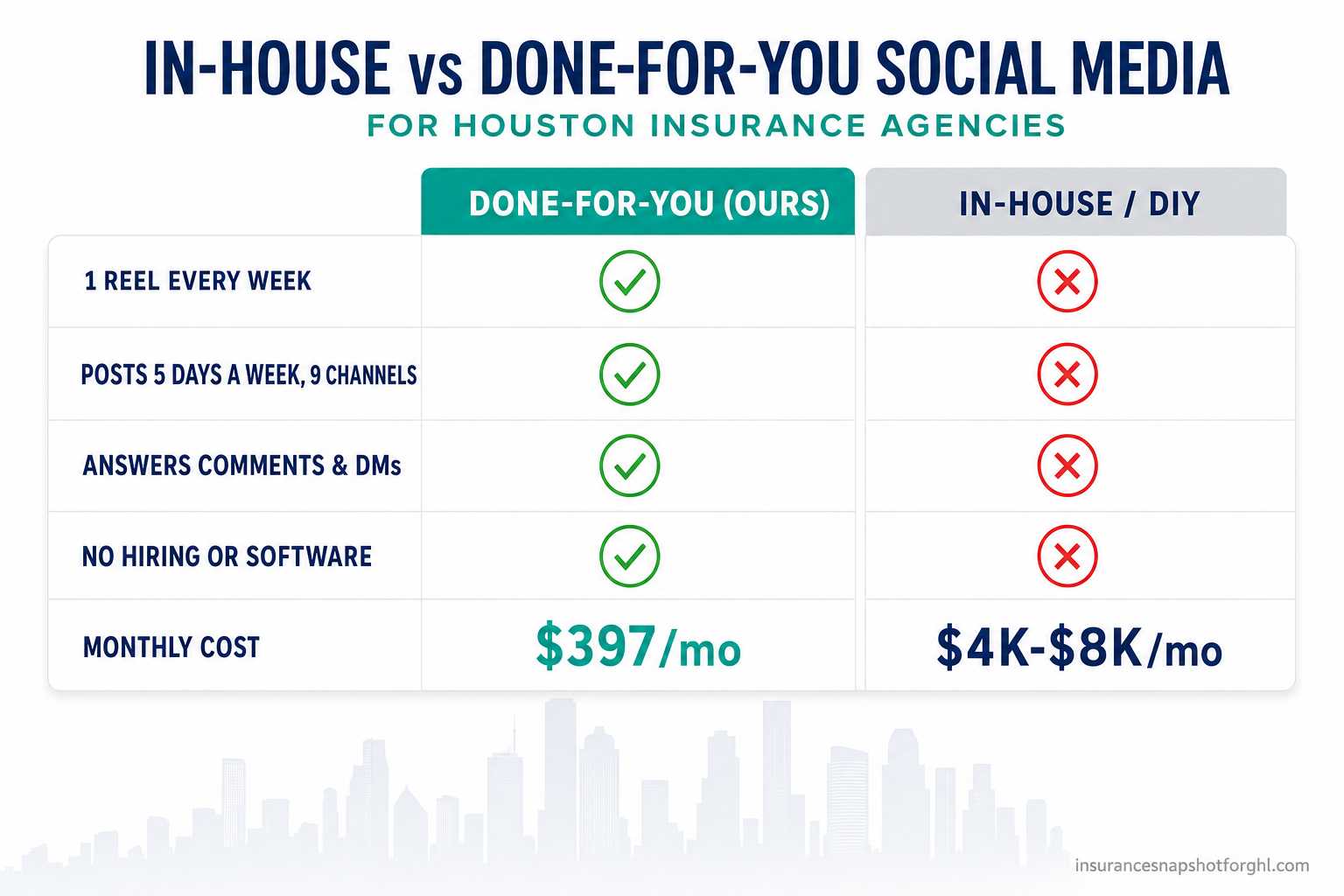
Table of contents
- Why Houston insurance shoppers judge you on social first
- The data: social and video now drive insurance buying
- In-house vs done-for-you: the head-to-head
- The real cost of doing it in-house
- Why Reels and short-form video matter most
- Where each option fits a Houston agency
- What a done-for-you social system looks like
- FAQ
Why Houston insurance shoppers judge you on social first
Houston is one of the largest and fastest-growing insurance markets in the country. The city’s population sits around 2.3 million, inside a metro of roughly 7.9 million that leads the nation in numeric growth (World Population Review, 2025). That means a constant stream of new arrivals shopping for auto, home, flood, and life coverage — and a crowded field of agents trying to reach them.
Here’s what’s changed: those shoppers form an opinion about your agency before they ever call. They see a friend share a post, they tap your profile, and in a few seconds they decide whether you look active, trustworthy, and worth a message. A feed that last posted in March reads as “this agency might not even be open.” A feed with a fresh Reel from this week reads as “these people are on it.”
That first impression matters because insurance buying has moved online. In J.D. Power’s 2025 study, digital auto-insurance shopping hit a record 57%, up from 49% a year earlier, and 47% of shoppers now purchase through digital channels (J.D. Power, 2025). The younger the buyer, the more true it is — more than two-thirds of Gen Z and Millennials prefer text-based communication with insurers, and speed of response is a top priority (One Inc analysis of J.D. Power data, 2024).
The data: social and video now drive insurance buying
Social media stopped being a place to “post updates” and became a place where buying decisions get made. The reach alone is hard to argue with: half of U.S. adults use Instagram and 37% use TikTok — TikTok up from just 21% in 2021 (Pew Research Center, 2025). And people don’t just scroll — they research local businesses there. Per BrightLocal, 34% of consumers use Instagram and 23% use TikTok to discover or vet local businesses, both rising year over year (BrightLocal Local Consumer Review Survey, 2024).
The part that should reshape how an agency thinks about content is video. Watching a video is what tips people from interested to buying.
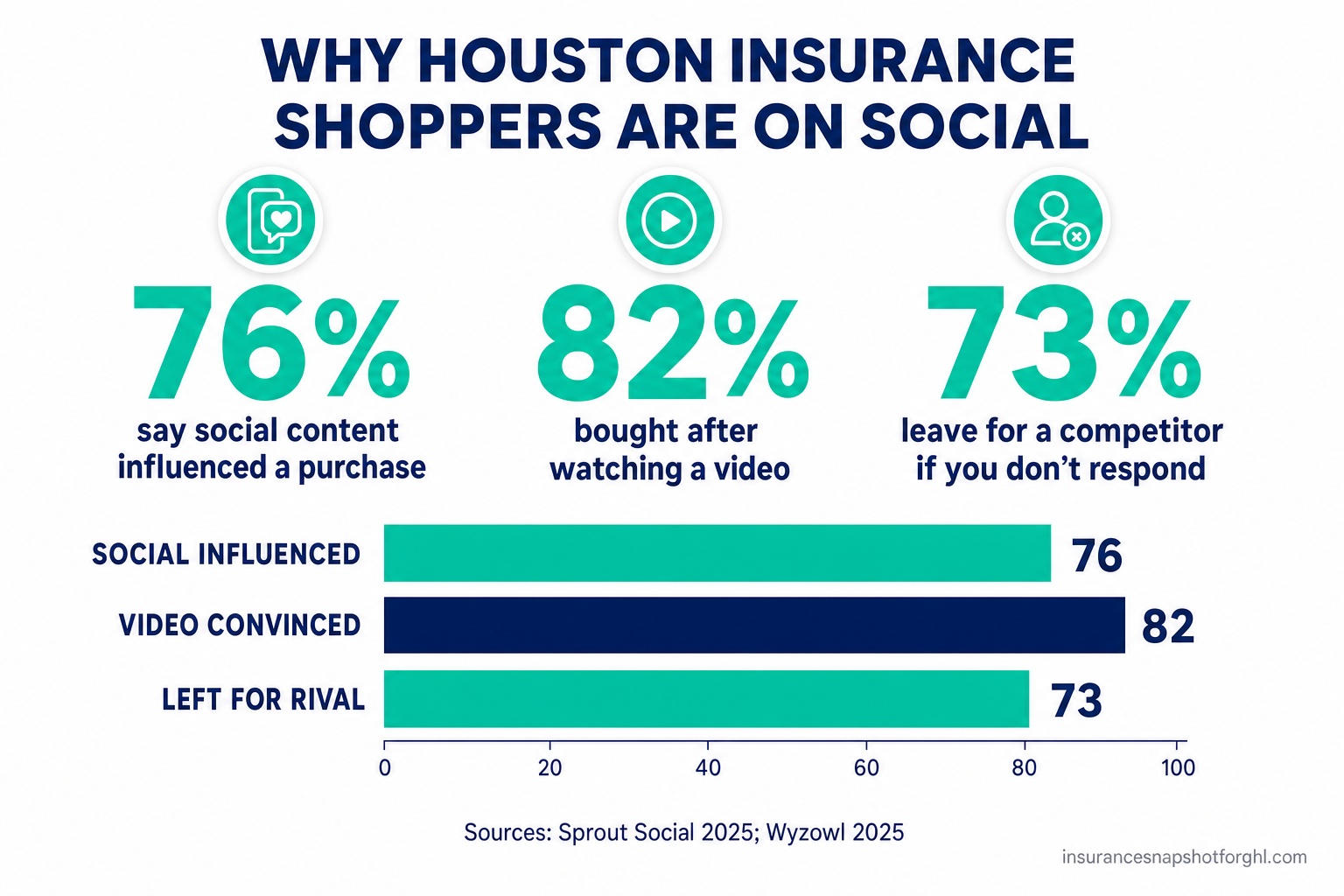
Notice the third bar. It isn’t about posting — it’s about answering. 73% of consumers will buy from a competitor if a brand doesn’t respond to them on social (Sprout Social, 2025). A comment left unanswered for two days, a DM that sits over the weekend — that’s a quote walking down the street. This is the same speed-to-lead problem that decides phone leads, just moved to the comment section; we broke down the phone side in our speed-to-lead playbook.
So the modern social job for an agency is three things at once: post consistently, make video, and respond fast. Hold that list — it’s exactly where the in-house vs done-for-you decision gets made.
In-house vs done-for-you: the head-to-head
Both models can work. They are not equal on the things that actually move results for a busy agency. Here’s the honest breakdown.
Running agency social: in-house vs done-for-you
| Plan | Done-for-you (ours) recommended | In-house / DIY |
|---|---|---|
| Price | $397/mo | $4K–$8K/mo team |
| Feature 1 | Ships weekly: 1 text, 1 image, 2 carousels, 1 Reel | Output depends on whoever has time that week |
| Feature 2 | Published 5 days/week across 9 channels | Reels stall — video is the first thing to slip |
| Feature 3 | AI agents answer comments, DMs & web chat | Replies wait until someone checks the inbox |
| Feature 4 | Insurance-niche content — TCPA-aware captions | You hire, train, and cover designer + editor |
| Feature 5 | Live in days, no hiring or software to manage | Consistency drops the first busy renewal week |
| See done-for-you social |
The pattern is consistent. In-house gives you control and a voice that’s unmistakably yours — but it lives and dies on internal time you rarely have to spare. Done-for-you trades a little of that hands-on control for the one thing social rewards most: it always ships. For an agency whose real job is quoting, binding, and servicing policies, “it always ships” is usually the deciding factor.
This is not a Houston-only pattern — it’s how small businesses operate everywhere. 71% of small businesses do all their own marketing, and only 8% work with an outside agency (SimpleTexting, 2024). Most agencies default to in-house not because they compared the options and chose it, but because outsourcing never got priced out. That’s the gap this comparison is meant to close.
The real cost of doing it in-house
“In-house” sounds free because no invoice arrives. It isn’t. To match what a done-for-you team produces, an agency needs four distinct skill sets: a content writer who knows insurance, a graphic designer, a video editor for Reels, and a community manager answering comments and DMs. Hire those roles — even part-time or blended — and you’re realistically looking at $4,000–$8,000 a month in salary and tools before a single lead comes in.
The likelier scenario is worse for results: you don’t hire anyone, and the work lands on a producer or your office manager “when things are slow.” Things are never slow. So the feed starts strong in week one and goes quiet by the first heavy renewal cycle — which is precisely the failure mode behind that 71%-DIY statistic. The cost isn’t just money; it’s the compounding trust you never build because the posting never sustains.
For context on the labor market, insurance and marketing talent isn’t cheap or easy to keep: the U.S. employed about 568,800 insurance sales agents as of May 2024, with competition for skilled staff pushing wages up (U.S. Bureau of Labor Statistics). Every hour your team spends editing a Reel is an hour not spent quoting — and quoting is where your margin actually lives.
Why Reels and short-form video matter most
If you only fix one thing about your agency’s social, make it video. Short-form video — Reels, TikTok, YouTube Shorts — is the format with the most reach and the strongest pull on a buying decision. Short-form video is ranked the #1 ROI-driving content format by 49% of marketers, and video overall is now used by 89% of businesses as a marketing tool (Wyzowl, 2025).
For insurance, this is a gift, because your best content is explanatory: a 30-second Reel on “what a home deductible actually means,” “do you need flood insurance in Houston,” or “three things that spike your auto rate.” That’s exactly the content that earns saves, shares, and DMs — the moments where 82% of viewers say a video convinced them to act (Wyzowl, 2025).
But Reels are also the first thing to die in an in-house workflow, because they’re the hardest to produce consistently. Writing a caption is quick; scripting, filming, editing, and captioning a weekly Reel is real production work. This is the single clearest place a done-for-you team pulls ahead — it treats one Reel a week as a standing deliverable, not a “when we get to it.” If video-first is your priority, our organic social playbook for insurance agents and the YouTube-specific playbook go deeper on format and cadence.
Where each option fits a Houston agency
Neither model is universally right. Here’s the honest fit.
- In-house makes sense when you have a genuine content person on staff who owns social as a real part of their role — not a side task — and the discipline to keep it going through busy weeks. A large agency with a dedicated marketing coordinator can absolutely run this well and keep a voice that’s 100% theirs.
- Done-for-you makes sense when your team is producing and servicing all day, you want Reels and daily posting without hiring, and you’d rather pay a predictable monthly fee than carry four salaries. For most independent and mid-size Houston agencies, this is the honest answer.
- The hybrid many agencies land on: a done-for-you team handles the heavy lifting — planning, design, Reels, scheduling across channels, and reply automation — while a producer occasionally drops in a personal post or a client win. You get consistency and authenticity.
The deciding question is simple: will your feed still be posting five days a week in month six? If you can honestly say yes in-house, do it. If the honest answer is “probably not,” done-for-you isn’t a luxury — it’s the only version that actually compounds.
What a done-for-you social system looks like
Concretely, here’s what a Houston agency gets instead of a producer squeezing posts in between binds:
That’s a real content engine: a weekly mix of a text post, an image, two carousels, and a Reel, published five days a week across Facebook, Instagram, TikTok, YouTube, Google Business, and more — with AI agents catching the comments and DMs the moment they land. It’s the consistency the data rewards, without the hiring, the software juggling, or the “who’s posting today?” scramble.
The comparison, in one line: in-house gives you control if you have the time; done-for-you gives you consistency because shipping is the product. In a market as big and competitive as Houston, consistency is what turns a quiet profile into a steady source of booked quotes. If you want it handled, see the done-for-you social media service or book a quick call and we’ll map it to your agency.
FAQ
Is done-for-you social media really better than in-house for an insurance agency?
For most agencies, yes — because social rewards consistency, and a producing agency rarely has time to post five days a week with real Reels. In-house gives you the most control and the most authentic voice, but it only works if you have a dedicated content person who keeps it going through busy renewal weeks. Done-for-you trades a little hands-on control for the thing that matters most: it always ships. That's why the hybrid model — a done-for-you team doing the heavy lifting while a producer adds the occasional personal post — is so common.
How much does in-house social media actually cost a Houston agency?
More than it looks. To match a done-for-you output you need four skill sets: an insurance-savvy writer, a graphic designer, a video editor for Reels, and a community manager for comments and DMs. Blended salaries and tools for those roles realistically run $4,000–$8,000 a month. The more common outcome is that the work falls to a producer 'when it's slow,' the feed goes quiet, and you get the cost of lost trust instead of a cash invoice.
Why do Reels matter so much for insurance social media?
Short-form video has the most reach and the strongest effect on buying decisions — 82% of people say a video convinced them to buy, and short-form is ranked the #1 ROI content format by 49% of marketers (Wyzowl, 2025). Insurance is perfect for it because your best content is explanatory: quick Reels on deductibles, flood coverage, or what spikes an auto rate. Reels are also the first thing to slip in an in-house workflow because they're the hardest to produce weekly, which is exactly where a done-for-you team pulls ahead.
Do I have to hand over my social media passwords?
No. A reputable done-for-you service never needs your account passwords. During onboarding you connect your existing accounts (or create them) to a secure social planner, and that connection is what lets the team publish on your behalf. You stay the owner of every account and can disconnect at any time.
Will the content sound like a generic agency, or like my Houston shop?
It should sound like insurance, and like you. Good done-for-you social uses real insurance language — lines of business, renewals, deductibles, flood and windstorm realities specific to the Gulf Coast — and keeps captions TCPA-aware. You review the plan and voice during onboarding, and a producer can always add a personal post on top. Generic 'agency hype' content is a sign of a bad provider, not the model itself.
How fast can a done-for-you team get my agency posting?
Days, not months. There's no hiring, training, or software to stand up — onboarding connects your channels, sets your voice and content calendar, and posting begins on schedule. Compare that to the weeks it takes to recruit even one part-time content hire, and the speed-to-live gap is one of the clearest advantages of outsourcing.
About the author
Priya Raman is an Insurance Agency Growth Strategist at Insurance Snapshot for GHL. She came up running marketing for a multi-line agency, so she thinks in terms of premium written, retention by line, and producer capacity rather than vanity metrics. She writes about the strategy layer of agency growth — which marketing actually pays for itself, how to sequence content so it converts, and how to measure whether any of it is working. Editorial byline only — Priya is not a licensed agent and does not quote, bind, or sell insurance.
Want your agency’s social handled without hiring a team? See the done-for-you Social Media service, book a quick call, or talk to a real person. Prefer to keep building your own organic engine? Start with our social media marketing playbook for insurance agents.