
You asked Applied how much Epic costs, and they booked you a demo. That is the whole experience in one sentence. There is no price page and no number you can take to your partner before a sales rep has learned your headcount and your budget. For an owner who buys on referral and hates surprise line items, that is backwards. So here is what small and mid-size agencies actually report paying for Applied Epic in 2026, the five-figure setup fee that never shows on the first quote, the add-on modules that get unbundled after the demo, and where a cheaper system honestly fits. Short version: expect roughly $150 to $200 per user per month plus a one-time implementation of $10,000 for a small shop and $15,000 to $30,000 for a 10-user agency, on a multi-year contract.
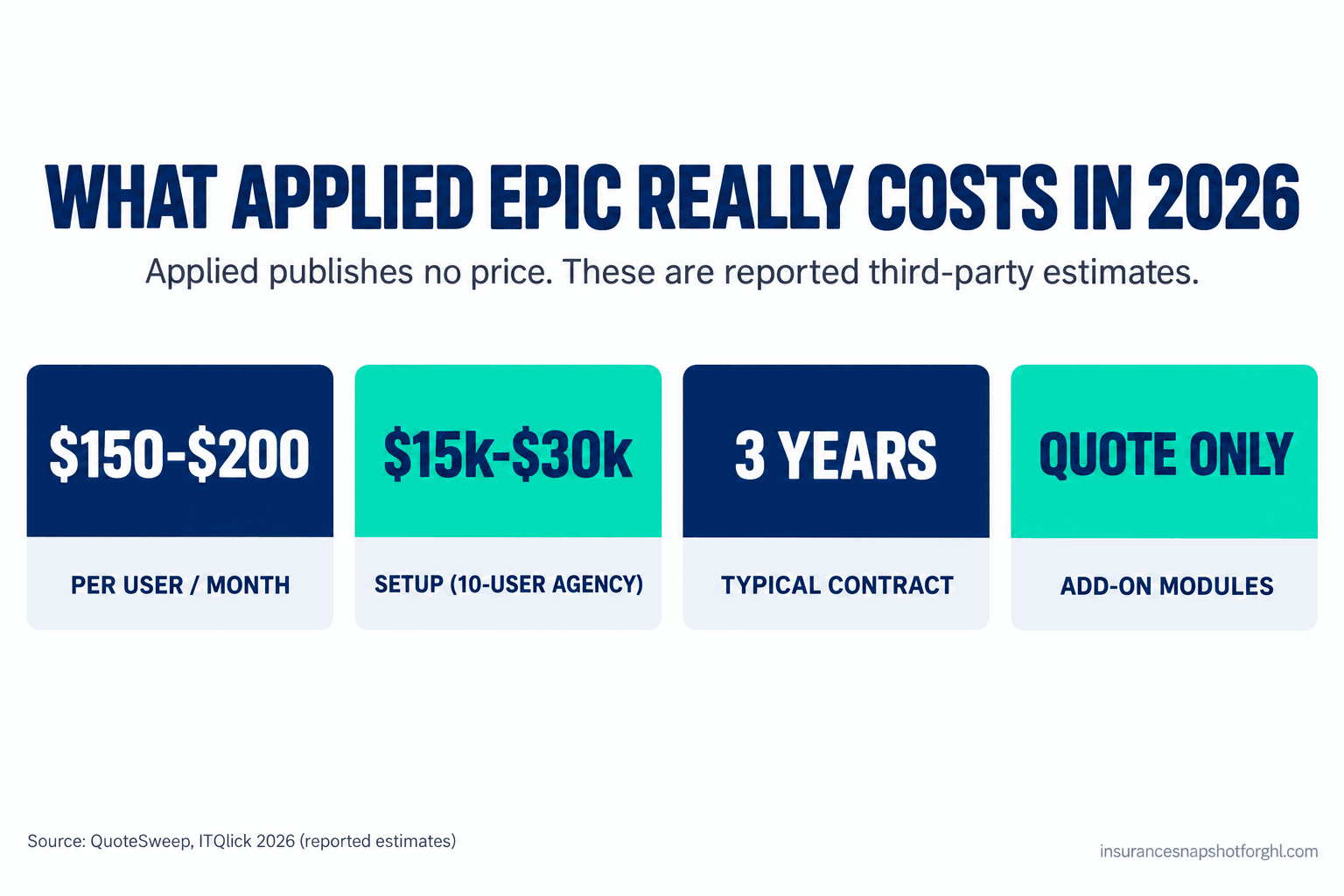
Table of contents
- Why Applied Epic won’t show you a price
- The six costs that make up the real Epic bill
- The add-on modules the demo doesn’t price
- What Epic costs a solo, a 5-producer team, and a large agency
- Steal this: the script that forces Applied to itemize
- Cheaper systems that do most of what a small shop needs
- The layer Epic was never built to run
- Objections
- FAQ
Why Applied Epic won’t show you a price
Independent agents place 61.5% of all U.S. property and casualty premium, according to the Big “I” 2025 Market Share Report (Insurance Journal). That is a large market of small and mid-size shops, and Applied knows how sticky an agency management system becomes once your whole book lives inside it. Moving off an AMS is slow, risky, and expensive, so the sales model is built to get you committed before you shop. That is why Epic routes you to a demo instead of a price page (Capterra).
There is a fair side to it. Epic is modular, priced per user and per feature, so the rep genuinely needs your headcount and add-on list before a number means anything. The problem is who carries the burden. A hidden price puts the work on you to force an itemized quote, because the first number a rep says is rarely the one you pay. The public figures are a mess too: Capterra lists a “$1,000” starting price that BitsReview flags as inconsistent and unusable for budgeting. Treat every figure here as a reported third-party estimate, then make Applied confirm your number in writing.
The six costs that make up the real Epic bill
The monthly license is one of six costs, and rarely the biggest over three years. Price all six, or you budget for a third of your real spend.
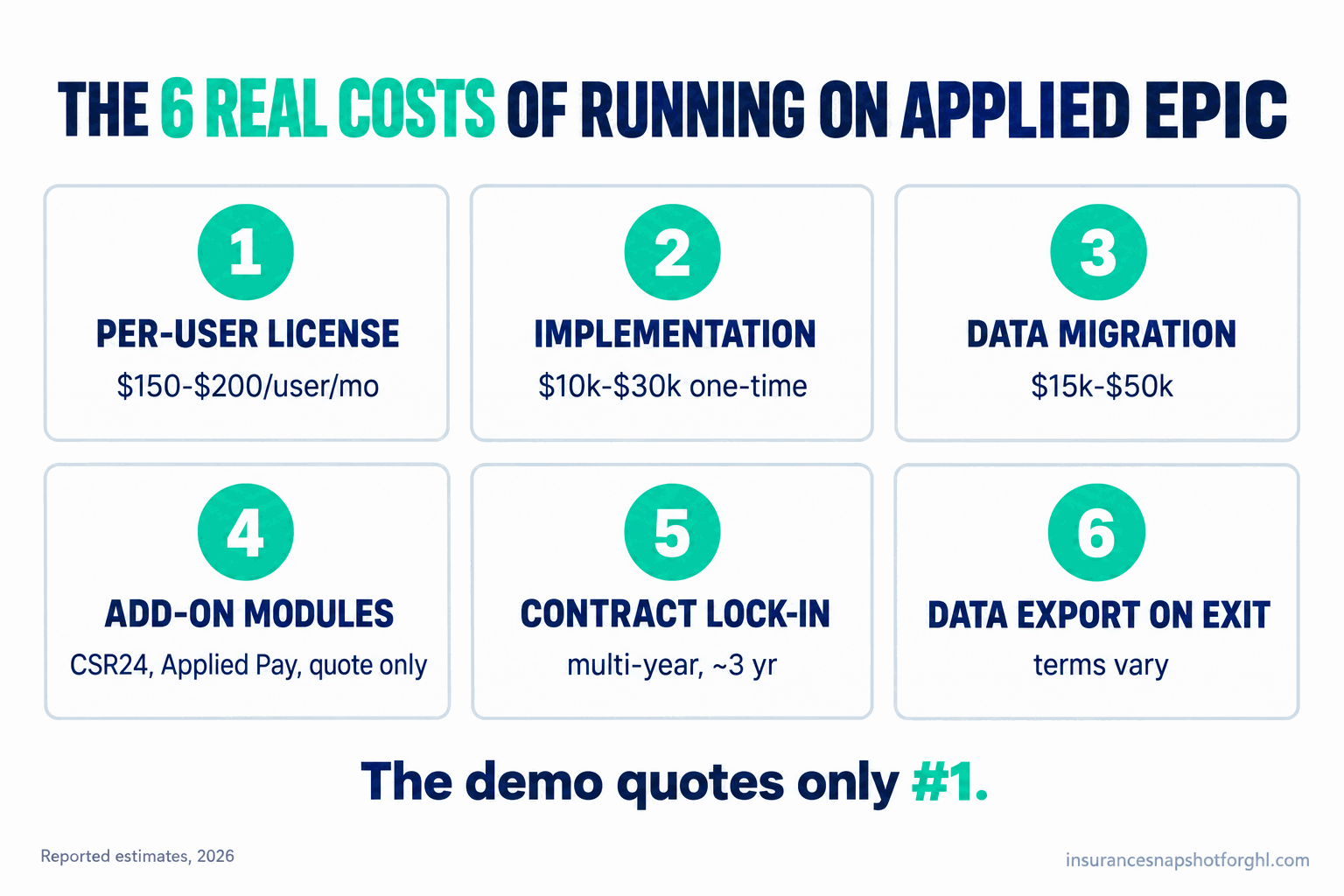
1. Per-user license. The recurring cost, billed per seat. Third-party sources land around $150 to $200 per user per month (QuoteSweep). Where it breaks: every hire adds a seat whether or not that producer has ramped. Ask whether you can deactivate a seat month to month, because many enterprise contracts bill it for the full term either way.
2. Implementation and setup. A one-time fee to configure the system, map your data, and train staff. This is the figure that shocks owners: small agencies report around $10,000 and a 10-user agency reports $15,000 to $30,000 upfront, with customization alone adding $5,000 to $20,000 (QuoteSweep, ITQlick). Where it breaks: the quote assumes clean data. Duplicate contacts and half-finished records make the mapping work balloon, and so does the invoice. Get the fee capped and the “in scope” definition in writing.
3. Data migration. Moving your book into Epic is its own project, often quoted separately from setup. An EZLynx to Epic migration is reported at $15,000 to $50,000 by size and complexity (QuoteSweep). Where it breaks: migrations slip, and a date that lands in renewal season has your team rekeying policies by hand while two systems bill at once. Pin the timeline to your slowest month.
4. Add-on modules. The demo showed payments, a client portal, and a market-access tool working together. Several are separate products with their own fees, covered below. Where it breaks: the slick all-in-one you watched becomes a quote with the good parts unbundled. Make the rep quote the exact configuration you saw, feature by feature.
5. Multi-year contract lock-in. Epic is reported to require multi-year commitments, commonly three years (QuoteSweep, BitsReview). Where it breaks: a system that disappoints you in month four still bills through year three. There is no 30-day exit the way there is on month-to-month tools. Read the auto-renewal clause, and put the cancellation date on your calendar the day you sign.
6. Data export on exit. The cost and speed of getting your own book back out in a clean format the day you leave. Where it breaks: if export is slow or billed, you are trapped by the switching cost, which is what the pricing model is built to create. Get your exit terms in writing before you sign.
Add those six across three years and the ranking of “cheap” versus “expensive” changes completely.
The add-on modules the demo doesn’t price
Epic’s base system is the system of record. A lot of what makes the demo impressive is Applied’s surrounding product stack, priced separately, and Applied publishes no price for any of it. Here is what the common modules do.
| Applied module | What it does | Published price? |
|---|---|---|
| Applied CSR24 | Self-service client portal and online certificates of insurance | None. ITQlick rates it “expensive for its category,” no free trial (ITQlick) |
| Applied Pay | Collects premium by card, ACH, Apple Pay, and pay-by-text, tied into Epic and CSR24 | None published (Applied) |
| Applied MarketFinder | Market-access and carrier appointment tool for placing hard-to-fit risks | None published |
| Applied Mobile | Mobile access to the book for producers in the field | Bundled or add-on, not disclosed |
| Applied Analytics | Reporting and book-of-business dashboards | None published |
The pattern is the same across the stack: you see it in the demo, you price it after. When you build your budget, assume every named product in the walkthrough is a separate charge until the rep confirms otherwise.
What Epic costs a solo, a 5-producer team, and a large agency
The right answer differs by size, and so does whether Epic is even the system to shop. These are reported recurring monthly estimates, before the one-time setup fee.
Solo operator or 1 to 2 users. Epic is overkill here, and the setup fee makes it the wrong first system. At $150 to $200 per user you are looking at $150 to $400 a month, plus a five-figure onboarding to run a book a simpler system could handle. A transparent AMS like NowCerts starts around $99 a month for one user (Capterra). Save the Epic budget until you have the headcount to use its depth.
Mid-size team, 5 producers. This is where per-user pricing starts to bite and the Epic decision is real. Five seats is roughly $750 to $1,000 a month recurring, before the $15,000 to $30,000 setup (QuoteSweep). HawkSoft at this size runs near $720 a month with no long-term contract (SelectHub). The real question is whether your workflows need Epic’s depth enough to justify the setup and the lock-in.
Large agency, 15-plus users. Now Epic’s depth earns its keep. Fifteen seats is roughly $2,250 to $3,000 a month recurring, plus a large implementation that can run well past $50,000 (ITQlick). At this scale the decision is workflow depth, carrier downloads, and integrations, not the sticker. Still force the itemized quote, and negotiate the bundling discount agencies report at 10% to 20% for committing to several Applied products (QuoteSweep).
Reported recurring monthly Epic cost by agency size, using the midpoint of $150–$200 per user and excluding the one-time setup fee. Source: QuoteSweep, ITQlick.
Estimated three-year total cost of ownership for a 5-producer agency, recurring fees plus one-time setup, using reported figures. Sources: QuoteSweep, SelectHub, Capterra.
Steal this: the script that forces Applied to itemize
Applied controls the demo. You control the questions. Read these off on your next call and write down every answer. A rep who won’t answer plainly is telling you something.
- “What is the all-in monthly cost for my exact number of users, at the configuration you just showed me?”
- “Which features in this demo are add-on modules, and what does each one cost per month? Specifically CSR24, Applied Pay, MarketFinder, and Analytics.”
- “What is the one-time implementation fee, is it capped, and is data migration quoted separately?”
- “What is the contract term, is there auto-renewal, and what is the cancellation notice window?”
- “If I leave, what does it cost and how long does it take to export my full book cleanly?”
Then send this the same day, so the numbers are in writing and not just a memory of a sales call:
Subject: Written quote request for [Agency Name]
Hi [Rep], thanks for the walkthrough. To compare fairly, please send one written quote for [X] users at the exact configuration we reviewed, itemized as: (1) per-user license, (2) each add-on module and its monthly price, (3) one-time implementation, whether it is capped, and what is in scope, (4) data migration cost and timeline, (5) contract term, auto-renewal, and cancellation window, and (6) any data-export fee on exit. I am comparing a few systems and can move quickly once I have all-in numbers. Thanks.
That gets you a comparable number in writing, and quietly tells the rep you are shopping, which is usually when the real pricing and the bundling discount appear.
Cheaper systems that do most of what a small shop needs
Epic is deep, and for a large agency with complex commercial workflows that depth is worth the price. For a small or mid-size shop, a lot of it goes unused while you pay for it and for the setup. Two transparent systems are worth a serious look. NowCerts (Momentum AMP) publishes tiers, reported at $99/mo for one user and about $349/mo for up to five, with commission tracking built in and no five-figure onboarding (Capterra). HawkSoft is reported at around $250/mo base plus roughly $94 per user, and what owners cite is the contract: a 30-day term, no early-termination fee, and no charge to extract your data if you leave (SelectHub). That posture says the vendor expects to keep you with the product, not the paperwork.
For the full side-by-side across all six platforms, including AMS360, EZLynx, and AgencyZoom, see our what agency management software actually costs in 2026 teardown, our list of the best Applied Epic alternatives for small agencies, and the AMS360 vs EZLynx for a 5-producer agency breakdown.
The layer Epic was never built to run
Here is what the pricing conversation misses. Even a fully loaded Epic does not market your agency. It stores policies, tracks commissions, and downloads from carriers. It does not text a missed caller back in 60 seconds, run a renewal cadence, ask a happy client for a Google review, or fire a cross-sell sequence after an auto bind. That work is what moves your 84% average retention, the figure the 2026 Independent Agency Growth Study reports for a typical agency (Digital Insurance). With 572,600 insurance sales agents chasing the same households (U.S. Bureau of Labor Statistics), the agency that follows up automatically keeps the renewal.
The common mistake is expecting the AMS to be the marketing engine too, then feeling let down that a $50,000 three-year system does not grow the book on its own. The cleaner model is a dedicated automation layer on top of whatever AMS you run, at a fraction of an enterprise setup fee. That is the gap behind our customer retention playbook and quote funnel guide.
Objections
“I already run Applied Epic. Should I switch to save money?” Usually not for its own sake. Migrating a full book is expensive and disruptive, and the migration cost often wipes out a year or two of monthly savings. If Epic does what you need, keep it. The bigger opportunity is adding the marketing automation Epic was never built to do, which costs far less than a switch.
“Isn’t Epic worth it because it is the industry standard?” For a large agency with complex commercial lines and many carrier downloads, often yes. The trap is a two or three person shop paying enterprise pricing and a five-figure setup for depth it will never use. “Industry standard” describes the biggest agencies, not yours by default.
“These reported prices could be wrong, so why trust them?” You should not fully trust any of them, and this post flags that on every line. They are reported figures precisely because Applied hides the real ones. Use them to build your budget and questions, then make Applied confirm your number in writing with the script above.
“Do I even need an AMS as powerful as Epic?” Many small agencies do not. If your pain is quoting speed, a comparative rater matters more than a deep AMS. If your pain is losing renewals and missing calls, that is a marketing problem no AMS solves. Name the actual pain before you shop the most expensive system in the category.
The bottom line
Applied Epic is one of the biggest recurring bills an agency will ever sign, and the one most designed to keep its price a secret until you are leaning in. Expect roughly $150 to $200 per user per month, a one-time setup of $10,000 to $30,000, a separate migration, add-on modules unbundled after the demo, and a multi-year contract. Run the three-year total, force an itemized written quote, and get the exit terms in writing before you commit your book. Then remember what even a fully loaded Epic does not do: it keeps your records, but it does not win the renewal, the review, or the missed call. That is a separate, far cheaper layer, and it is where the growth comes from.
FAQ
How much does Applied Epic cost per user in 2026?
Applied publishes no price, so every figure is a reported third-party estimate. The most consistent sources put Epic around $150 to $200 per user per month, so a 10-user agency is roughly $1,500 to $2,000 a month recurring, before setup and add-on modules. Force an itemized written quote for your exact user count and configuration.
What is the setup or implementation fee for Applied Epic?
Agencies report setup, training, and data migration starting around $10,000 for a small shop and $15,000 to $30,000 for a 10-user agency, with complex migrations running past $50,000. Customization alone can add $5,000 to $20,000. Get the fee capped in writing, because dirty data inflates it fast.
What are the hidden add-on costs in Applied Epic?
A lot of what makes the demo impressive is Applied's surrounding product stack, priced separately: CSR24 (client portal), Applied Pay (premium payments), MarketFinder (market access), Applied Mobile, and Applied Analytics. Applied publishes no price for any of them, so assume every named product in the walkthrough is a separate line item until the rep confirms otherwise.
Is Applied Epic worth it for a small agency?
For a solo or two-person shop, usually not. The depth goes largely unused while you pay enterprise per-user pricing and a five-figure setup. Transparent systems like NowCerts (about $99/mo for one user) or HawkSoft (about $250/mo base plus per-user, no long-term contract) cover most small-agency needs at a fraction of the three-year cost.
Do I still need a marketing tool if I run Applied Epic?
For most growing agencies, yes. Epic is a system of record: it stores policies, tracks commissions, and downloads from carriers. It does not text missed callers back, run renewal cadences, request reviews, or fire cross-sell sequences. That work lives in a dedicated automation layer on top of your AMS, and it is what drives retention and cross-sell revenue.
About the author
Priya Raman is an insurance agency growth strategist at Insurance Snapshot for GHL. She came up running marketing for a multi-line agency, so she thinks in premium written, retention by line, and the three-year total cost of a system, not the sticker on the demo. She writes about the economics of agency software and the automations that pay for themselves. Editorial byline only. Priya is not a licensed agent and does not quote, bind, or sell insurance.
Pricing a new system? See how the Snapshot fits alongside any AMS, book a 30-minute demo, or talk to a real person.