
It is a Thursday afternoon and an email lands from a regional buyer rolling up agencies in your state. “We would love to talk about acquiring your book. What are your expectations on value?” You have run this agency for fifteen years, it is the biggest asset you own, and you genuinely do not know what to type back. Two times revenue? Three? Is that even how it works anymore? You close the email and tell yourself you will deal with it later, and later you are still guessing.
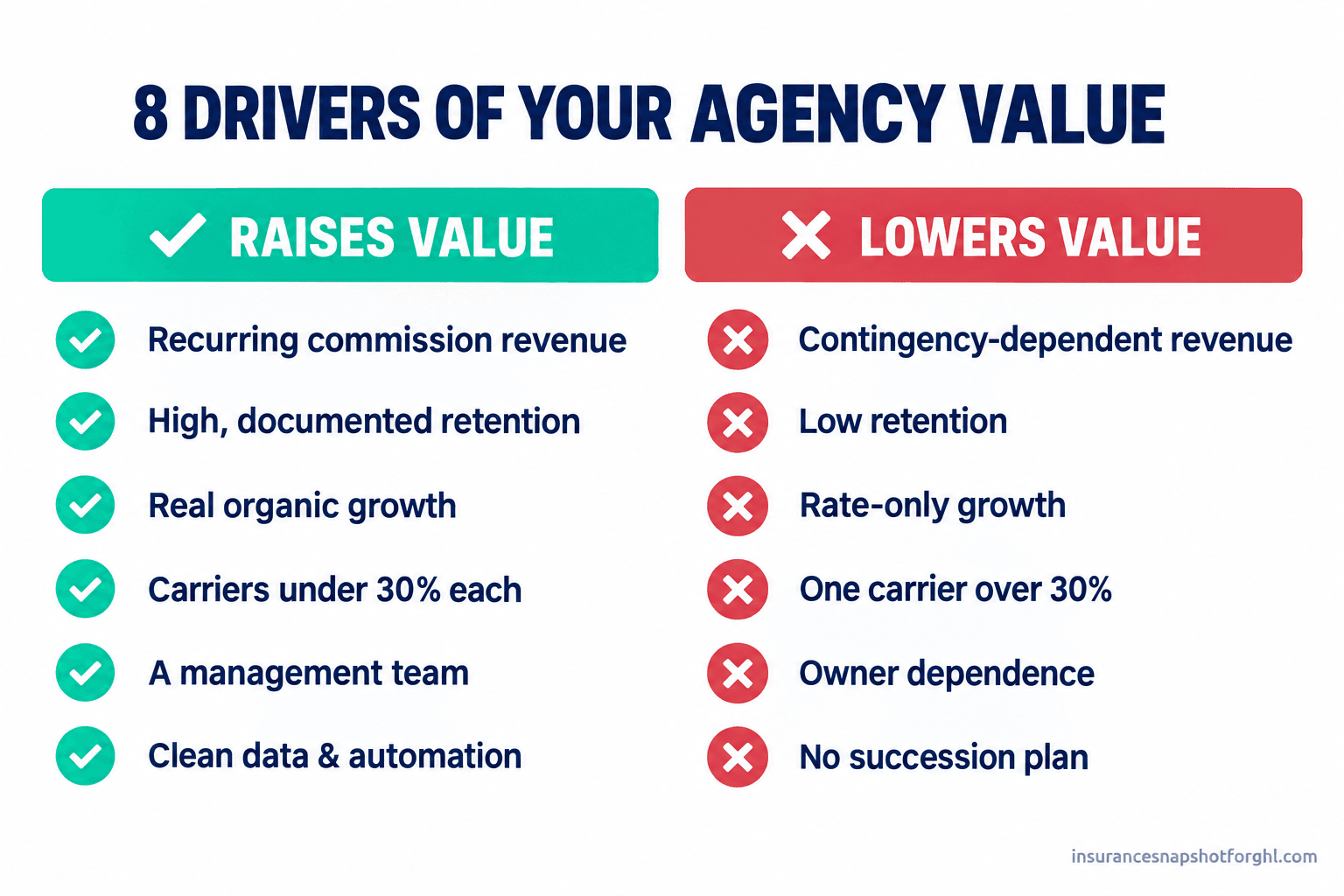
Here is the answer up front. A small independent agency is valued on a multiple of its normalized EBITDA, not a flat multiple of revenue, and the multiple you get is decided less by the headline numbers online and more by eight things you control: revenue quality, profit margin, retention, growth, carrier and client concentration, how much the business leans on you, and whether anyone could run it without you. This guide walks all eight, shows the math for three agency sizes, and hands you a one-page worksheet so you can put a defensible number on that email.
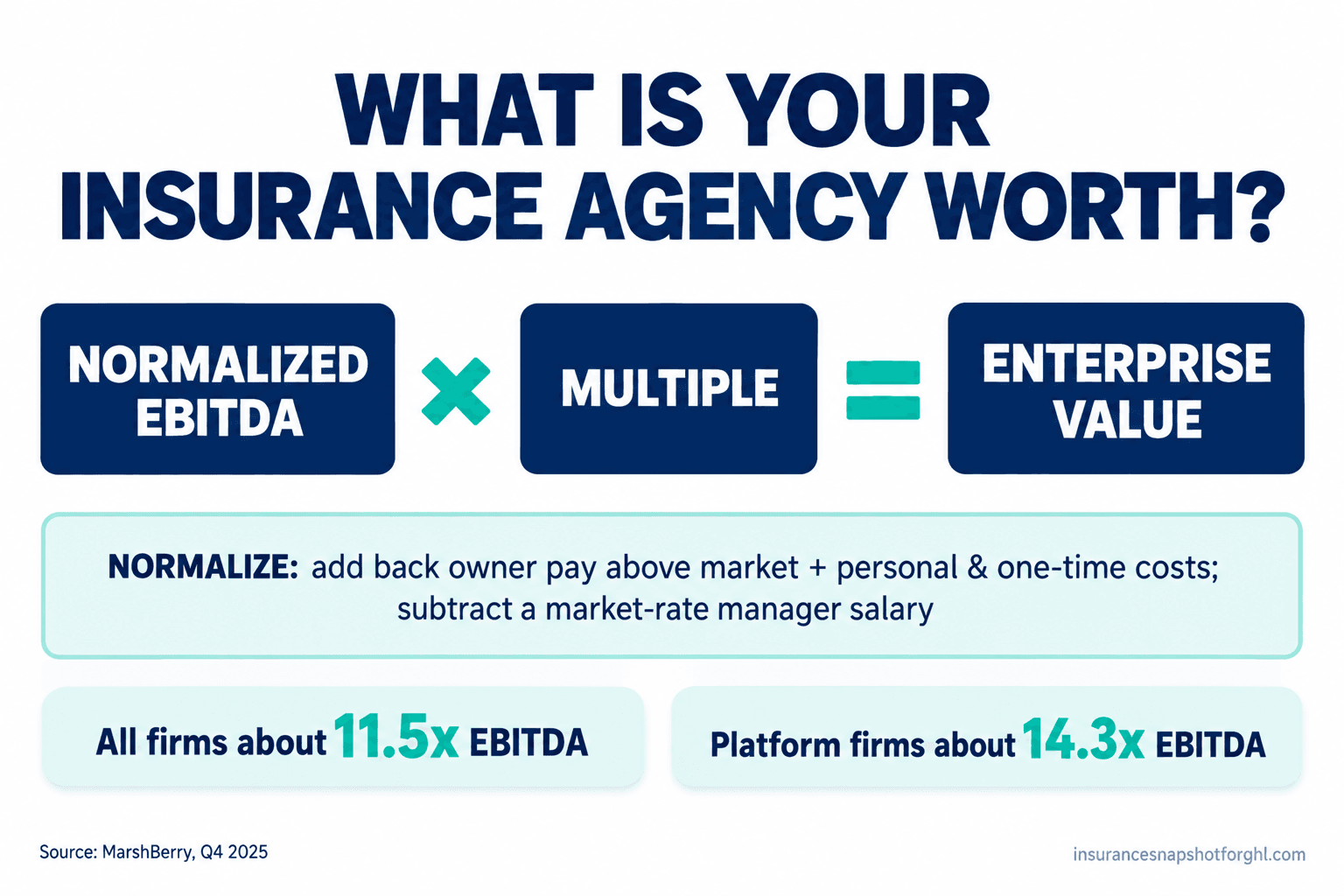
Table of contents
- Why know your agency’s worth now
- How small agencies are valued in 2026
- Driver 1: Revenue quality
- Driver 2: Real EBITDA and add-backs
- Driver 3: Retention
- Driver 4: Growth that counts
- Driver 5 and 6: Concentration
- Driver 7: Owner dependence
- Driver 8: Systems and succession
- Steal this: a valuation worksheet
- Three worked examples
- What a real valuation requires
- Objections
- Back to the offer on your desk
- FAQ
What a valuation actually answers, and why to know yours now
A valuation is the price tag on the largest thing you own, and you need it long before any sale: to answer that buyer’s email, to price a producer’s buy-in, to back a loan, and to build a perpetuation plan. An owner carrying an “everyone says two times revenue” figure usually overvalues a book that leans on one carrier and on them personally, then is insulted when a serious buyer comes in far lower.
The market has cooled, too. Agency M&A fell to about 695 deals in 2025, the third straight annual decline (OPTIS Partners via Insurance Journal). Fewer deals means pickier buyers who pay up for clean books and discount messy ones. Quality is worth more in a slow market, not less.
U.S. agency and brokerage M&A deal count by year. Source: OPTIS Partners, via Insurance Journal (2025) and Insurance Journal (2026); OPTIS later revised 2024 to about 787.
How small agencies are really valued in 2026
Forget the revenue rule of thumb first, because the people who buy agencies have retired it. The method they use instead has three steps.
Step one, normalize your profit. Adjust pre-tax profit to what the business would earn under a normal owner: add back owner pay above a market salary and personal or one-time costs, then subtract a market-rate salary for the job you do. What is left is normalized EBITDA (earnings before interest, taxes, depreciation, and amortization). Very small agencies are valued on Seller’s Discretionary Earnings, which adds the full owner salary back.
Step two, pick a multiple. This is where the eight drivers live, and the published averages are the ceiling, not your number. MarshBerry puts the all-firm average upfront purchase price near 11.5 times EBITDA at the end of 2025 and platform firms at 14.3 times, rising to 15.5 to 18.4 times with maximum earnouts (MarshBerry, Q4 2025). Those are large firms; a small agency starts below that platform figure.
Step three, multiply, then sanity-check. Normalized EBITDA times your multiple is your enterprise value, though a chunk is usually an earnout paid over several years if the book holds, so the cash at closing is lower than the headline.
Average purchase price as a multiple of EBITDA, upfront base versus total value with maximum earnout, end of Q4 2025. Platform firms are large, acquirer-ready agencies; small agencies transact below these. Source: MarshBerry State of Valuations 2025.
Driver 1: The quality of your revenue
Not all revenue earns the same multiple. A dollar of recurring commission on a renewing policy is your most valuable, because a buyer can count on it next year. Contingent income is worth less because it swings with loss ratios, and one-off fee income is worth less still. A book that is mostly recurring commission earns a higher multiple than one the same size leaning on a fat but unpredictable bonus.
Failure mode: counting a big contingency year as base revenue, then pricing the agency on a peak that does not repeat. Buyers discount contingent income, so separate it in your reporting first. For how that recurring stream is built, our insurance producer commission structure guide covers the carrier and contingent pieces.
Driver 2: Your real EBITDA, after the add-backs
Two agencies report the same revenue and the same “profit,” and one is worth nearly double, because profit on a tax return is built to be small and a buyer rebuilds it. The 2025 Best Practices Study put the average EBITDA margin at 26.1% (Big “I” and Reagan Consulting). If your normalized margin sits at 12%, that gap is the first thing a buyer prices in, and the fastest thing you can fix before a sale. The worksheet below lists the add-backs that raise EBITDA and the one honest subtraction: a market-rate salary for the role you fill.
Failure mode: padding add-backs with things a buyer will not accept, such as ongoing costs dressed up as one-time. Add back only what you can document; one indefensible add-back makes a buyer re-examine every number.
Driver 3: Retention, the renewal book that is most of the value
Strip everything away and a buyer is paying for one thing: the odds your book renews next year, and the year after. That is why retention moves your multiple most. Account retention is a core driver of organic growth and the one most inside your control. An agency keeping 95% of its book holds most of its value through a transition; one at 82% is a bucket with a hole in it, and a buyer pays accordingly.
Failure mode: treating retention as a feeling instead of a tracked number per carrier and line. A buyer pulls it from your management system in due diligence, so know it first. Start with calculating your agency’s retention rate, then the levers in insurance customer retention.
Driver 4: Growth a buyer actually respects
Growth raises your multiple, but only the right kind. MarshBerry flags that “growth that results primarily from ‘hard market’ rate increases” is a red flag, while “demonstrable organic growth” enhances value (MarshBerry). A book that grew 10% on a 10% rate increase has not gotten bigger. The 2025 Best Practices Study recorded a record 10.7% average organic growth (Big “I” and Reagan Consulting), but the 2026 update showed it slowing to roughly 6.2% to 10.2% (2026 update), so an agency growing independent of rate stands out.
Failure mode: presenting rate-driven revenue as growth and getting caught. Separate rate from new business so you can show the part that is real. If growth stalled because you cannot get into enough markets, carrier appointments for a small independent agency covers widening access.
Driver 5 and 6: Carrier and client concentration
Concentration is the quiet value-killer, and it comes in two forms.
Carrier concentration. If one carrier holds a big share of your book, a canceled program, a state pullback, or a contract change can wipe out income overnight. MarshBerry names having “multiple carriers (e.g., less than 30% of business with any single carrier)” as a factor that enhances value (MarshBerry). Keep your largest carrier under roughly 30% of premium.
Client concentration. The same applies to clients: if your top few accounts make up a large share of revenue, losing one hurts the buyer badly, and “revenue concentration is a red flag.” A book of many small-to-mid relationships is worth more per dollar than one propped up by three big accounts.
Failure mode: not knowing your concentration until a buyer calculates it for you. Run two reports before any conversation: premium by carrier as a percent of the book, and revenue from your top ten clients as a percent of total. If either is lopsided, start diversifying now; it takes years.
Driver 7: How much the agency depends on you
If every relationship runs through you, a buyer is not buying an agency, they are buying a job that quits the day you leave. MarshBerry says it directly: “if most client relationships hinge on the owner or a few key advisors, the agency faces ‘key person’ risk” (MarshBerry). The fix is to spread relationships across your team, so clients know their account manager and service runs to a documented standard rather than from your memory. The buyer’s test: if you vanished for three months, what happens to the book? The closer the answer is to “nothing much,” the higher your multiple.
Failure mode: being the hero of your own agency and calling it loyalty. Owner-dependence reads as fragility to anyone buying the agency, so start handing off named relationships a year or two before you sell.
Driver 8: Systems, data, and a succession plan
The last driver is the one owners underrate most: the condition of the machine. A buyer pays more for an agency with a clean management system, reliable data, documented workflows, and automation that runs retention and service on its own, and less for one held together by sticky notes and one veteran CSR’s memory. MarshBerry lists outdated platforms, aging producers, and no succession plan among the things that lower value. It is also the most fixable driver, because it is operational, not relational.
Failure mode: carrying the book in one person’s head. If the knowledge is not in the system, it does not transfer, so get retention, renewals, and service into documented, automated workflows well ahead of any sale. Our guide to automating renewal reminders without an AMS upgrade is a practical starting point.
Steal this: a one-page valuation worksheet
Fill this in tonight. It will not replace a professional appraisal, but it turns “no idea” into a defensible range.
Have ready, too, the list a serious buyer asks for in the first week of due diligence, because having it signals a clean operation and lifts your multiple before a single negotiation.
Solo, five-producer, and larger: three worked examples
The method is the same at every size, but the number changes. These are illustrative round figures, not quotes for any real agency.
| Agency | Revenue | Normalized earnings | What moves the number |
|---|---|---|---|
| Solo owner-producer | ~$300,000 | ~$120,000 SDE | Owner is the agency; key-person risk is the whole story |
| Five-producer P&C shop | ~$1.2M | ~$310,000 EBITDA | Carriers and a team put this in the buyer sweet spot |
| Larger agency | ~$3M+ | ~$780,000 EBITDA | A management layer and processes approach platform multiples |
The solo owner-producer is valued on Seller’s Discretionary Earnings, because you are both owner and staff; the realistic buyer is a nearby agency doing a tuck-in at the low end of the range, and the highest-value move is getting relationships off yourself. The five-producer P&C shop is the size most acquirers want, and at a 26% margin that is roughly $310,000 of normalized EBITDA; your multiple is decided almost entirely by the eight drivers, so a tidy shop commands far more than a sloppy one the same size. The larger agency, with a management team and documented workflows, approaches platform multiples, because it runs without the owner.
What a real valuation requires, and the legal line
Everything above gets you a credible range. A number you take to a bank, a buyer, or a partner buy-in needs more: a formal valuation from a qualified M&A advisor or certified appraiser, and for anything with tax or legal weight (a buyout, an estate plan, a dispute) you want that, not a worksheet. This guide is education, not an appraisal or legal and tax advice.
Two things also shape the real number. The expirations are the asset, so nail down who owns them: if a producer owns their book under your agreements, that revenue may walk out with them, so sort out book ownership and non-competes long before a sale. And a sale does not suspend your obligations as a licensed agency: policy decisions stay with licensed staff under their own appointments and E&O, and a clean compliance record is itself a value driver.
Objections
“Everyone in my market says two times revenue, why complicate it?” Because the people writing checks stopped using it. A revenue rule ignores whether you keep 26 cents or 8 cents of each dollar, so two agencies at the same revenue with different margins and retention are not worth the same. MarshBerry has flatly retired it.
“I am not selling, so why do I care?” Because value is a tool even if you never sell: it sets the price when a producer buys in, backs a loan, and anchors your perpetuation plan. And the drivers that raise it, higher retention and less dependence on you, make the agency better to run today, not only better to sell later.
“The 11.5x and 14.3x multiples are not for my little shop.” Correct, and that is the point. A small agency transacts below those platform firms, but the eight drivers that separate a top multiple from a bottom one are identical at every size and are things you control.
Back to the offer on your desk
Open that email again. Instead of a shrug, you can reply with a process: here is my normalized EBITDA, my recurring revenue mix, my retention and carrier spread, and the range that supports. You might still negotiate hard, but from a number you built and can defend.
The work is not glamorous: know your margin after honest add-backs, track retention per carrier, get your largest carrier under 30%, and spread client relationships off yourself. Do that and you are ready for the next buyer’s email, and running a more valuable, more durable agency in the meantime, which pays off whether you sell or not.
FAQ
How much is my insurance agency worth?
A small independent agency is valued on a multiple of normalized EBITDA, not a flat multiple of revenue. Published averages are about 11.5x EBITDA for all firms and 14.3x for large platform firms at the end of 2025 (MarshBerry), but small agencies transact below those figures. Your actual multiple depends on revenue quality, margin, retention, growth, concentration, owner dependence, and your systems.
Is the old two-times-revenue rule still used to value agencies?
Not by serious buyers. MarshBerry states a standard multiple of revenues is no longer a legitimate valuation guideline. Two agencies with identical revenue can be worth very different amounts because margin, retention, and concentration differ, so valuations are built on normalized EBITDA with a multiple adjusted for risk and quality.
What is normalized EBITDA for an insurance agency?
It is pre-tax profit adjusted to what the business would earn under a typical owner: add back owner pay above a market salary, personal expenses, and one-time costs, then subtract a market-rate salary for the role you fill. Very small agencies are often valued on Seller's Discretionary Earnings, which adds the full owner salary back.
What raises an insurance agency's valuation the most?
High, documented retention and a high share of recurring commission revenue, because together they prove the book is durable. After that: a strong EBITDA margin, real organic growth rather than rate-driven growth, diversified carriers (any single one under about 30%), low client concentration, and an agency that runs without the owner.
Should I get a professional valuation or is a worksheet enough?
A worksheet gives you a defensible starting range, enough to respond to an inquiry. For anything with real financial, tax, or legal weight (a sale, a partner buy-in, an estate plan, a dispute) you want a formal valuation from a qualified M&A advisor or certified appraiser. This guide is education, not an appraisal or legal and tax advice.