
It is a Tuesday and a producer you have courted for a month finally asks the only question that matters to them: “So how do I get paid here?” You give a number off the top of your head, 50 percent sounds fair. You cannot tell if you just overpaid for someone who will coast on renewals, or lowballed someone about to bring you a book. You are guessing with real money, out loud.
Here is the answer up front. Your agency runs on two commission numbers, not one. The first is what the carrier pays you, usually 10 to 20 percent of premium on property and casualty, front-loaded and far higher on life, and capped by the government on Medicare. The second is the share you hand a producer, typically 30 to 50 percent on new business and 10 to 12 points lower on renewals (MarshBerry). Get the first wrong and you misprice the whole book; get the second wrong and you cannot keep producers or cannot afford them.
This is general business education, not legal, tax, or compliance advice. Confirm your own numbers against your carrier agreements, your accountant, and your state insurance department before you sign anything.
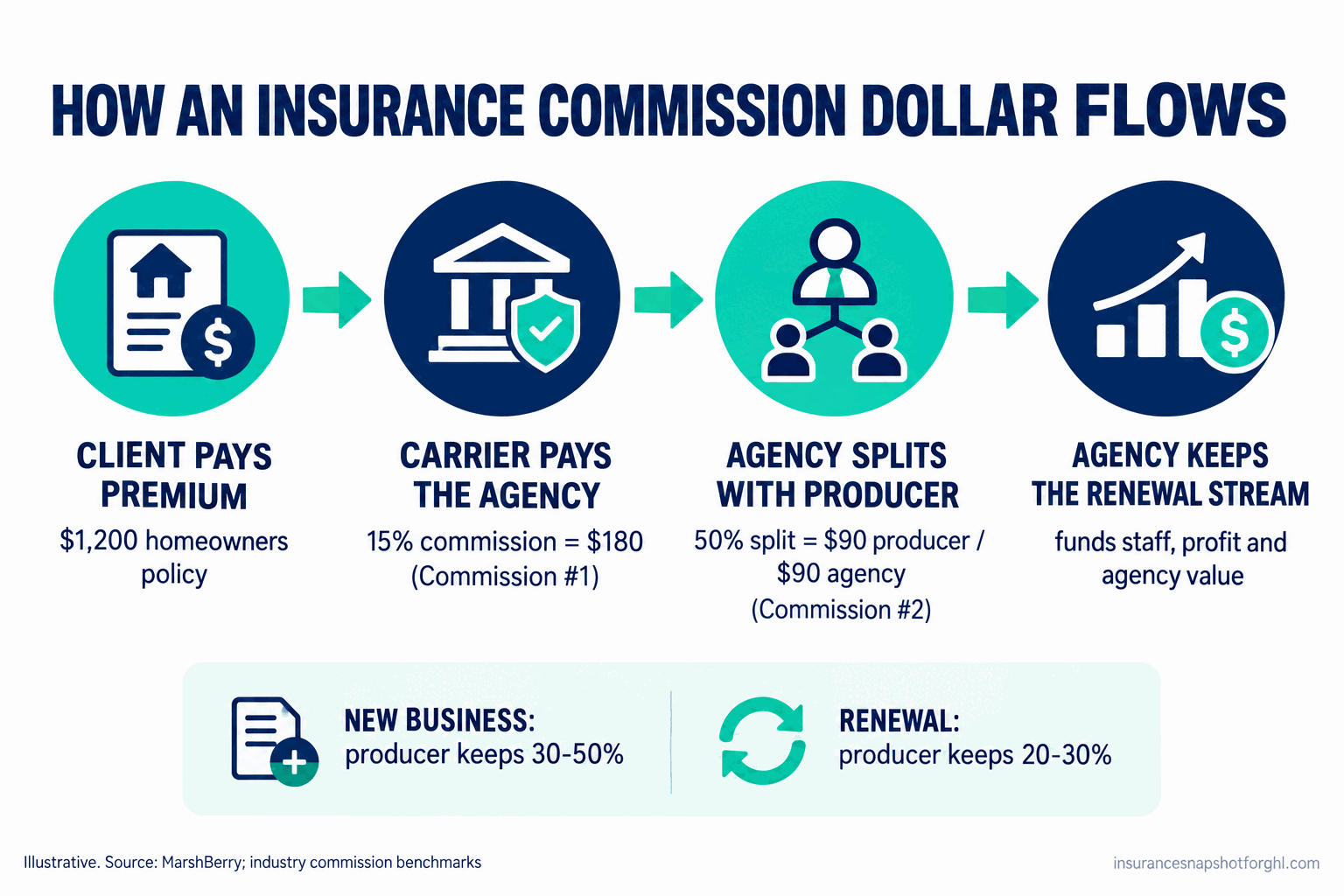
Table of contents
- The two commission numbers that run your agency
- What carriers pay on personal lines
- What carriers pay on commercial lines
- Why life commissions look nothing like P&C
- Medicare and health: the rates CMS sets for you
- Contingent commission: the second paycheck owners forget
- The producer split: new versus renewal
- Steal this: a producer comp plan you can fill in
- Solo, five-producer, and larger: who gets paid how
- The compliance layer on commissions
- Objections
- Where automation protects the renewal stream
- Back to that Tuesday question
- FAQ
The two commission numbers that run your agency
When a client pays a $1,200 homeowners premium and your agency has a 15 percent agreement, the carrier sends you $180. That is commission number one, and you earn it whether you have producers or not.
Commission number two is what you pay out of that $180 to whoever sold and services the policy. At a 50 percent split, the producer gets $90 and the agency keeps $90 (Smart Choice). That $90 covers staff and overhead and becomes profit.
Owners fixate on number two, the awkward one, but number one decides whether the agency is viable. Independent agents placed 61.5 percent of U.S. property and casualty premium in 2024 (Big “I” via Insurance Journal), so there is plenty to go around. The shops that struggle are rarely the ones with a bad split, but the ones who never did the arithmetic on both numbers at once.
What carriers pay on personal lines
Personal lines commissions cluster in a tight band. Here are the industry-typical ranges, understanding that your actual carrier contract is the only number that counts.
| Personal line | New business | Renewal |
|---|---|---|
| Personal auto | 10% to 15% | 10% to 12% |
| Homeowners | 15% to 20% | 12% to 15% |
| Umbrella | 10% to 15% | 8% to 12% |
Source: industry commission benchmarks (Sonant). Treat these as bands, not quotes. Because they are percentages of premium, a hard market lifts your commission dollars even when the rate stays flat.
Failure mode: building a comp plan on the industry average instead of your blended rate. If one carrier pays 12 percent on auto and another 10, and your producer writes mostly the 10 percent carrier, your split costs more than you modeled. Know the blended rate per producer.
What carriers pay on commercial lines
Commercial is where the money and the variance both climb, and it is the channel’s home turf: independent agencies wrote 87.2 percent of commercial lines premium in 2024 (Big “I”).
| Commercial line | New business | Renewal |
|---|---|---|
| Business owner’s policy (BOP) | 15% to 20% | 12% to 15% |
| General liability | 10% to 15% | 8% to 12% |
| Commercial property / package | 15% to 20% | 10% to 15% |
| Commercial auto | 10% to 15% | 8% to 12% |
| Workers’ compensation | 5% to 10% | 5% to 8% |
Sources: industry benchmarks (Sonant, Agentero).
Notice workers’ comp: it pays the least because premiums are large and carriers keep more margin, so a producer who writes a lot of comp can look productive on a premium report while earning the agency less than one writing BOPs.
Failure mode: a producer loads the book with low-commission comp to hit a premium target, your income lags the premium growth, and a “growing” agency feels broke. The fix: pay on commission dollars, not premium written.
Why life commissions look nothing like P&C
If you cross-sell life, throw out the P&C model. Life is front-loaded to an extreme that surprises P&C people.
| Life product | First-year commission | Renewal (years 2+) |
|---|---|---|
| Term life | 50% to 110% of first-year premium | 2% to 5% |
| Whole life | 40% to 90% of first-year premium | 3% to 6% |
| Universal life | 50% to 100% of first-year premium | 3% to 8% |
Source: life commission structures (Insurance Pro Agencies).
A term policy can pay most or all of the first year’s premium as commission, then almost nothing, so one life case can out-earn a month of P&C work on a single application.
Failure mode: paying a P&C renewal-style split on a life case. Give a producer 50 percent of a term policy that pays 100 percent first-year commission and you handed out half a year’s premium on one sale. Many agencies give a larger writing-producer share on life because the renewal stream barely exists, so decide this before anyone writes a life app.
Medicare and health: the rates CMS sets for you
Medicare is the one line where you do not negotiate. The Centers for Medicare and Medicaid Services (CMS) sets a national maximum every year, and carriers pay up to it. For 2026:
| Medicare / Part D (2026) | New enrollment | Renewal |
|---|---|---|
| Medicare Advantage (national) | $694 | $347 |
| Medicare Advantage (CA, NJ) | $864 | $432 |
| Medicare Advantage (CT, PA, DC) | $781 | $391 |
| Standalone Part D (PDP, national) | $114 | $57 |
Source: CMS 2026 agent/broker compensation (ActionBenefits). The 2025 national MA figures were $626 and $313, so 2026 is up about 11 percent. CMS also sets referral fees: $100 for Medicare Advantage, $25 for a PDP.
These are flat dollars per member per year, and the renewal is exactly half the initial, paid as long as the member stays enrolled. So 300 members renewing at $347 is over $104,000 a year before a single new sale, which is why retention is everything here.
Failure mode: overpaying a producer because the initial $694 looks big, then forgetting the renewal is only $347 and the renewal is what lasts. Split Medicare with the long tail in mind, and never structure anything that looks like paying over the CMS maximum. That is a federal compliance line, covered below.
Contingent commission: the second paycheck owners forget
Base commission is not the whole story. Most carriers also pay contingent or profit-sharing commission, an annual bonus tied to the loss ratio, volume, and growth of the book you place with them, paid as a lump sum after year-end (Agentero). Because it is earned by the agency’s whole book, not any one producer, most agencies keep it at the agency level. Decide the rule in advance.
Midpoint of typical agency new-business commission by line (percent of premium); renewals run a few points lower. Source: industry benchmarks (Sonant, Agentero).
The producer split: new versus renewal
The producer split is the share of your commission that goes to whoever wrote and services the account.
- New business: producers commonly keep 30 to 50 percent. One who brings their own book or owns their expirations can command 60 to 70 percent (Smart Choice).
- Renewal: lower, often 20 to 30 percent, or roughly 10 to 12 points below the new-business split (MarshBerry).
The gap is the whole point. You pay more on new because it is the hard, skilled work you want to reward, and less on renewal because servicing one is lighter and the renewal stream funds the agency. A flat 50 percent on both tells producers that farming old accounts pays as well as hunting new ones, and you end up with an agency full of farmers and no hunters.
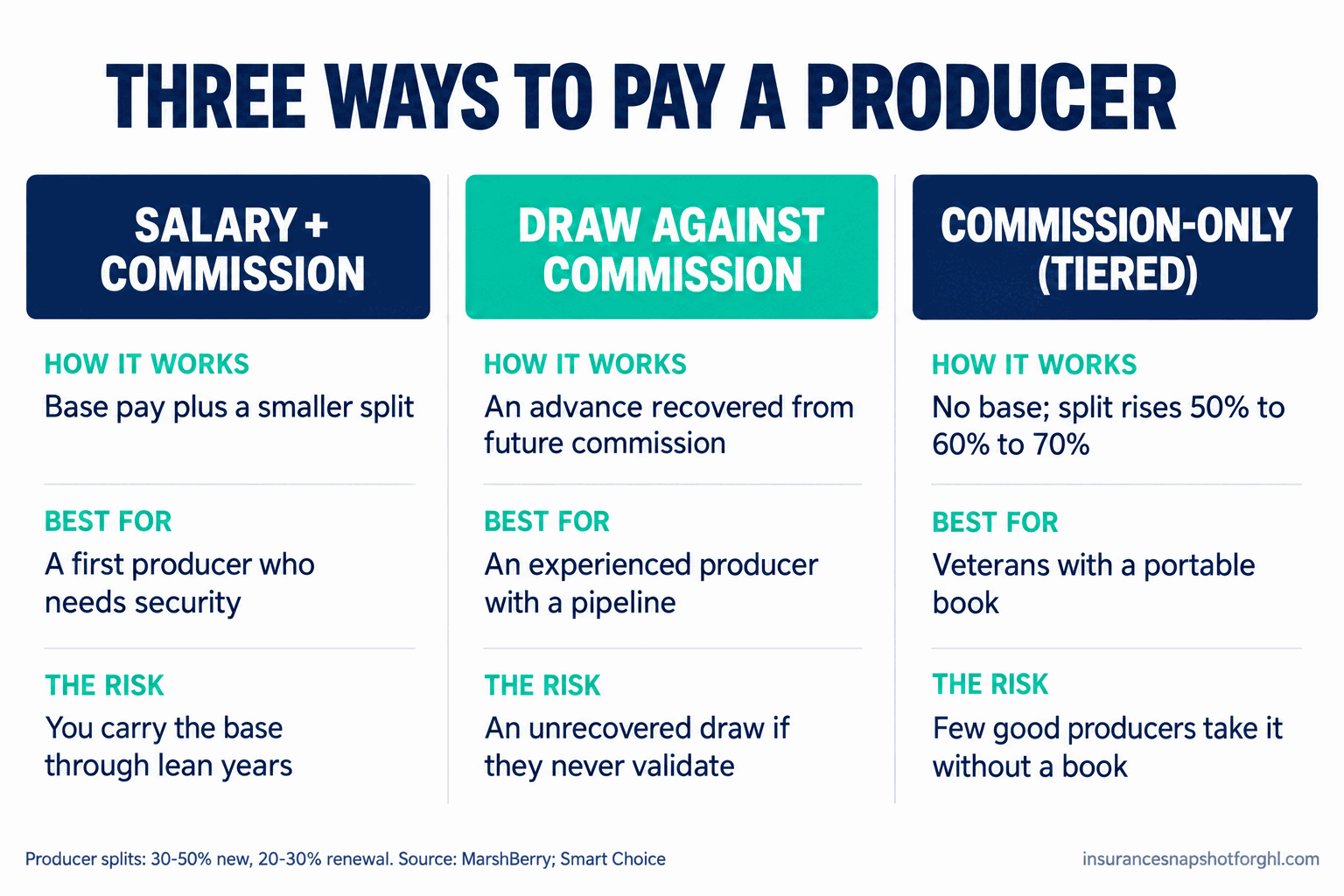
| Model | How it works | Best for | The risk you carry |
|---|---|---|---|
| Salary + commission | Base pay plus a smaller split | A first producer who needs security | You carry the base through lean years |
| Draw against commission | An advance recovered from future commission | An experienced producer with a pipeline | An unrecovered draw if they never validate |
| Commission-only (tiered) | No base; split rises with production (50% to 60% to 70%) | Veterans with a portable book | Almost nobody good takes it without a book |
Many run a hybrid: base plus commission for a new producer, shifting to tiered commission at validation. Owners often keep a 5 to 10 percent override on top of a producer’s split to cover the leads, carriers, and management they provide.
Failure mode: promising a generous split verbally and sorting out the details later. Vague comp attracts people shopping for the softest-sounding number and repels the disciplined producer. Put it in writing before the first account. For the hiring side of this, our small-agency producer hiring playbook covers screening and the ramp.
Steal this: a producer comp plan you can fill in
Fill in the brackets and run it past your attorney and accountant.
The second thing worth stealing is the arithmetic that tells you if a producer pays off:
Solo, five-producer, and larger: who gets paid how
The solo owner-producer. You are both commission numbers. You keep 100 percent of what the carrier pays, there is no split, and the only decision is how much to pay yourself versus reinvest. The median insurance sales agent earns about $62,280 (BLS, May 2025), but a solo owner’s real pay is agency profit, which lives or dies on retention.
The three-to-five-producer shop. This is where comp plans make or break the agency. You need the new-versus-renewal gap to keep producers hunting, a validation target so you are not carrying a passenger, and clear book ownership so a departing producer cannot walk with the renewals that fund you. Standardize the plan; one-off deals cut in the hallway blow up when a producer compares notes with a peer.
The larger agency. Past five or six producers you are running a system, not handshakes. Splits tier by production and tenure, account managers are paid salary so producers can hunt, and someone reconciles every producer’s statement against the carrier’s, because a 2-point error across thirty producers is real money every month.
The compliance layer on commissions
Producer commissions are not rebates. Anti-rebating laws limit what you can give a client to induce a purchase. Florida caps client gifts at $100 per person per year, Texas at $25. Those rules are about the insured, not your employees. A producer’s commission split is normal compensation, not a rebate.
Medicare commissions are federal. CMS sets the maximum. Paying over it, or anything that looks like paying a producer to steer a beneficiary to a plan for a bigger check, is a serious compliance problem. Keep Medicare comp at or under the published amounts and document it.
W-2 versus 1099 is a real decision. Classification affects taxes, benefits, and whether non-competes hold up. An agency-leads, agency-owns-the-book setup looks more like employment; a true book-owning independent looks more like a contractor. Have your accountant and attorney bless it before you set the split.
Advertising rules are separate. NAIC Model 570 governs how life and annuity products are advertised (testimonials must be accurate and disclose paid endorsements). That constrains marketing, not how you pay producers.
Objections
“My best producer wants to own their renewals.” Sometimes that is fine, but price it. A book-owning producer costs you the renewal stream, which is most of what your agency is worth. Grant it only with a buy-back right, a non-compete, and a clear schedule, or you are financing a competitor who sits in your office.
“Isn’t commission-only the cheapest way to hire?” Only on paper. The producers worth having rarely take it without a starting book, because year one is lean. A modest base you recover through a lower split usually buys a better producer.
“Do I get the draw back if they quit?” It depends on your agreement and your state. A recoverable draw comes out of earned commission while they are there, but an unrecovered balance after they leave is often hard to collect, which is why the draw and recovery terms belong in writing before day one.
Where automation protects the renewal stream
Every number here leans on the renewal book. Lose retention and the comp model stops working, because you are paying new-business splits to replace policies you already had.
That is where operations earn their keep. A renewal cadence that reaches every policyholder before their x-date, quote follow-up that does not let new business leak out the bottom, and cross-sell sequences that deepen each household keep the renewal stream full. Our guides on automating renewal reminders without an AMS upgrade and insurance customer retention cover the mechanics, and carrier appointments for small agencies covers getting into the markets that pay these commissions.
Back to that Tuesday question
When the producer asks how they get paid, you should not be guessing out loud. You should be able to say: new business pays you 40 percent, renewals 25, here is what validation moves you to, who owns the book, and how the draw is recovered. One page, same for everyone. Know what each carrier pays by line, pay producers more to hunt than to farm, protect the renewal stream that funds it all, and write every term down.
FAQ
What is a typical insurance producer commission split?
Producers commonly keep 30 to 50 percent of the agency's commission on new business and 20 to 30 percent on renewals, with the renewal share running about 10 to 12 points below the new-business share. Producers who bring or own their book can command 60 to 70 percent on new business.
How much commission does an agency earn from the carrier?
On personal and commercial property-casualty lines, agency commissions typically run 10 to 20 percent of premium, with new business a few points higher than renewal. Workers' comp pays less (around 5 to 10 percent). Life is front-loaded at 40 to 110 percent of first-year premium, then small renewals. Medicare is set by CMS as a flat dollar amount.
What are the 2026 Medicare commission rates?
For 2026, CMS set the national Medicare Advantage maximum at $694 for a new enrollment and $347 for a renewal, up about 11 percent from 2025. Regional caps are higher in CA/NJ ($864/$432) and CT/PA/DC ($781/$391). Standalone Part D is $114 initial and $57 renewal nationally. Referral fees are $100 for MA and $25 for PDP.
Should I pay producers on premium written or commission earned?
On commission earned, always. Paying on premium rewards a producer who loads up on large, low-commission lines like workers' comp while your actual income lags. Commission earned ties pay to what the agency actually makes.
Is paying a producer a commission split a rebate under anti-rebating laws?
No. Anti-rebating laws limit what you can give a client or prospect to induce a purchase (Florida caps client gifts at $100 a year, Texas at $25). A producer's earned commission split is ordinary compensation, not a rebate. Medicare producer pay, however, is capped by CMS and must stay at or under the published amounts.