
It is 9:12am on a renewal-heavy Tuesday. Your best producer is on a quote call that could bind two lines. Then a text: a commercial client needs a certificate of insurance for a job site by noon. A voicemail: a lender wants proof of insurance on a refinance. Two emails: “add my new driver,” and “why did my payment go up?” None of it is new business, and all of it has to happen today. By 11am your producer has set the quote aside and is typing a certificate by hand. The quote goes cold. You did not lose it to a competitor. You lost it to the pileup.
Here is the answer up front. You do not need a bigger agency management system to fix this. You need a thin intake-and-triage layer on top of the AMS and phone you already run: one place every request lands, triage by type and urgency, self-serve for the simple asks, routing with a named owner and a deadline for the rest, and a log that doubles as your E&O file. This post is the build, with the real copy and the rules that keep a certificate from turning into a claim.
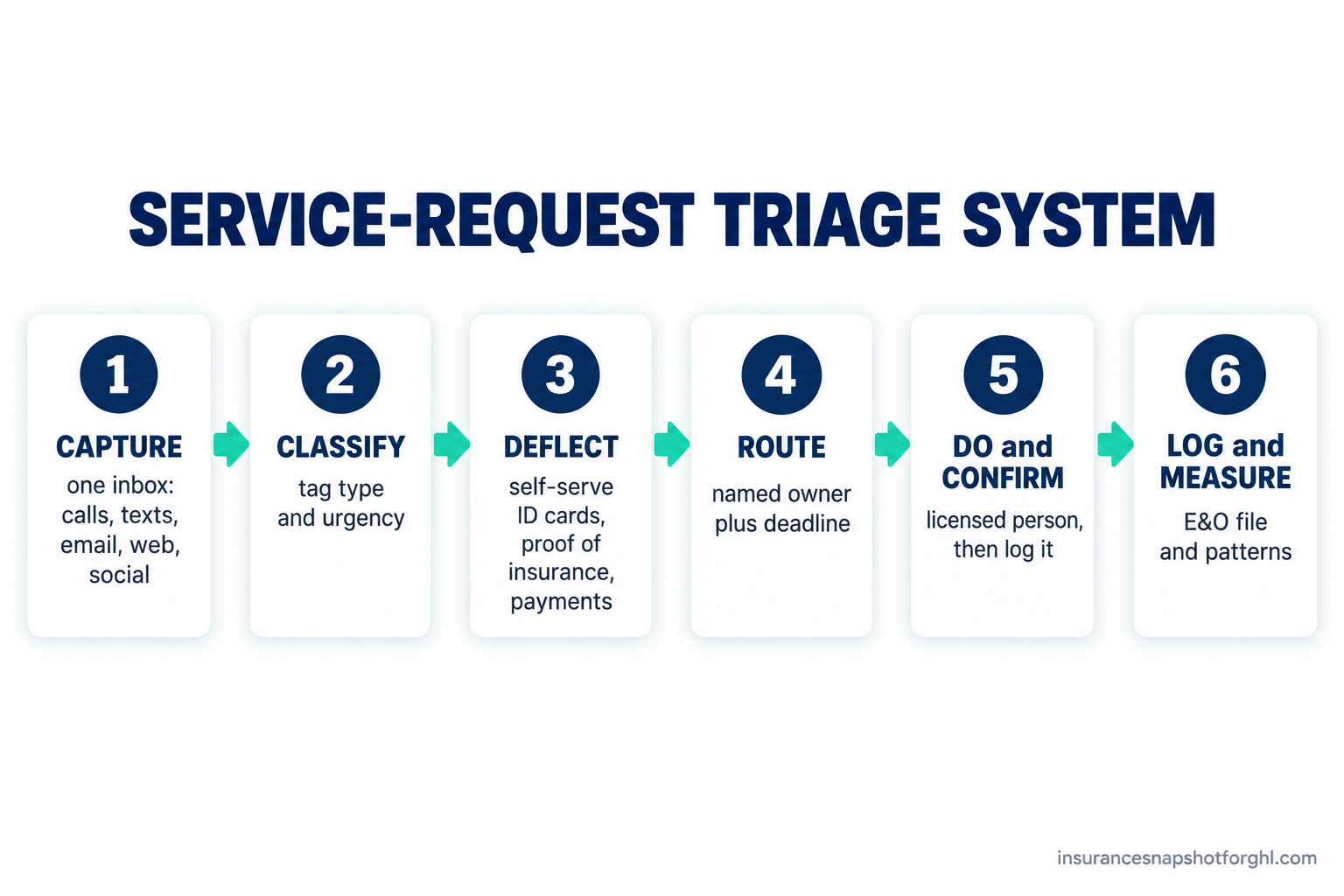
Table of contents
- What the service pileup costs you
- Why service requests are their own problem
- Stage 1: Capture every request in one place
- Stage 2: Classify type and urgency
- Stage 3: Deflect what is genuinely self-serve
- Stage 4: Route the rest, with an owner and a deadline
- Stage 5: Do the work and confirm it, safely
- Stage 6: Log, close, and measure
- The triage matrix
- Steal these messages
- Solo, five-producer, and large
- The compliance layer
- Objections
- The Tuesday that does not fall apart
- FAQ
What the service pileup costs you
Service work does not show up on a dashboard, so it is easy to miss how much it takes. It takes the thing you cannot buy back: your producers’ selling time. Independent agents placed 61.5% of U.S. property and casualty premium written in 2024 (Big “I” via Insurance Journal), so the channel is not short on opportunity. The constraint in a two-to-five-person shop is attention, and service requests are attention thieves that land on the people meant to be quoting.
The research matches the feeling. In a ReSource Pro and Oceanus Partners survey, 55% of service staff said producer requests interrupt their workstreams, while only about 14% of producers thought they were causing it, and 62% of service staff said urgent requests are common against just 24% of producers (Insurance Journal). The people doing service feel buried; the people adding to the pile do not see it. In a small agency one person often plays both roles, so the interruption is internal and invisible.
Share who agree “urgent producer requests are common,” by role. The gap between service staff and producers is the hidden cost of unmanaged service work. Source: Insurance Journal / ReSource Pro and Oceanus Partners Sales and Service Survey.
There is a retention cost too. Average agency account retention sits around 84%, with top agencies at 93 to 95 percent (Liberty Mutual 2026 Growth Study via IA Magazine, Agency Performance Partners). The client who got an ID card with the wrong car remembers it at renewal. Good service is retention work that looks like admin.
Why service requests are their own problem
A quote has a pipeline and a renewal has a date you see 120 days out, but a service request has neither. It is unscheduled and varied, with stakes that run from trivial to serious and no label on the envelope: “send me my ID card” is a two-click self-serve task, while “add my 16-year-old to the auto policy” is a coverage change with real exposure if it is missed. The channels are scattered (call, text, email, web form, social), the work mixes the automatable and the human, and some of it carries E&O exposure, because a certificate of insurance is “a frequent source of easily preventable E&O claims” (Utica National). Speed alone is the wrong goal. The six stages below assume GoHighLevel, but port to any tool that can tag a contact, send SMS and email, and assign a task.
Stage 1: Capture every request in one place
You cannot triage what you cannot see, so funnel every channel into one queue. Point the main phone line, text number, service email, website form, and social inboxes at a single CRM, so a request by any route creates or updates one contact record in one “Service Requests” pipeline. In GoHighLevel the shared inbox and inbound webhooks pull calls, texts, emails, and website chat into one timeline per client, and a missed-call text-back means an after-hours ask does not die in voicemail, the same pattern that catches after-hours leads. When every request is a timestamped record, you can route it, measure it, and prove later what was asked and when.
Failure mode: the side-channel request. The client who texts a producer’s personal cell creates a request with no record, so make the official channels easy and train the team to log a stray ask in ten seconds. The request you cannot see is the one you cannot defend in an E&O dispute.
Stage 2: Classify type and urgency
Before anyone touches it, a request needs two labels: what kind it is, and how fast it has to move. Type drives the path; urgency drives the order. A short set of categories covers most of a P&C shop: proof of insurance and ID cards, certificates, policy changes and endorsements, billing questions, claims, and general questions. Automation does much of this: a web form asks the client to pick the type, and an AI chatbot or receptionist reads an inbound message, classifies it, and tags it before a human reads it.
Failure mode: the coverage change hiding as a question. “Quick question, is my boat covered?” is a coverage inquiry with E&O weight, and a bot must never auto-answer it with a cheerful “yes.” Build the classifier to escalate anything that asks whether something is covered, or asks to change coverage, to a licensed person. When in doubt, route up, never down.
Stage 3: Deflect what is genuinely self-serve
A large share of service volume is requests the client can finish faster themselves than by waiting on you. Proof of insurance for a lender, an auto ID card, a dec page, a simple payment, a mailing-address update: give the client a self-serve path and these resolve in a minute without pulling a producer off revenue work. A client portal or self-serve menu handles the repeat, low-risk asks around the clock, so a text matching “ID card” or “proof of insurance” gets an automatic reply with the document or a secure link, logged and closed.
Two honesty rules keep self-serve from backfiring. Never fake a path that dead-ends: if only your team can issue a certificate, say so and set a time. And never let self-serve touch coverage: a client can pull their current ID card, but a client cannot decide that a new car is covered.
Failure mode: the stale document. A self-serve ID card that pulls an old version is worse than none, because the client trusts it. Tie self-serve documents to the live record and stamp each with its issue date.
Stage 4: Route the rest, with an owner and a deadline
Everything that is not self-serve needs two things the moment it is classified: a named owner and a due time. “The team will get to it” is how requests rot. Route each type to the right person: endorsements to the servicing CSR or producer, certificates to a trained and authorized issuer, billing to whoever knows the carrier portals. In GoHighLevel the request becomes a task assigned to a specific person, with the details, the client, and a deadline attached. The deadline is set by the request, not by convenience: an urgent certificate inside two hours, a routine address change same or next day. Set a service standard per type and let the system escalate before a task breaches it, pinging a lead when an urgent request has sat untouched for an hour.
Failure mode: the shared queue with no owner. A request in a pool that is “everyone’s” is no one’s: three people assume someone else has it, and the client waits. Assign every non-self-serve request to a single person, even if they reassign it.
Stage 5: Do the work and confirm it, safely
This is where the work gets done, and where a certificate can turn into a claim if the system only optimizes for speed. The pattern: a licensed person makes the change or issues the document in the AMS where the policy of record lives, the automation sends a plain confirmation of what was done, and both the request and the action are logged. The confirmation closes the loop and heads off the follow-up call.
Certificates get their own guardrails. Before one goes out, check that the policy has not been cancelled or non-renewed, confirm any additional insured named on it is actually endorsed onto the policy, and never use the certificate to state coverage the policy does not provide (Utica National, Insurance Journal). The standard ACORD 25 certificate says in its own text that it is issued as a matter of information only and does not amend, extend, or alter coverage, and a second set of eyes before release catches most mistakes.
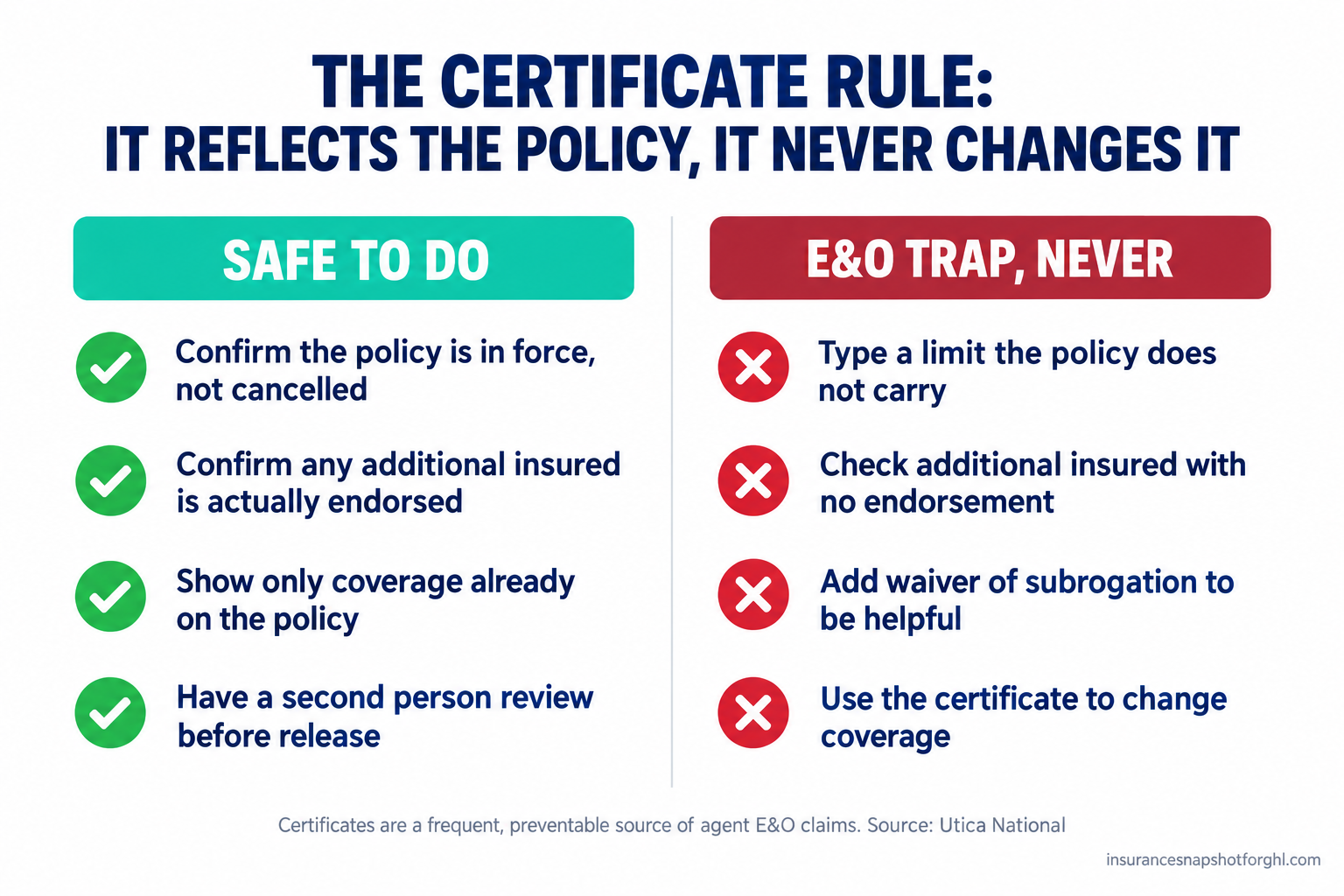
Failure mode: the certificate that promises coverage that is not there. A holder asks you to “just add waiver of subrogation” or bump a limit on the certificate, and someone obliges to be helpful. If the endorsement is not on the policy, the certificate is wrong and the agency owns the gap. A certificate reflects the policy, it never edits it; if the client needs different coverage, that is an endorsement request that routes back through Stage 4.
Stage 6: Log, close, and measure
A request is finished when it is logged and closed, not just done. Every request should leave a timestamped trail: what was asked, by whom, what was done, what was sent, and when. That trail is E&O documentation, the record that settles the dispute when a client insists they asked you to add a car in March and you can show the request never came.
Then measure. Because every request is now a record with a type, an owner, and timestamps, you can see what you never could: which types eat the most time, where delays cluster, and whether a carrier’s billing change just spiked your “why did my payment go up” volume, which is a systemic signal, not a client problem. Track service turnaround next to retention by line; the two move together.
Failure mode: measuring nothing and repeating everything. If “send proof of insurance to a lender” is a quarter of your tickets, that is a self-serve template waiting to be built. Review the request mix monthly and move the top repeat asks into Stage 3.
The triage matrix
Here is the whole system on one page: what gets automated, what gets a human, and how fast each should move.
| Request type | Best path | Who owns it | Target turnaround |
|---|---|---|---|
| Proof of insurance / ID card | Self-serve or auto-send from the live record | Automation, no human | Minutes |
| Payment or billing question | Self-serve link to carrier or processor | Automation, escalate if disputed | Minutes to same day |
| Certificate of insurance | Human issues after cancellation and endorsement check | Authorized issuer | Urgent ~2 hours; standard same day |
| Policy change or endorsement | Licensed person touches the policy in the AMS | Servicing CSR or producer | End of next business day |
| “Is X covered?” question | Escalate to a licensed person, never auto-answer | Producer | Same day |
Steal these messages
Copy these and change the bracketed fields. The texts assume prior express consent and a working opt-out already in place. Keep them about the service at hand, never a cross-sell bolted onto a ticket.
Intake auto-reply (Stage 1), SMS:
Hi [First Name], this is [Agency]. We got your request and it is in our queue. If it is urgent (a closing, a job site today, a lender deadline), reply URGENT with the time you need it by. Otherwise we will have it back to you by [standard time]. Reply STOP to opt out.
Self-serve proof of insurance (Stage 3), SMS:
Hi [First Name], here is the current proof of insurance for your [auto] policy: [secure link]. It reflects your coverage as of today, [date]. Need it sent to a lender or landlord? Reply with their email and we will take care of it. Reply STOP to opt out.
Certificate request confirmation (Stage 4), email, subject “Your certificate request for [Holder]”:
Hi [First Name], we have your certificate request for [holder/project]. Please confirm the holder’s full name and address and any wording your contract requires. One note: a certificate can only reflect coverage already on your policy, so if your contract needs coverage you do not carry (an additional insured, a higher limit), tell us now and we will handle that as a policy change first. Expect it by [time]. Thanks, [Name], [Agency].
Solo, five-producer, and large
The system is the same at every size. Who answers changes.
Solo operator. You are the only human in the loop, so lean hardest on Stages 1 through 3: auto-capture every channel, auto-classify, and push every safe, repeat ask to self-serve so you never touch it. Set the Stage 4 tasks to yourself and batch them into one or two blocks a day instead of letting each interruption derail a quote.
Five-producer agency. This is where requests fall between people, so Stage 4 ownership is everything. Route each type to a named CSR or servicing producer, never a shared pool, and turn on the escalation that pings a lead when an urgent ticket sits untouched. Pair the queue with your renewal and annual-review cadence, and give certificates to one or two trained issuers.
Large agency. You have the volume to see patterns, so make Stage 6 earn its keep: report request mix and turnaround by type and by carrier, and watch for spikes that signal a systemic cause. Hold a service standard per type, and treat certificate accuracy as a tracked quality metric, because at your scale a single recurring certificate error is a six-figure E&O exposure waiting to repeat.
The compliance layer
Service automation runs under the same rules as any other client contact, plus a few specific to the work. Texting clients requires A2P 10DLC registration, prior express consent, and a working STOP and HELP opt-out on every automated message, inside the calling-time window, generally 8am to 9pm in the client’s time zone (FCC). A service text about an existing policy the client bought from you is servicing, not cold marketing, which is solid ground, but keep the content on the service. The mechanics are in our TCPA field guide. Do not build your consent process around the FCC’s one-to-one consent rule, which the Eleventh Circuit vacated on January 24, 2025 in Insurance Marketing Coalition v. FCC, so it never took effect (Morrison Foerster).
Certificates are the compliance heart of this system: issue only what the policy supports, check for cancellation or non-renewal first, and confirm any additional insured is endorsed (Utica National). Two more rules. Do not sweeten a service miss with a gift, because state anti-rebating laws cap client gifts (Florida around $100 a year, Texas $25). And if any message touches a life or annuity product, the NAIC advertising model requires accuracy and disclosures. None of this slows the system; it decides which stages a machine can finish and which a licensed person must own.
Objections
“Won’t clients hate automated service texts?” Not when the text does something for them. “Here is your ID card” and “we got your request, here is when to expect it” are favors, not spam. The friction clients hate is silence and repeat-yourself, which is what this removes.
“We are a relationship shop. Isn’t this impersonal?” The opposite. Right now the relationship takes the hit, because a buried request and a slow certificate feel personal in the worst way. Taking the robotic work off your people frees them for the calls that build the relationship.
“My AMS already handles service.” Your AMS stores the policy and lets a person do the work, which is essential. What it usually does not do is capture every channel into one queue, auto-deflect the self-serve asks, route with a deadline, and escalate on a breach. This layer sits on top of the AMS and feeds it, and you do not have to upgrade it.
The Tuesday that does not fall apart
Go back to 9:12am. In the agency that runs this system, the certificate request lands in one queue tagged urgent, the client gets an instant “we have it, expect it by 11,” the proof-of-insurance ask is answered by a self-serve link, and the new-driver email becomes a routed task with a same-day deadline. Your best producer never leaves the quote call. It binds.
That is the difference between an agency that is busy and one that is in control. Not more hours and not a bigger system, but one intake, fast triage, self-serve where it is safe, a named owner and a deadline where it counts, and a log that protects you. Build the queue, keep a licensed human on the work that touches a policy, and the pileup stops running your week.
What is a service-request system for an insurance agency?
It is a single intake and triage layer that captures every client service request (certificates, ID cards, proof of insurance, endorsements, billing questions) in one place, classifies it, resolves the simple ones with self-serve, routes the rest to a named owner with a deadline, and logs every action for the E&O file. It sits on top of your agency management system, not instead of it.
Can I automate certificate of insurance requests?
Automate the intake, the acknowledgment, the information you need from the client, and the delivery and logging. Issuance should stay with a trained person who first checks the policy is in force and any additional insured is endorsed, because certificates are a frequent source of E&O claims. A certificate reflects the policy; it never changes it.
Which service requests are safe to let clients handle themselves?
Low-risk requests that only retrieve what already exists: current proof of insurance, auto ID cards, a dec page copy, simple payments, and address updates. Never let self-serve touch coverage. Anything that asks whether something is covered, or asks to change coverage, must route to a licensed person.
Is it legal to text clients about service requests?
Yes, with the right setup: A2P 10DLC registration, prior express consent, and a working STOP opt-out on every automated message, within the 8am to 9pm window. A text about an existing policy the client bought from you is servicing, not cold marketing. Do not rely on the FCC one-to-one consent rule, which was vacated in January 2025.
Do I need to replace my agency management system to do this?
No. This is a thin layer that routes your phone, text, email, web, and social channels into one queue, triages and deflects, assigns routed tasks with deadlines, and logs the trail. The licensed work still happens in the AMS where the policy lives.
Related reading: