
It is 4:50pm Thursday and you are trying to bind a home policy before the carrier’s cutoff. The quote is accepted. What you do not have is the signed application, a photo of the dec page, and the voided check for autopay. You asked Monday; life happened. So you leave another voicemail, send one more “just need those docs” text, and the bind slips to Friday.
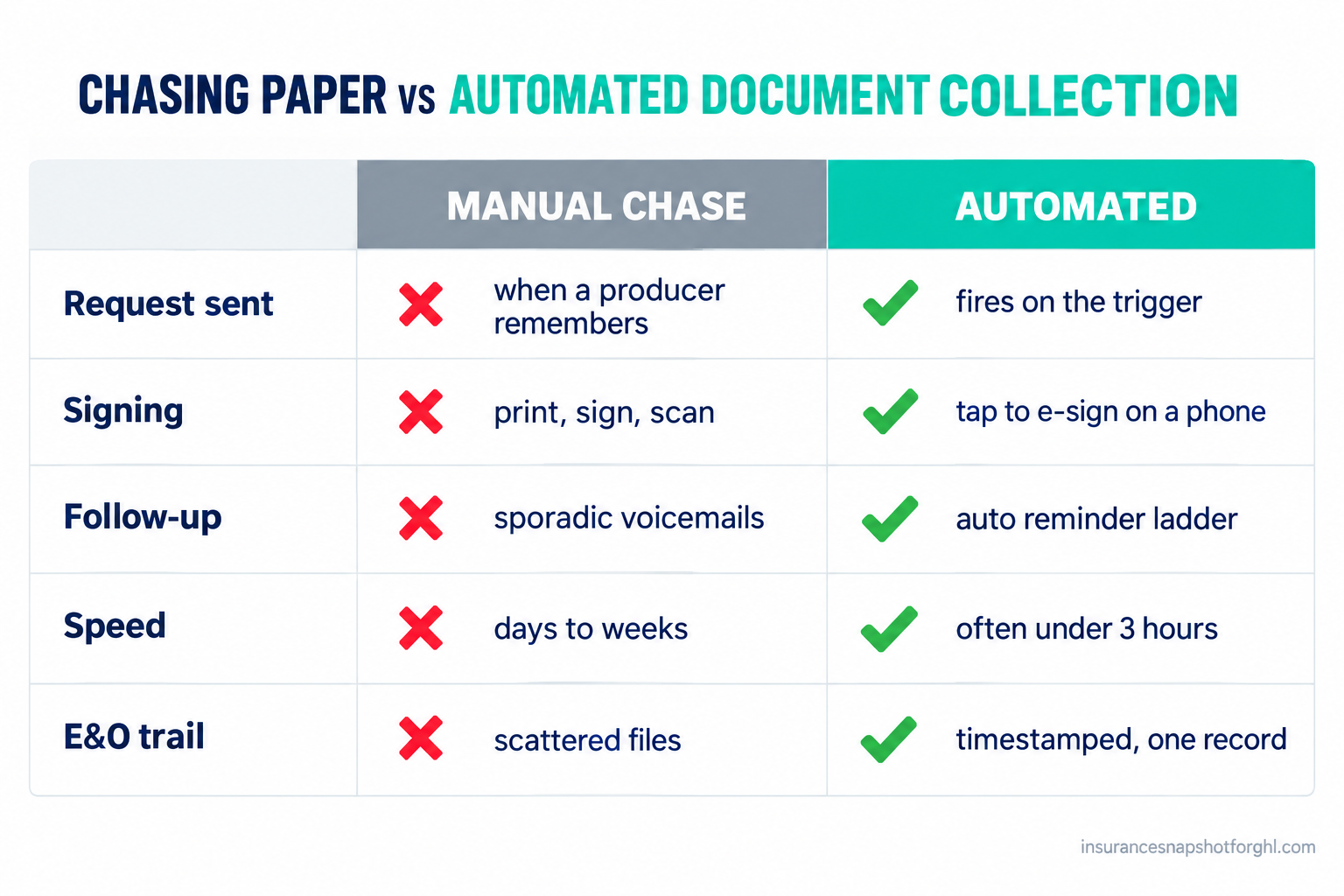
Automating insurance document collection means replacing that hand-chasing with one system that requests the right documents the moment they are needed, captures a legally binding e-signature, reminds the client until everything is in, and files each item with a timestamp so your E&O trail builds itself. The documents are not the hard part. The chasing is, and a machine does it better than a producer who also has to sell and service.
Table of contents
- What a stalled document actually costs you
- The system at a glance: 6 stages
- Stage 1: trigger the request the moment the need appears
- Stage 2: send one link, pre-filled, built for a phone
- Stage 3: collect the signature and the file in one step
- Stage 4: the reminder ladder that does the chasing
- Stage 5: escalate to a human before the deal goes cold
- Stage 6: file it, timestamp it, build the E&O trail
- Solo, five-producer, and large: who runs what
- The compliance layer you cannot skip
- Objections
- The renewal that files itself
- FAQ
What a stalled document actually costs you
A stalled document costs you in three places at once, and only one shows up on a report.
The first is the bind that slips. Every day a form sits in a client’s inbox is a day the policy is not bound and the premium is not written. You already ran the rater and wrote the proposal; a missing signature holds all of it hostage.
The second is the E&O exposure agencies underrate. The single largest cause of agency E&O claims is “coverage not procured,” about 30% of claims, with the next category barely reaching 10% (IA Magazine). When one lands, your defense counsel asks for the paper trail: the signed application, the timestamp on your follow-up, the coverage you offered and they declined. A document you never collected is a defense you do not have.
Top causes of agency E&O claims: “coverage not procured” is the single largest at about 30%, the next barely 10%. Source: IA Magazine, Top 5 Causes of Agency E&O Claims.
The third is the producer hour. Independent agents place 61.5% of all U.S. property and casualty premium (Insurance Journal), much of it in two-to-five-person shops where the same person quotes, binds, services, and chases paperwork. Every hour a producer spends re-sending a form is an hour not spent on the cross-sell that grows the book. And the friction is fixable: DocuSign reports its customer AAA Washington now closes 87% of agreements in under three hours after moving to e-signature (DocuSign). The bottleneck was never the client’s willingness.
The system at a glance: 6 stages
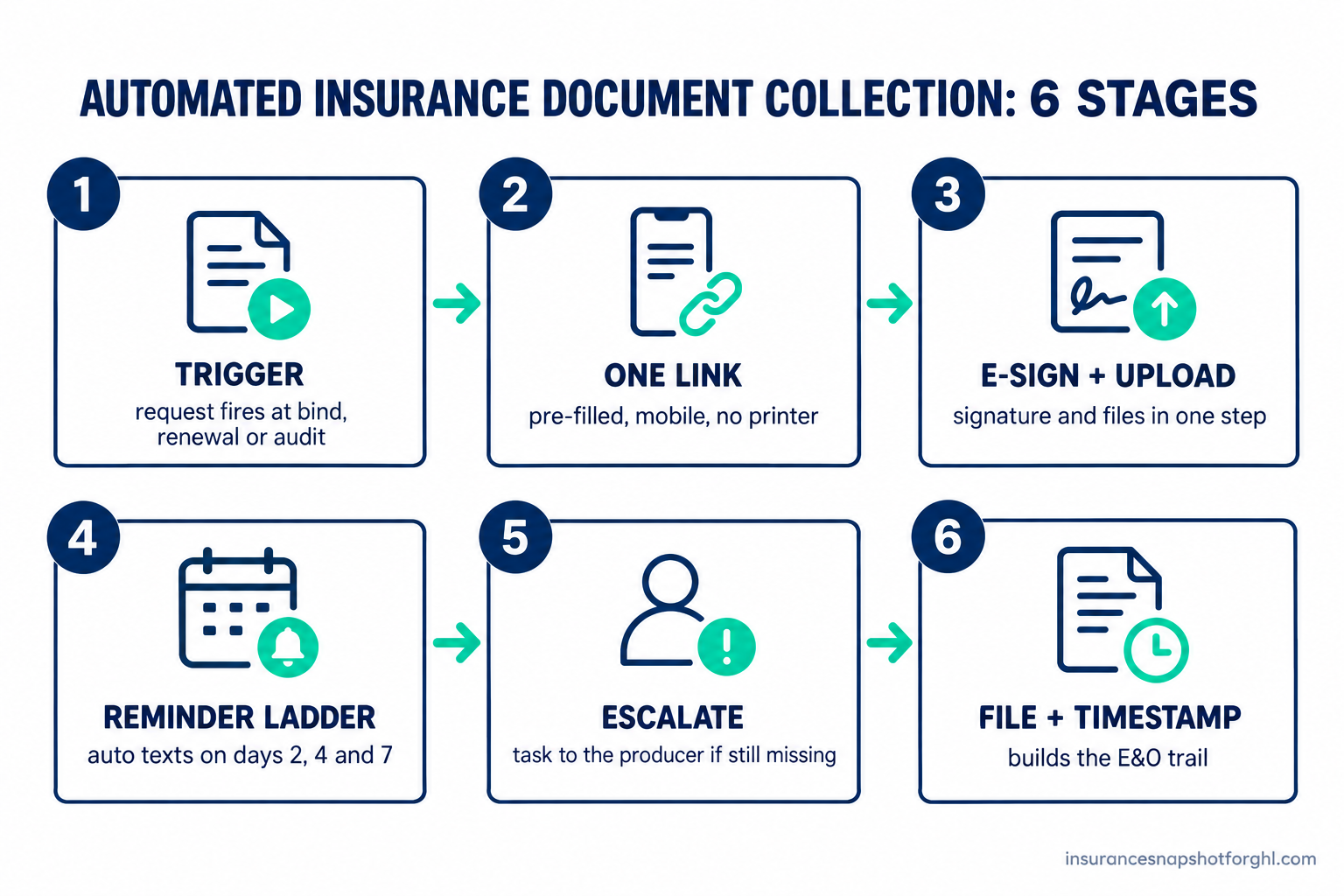
Six stages, and after setup only one ever needs a human. A trigger fires the request, the client e-signs and uploads in one link, a reminder ladder does the chasing, a producer steps in only if it runs out, and every item files itself with a timestamp. The point is the documents you need showing up without anyone remembering to ask twice.
It is the paperwork spine under your post-bind client onboarding and what makes a carrier remarket survivable when you suddenly need a loss run and dec page from 40 clients.
Stage 1: trigger the request the moment the need appears
Document collection should start with an event, not a producer remembering to ask. The moment a quote is accepted, a policy renews, a mortgagee changes, or an audit notice arrives, the CRM should know which documents that event requires and fire the request on its own.
Map the triggers to the documents once. A new auto bind needs a signed application, a driver’s license, and an EFT or voided check. A home bind adds the prior dec page and sometimes a four-point or roof photo. A commercial renewal audit needs payroll records and current loss runs; a life application needs the signed illustration and HIPAA authorization. Many are standardized ACORD forms, easy to template once so the right request goes out the second the trigger fires.
How it breaks: you build one generic “please send your documents” request for every line. The client does not know what a dec page is, sends the wrong thing, and now you are in a back-and-forth slower than paper. Build the request per trigger, name each document plainly, and say why you need it.
Stage 2: send one link, pre-filled, built for a phone
The request goes out as a text and an email, both pointing at one link, not a printable attachment or a portal login. It opens on a phone and shows a short checklist of what to provide.
Hi [first name], it's [producer] at [agency]. To finish binding your
[auto/home] policy I need 3 quick things, all on one link, takes about
2 minutes on your phone: your signed application, a photo of your [prior
dec page / driver's license], and a voided check for autopay.
Here you go: [secure link]
Reply STOP to opt out of texts.
Pre-fill everything you already know, so the client never retypes their name, address, or policy number. Each document is a labeled step: tap to e-sign the application, tap to photograph the dec page, tap to upload the voided check. The phone is the scanner, and the fewer taps between the client and “done,” the faster it comes back.
How it breaks: you send a PDF the client has to download, print, sign, and scan. Half of them do not have a printer within reach, so the form sits for a week. Any step that assumes a desktop and a printer rebuilds the friction you removed.
Stage 3: collect the signature and the file in one step
The signature and the upload belong in one motion, not two errands. The client taps the application, reads it, e-signs it, then taps the next step to photograph the dec page, and both land in your system attached to their record in one session.
The legal footing is firmer than most agents assume. An electronic signature is binding under the federal ESIGN Act of 2000 and the state-level Uniform Electronic Transactions Act, provided you capture the signer’s intent, their consent to sign electronically, clear attribution, and a retained record (ESIGN Act, congress.gov). A compliant tool logs all four plus an audit trail of who signed, when, and from what device, worth more to your E&O defense than a wet signature in a drawer. The one caution: some carriers and states still require wet ink on specific forms, so keep a short exceptions list and route those separately.
How it breaks: you collect the e-signature in one tool and the documents in another, then stitch them together by hand, which creates two places a document can go missing. Collect the signature and the file in one flow, into one record.
Stage 4: the reminder ladder that does the chasing
Most documents do not come back on the first ask, which is fine if a machine does the following up. The reminder ladder is three automated touches that escalate in tone, each firing only if the document is still outstanding. The instant a client completes the link, the ladder stops for them, so nobody who already sent their forms gets nagged.
Day 2, the gentle nudge:
Hi [first name], [producer] here. Still need those few documents to get
your [line] policy bound, here's the link again: [secure link]. Takes
about 2 minutes. Reply if anything's giving you trouble.
Day 4, the reason it matters:
Hi [first name], quick heads up on your [line] documents. Until they're
in, your coverage isn't active, so I don't want you driving/your home
sitting uncovered a day longer than needed. Same link: [secure link].
Day 7, the honest deadline:
Hi [first name], last nudge on the [line] paperwork. The carrier holds
this quote until [date]; after that the rate can change. If now's not a
good time just tell me and I'll work around it: [secure link].
Each touch carries one new, true reason, never a flat “just following up,” and the deadline is real, tied to the carrier’s quote hold. The same engine powers automated renewal reminders without an AMS upgrade.
How it breaks: the ladder does not stop when the client completes the link, so someone who sent everything on Day 1 still gets the Day 7 “last nudge.” That one mistake makes your operation look like it is not paying attention. The completion event must pause the sequence for that contact, every time.
Stage 5: escalate to a human before the deal goes cold
The ladder handles the 80% who just needed a reminder. The last 20% need a person, and the system’s job is to make sure that person steps in with full context.
When the Day 7 touch passes with documents still missing, the automation stops firing and drops a task on the producer who owns the relationship, with everything attached: what is outstanding, when each item was requested, every reminder that fired, and the client’s last reply. Now the producer makes one informed call, not a cold “did you get my texts.” It is short: the client already knows what is needed, and the job is just to clear whatever is in the way.
How it breaks: there is no stop, so the automation fires reminders forever, the client tunes them out, and nobody ever picks up the phone. Automation makes the human touch land at the right moment; it does not replace it. Cap the ladder, then hand it to a person.
Stage 6: file it, timestamp it, build the E&O trail
Every document that comes in files itself to the client record, tagged by type and stamped with the dates it was requested and arrived. This is the quiet stage that pays off years later, the first time a claim gets contested.
It builds your E&O defense in the background: the timestamped request proves you asked, the signed application proves what the client chose, the audit trail proves who signed and when, and a logged declined coverage proves you offered it. None of it is extra work once filing is automatic, because collecting the document documents it.
There is no universal retention number. New York, for example, requires a policy record be kept six years after the policy is out of force (NY DFS), and E&O risk managers advise matching it to your book and any E&O tail coverage (Utica National). One rule that trips agencies up: keep paper and electronic records on the same schedule. This ties straight into how much E&O a small agency actually needs.
How it breaks: documents land in a shared email inbox or a desktop folder named “scan_0043.pdf.” A year later nobody can find the signed app for the account with the open claim. If filing is not automatic and tagged, the E&O value of collecting the document evaporates.
Solo, five-producer, and large: who runs what
The same six stages run at every size. What changes is who owns the exceptions and how hard you lean on automation.
The solo agent. You are the trigger, the producer, and the filer, and you cannot chase paperwork and sell at once, so lean on automation hard: let the triggers fire every request and the ladder run all three reminders, and reserve yourself for the Stage 5 escalations. Keep the map simple, just the three or four lines you write.
The five-producer agency. Now you have a routing problem. Each producer’s binds should escalate back to that producer, not into a shared pile nobody owns. Add a service person or account manager as the backstop who works the Stage 5 tasks, so a licensed seller is not pulled off the phone to chase a dec page. This is the size where “whose client is this” confusion quietly kills completion rates, so make ownership explicit.
The large agency or cluster. You are running this across lines, locations, and multiple carriers’ rules at once. Standardize the trigger-to-document map centrally so every office collects the same way, then let each team work its own escalation queue and share one carrier and state exception list. Track completion rate and time-to-complete by team, so you see where binds leak before revenue does.
The compliance layer you cannot skip
Automating document collection touches three rulebooks. Get them right at setup and forget them.
E-signature validity. As in Stage 3, the ESIGN Act and UETA make electronic signatures binding when you capture intent, consent, attribution, and a retained record. Use a tool that logs all four, and keep a short list of the carrier and state exceptions that still demand wet ink.
Texting consent. Your reminder ladder runs on SMS, which puts you under the TCPA and the A2P 10DLC rules for business texting. You need prior express consent to text, every message needs a working STOP, and opt-outs must be honored instantly. Our guide to TCPA-safe insurance SMS walks the mechanics in full. One note: the FCC’s proposed one-to-one consent rule was vacated by the Eleventh Circuit in January 2025 and removed, so it is not a requirement, though standard TCPA prior-express-consent rules still apply.
Record retention and privacy. Keep what you collect for the retention period, protect it like the sensitive data it is, and apply one schedule to paper and electronic files alike. Health and Medicare lines carry their own handling rules on top.
Objections
“My clients are older, they will never e-sign on a phone.” Design decides this, not age. A single pre-filled link with a tap-to-sign step is easier for an 80-year-old than printing, signing, and scanning. The ones who genuinely cannot are who Stage 5 is for: the producer calls, walks them through it, or routes them to a wet-signature path.
“I already pay for an AMS, doesn’t it do this?” Most agency management systems store documents well and collect them poorly. They are a filing cabinet, not a chaser. The triggers, pre-filled link, reminder ladder, and auto-filing are the gap, and you run them alongside your AMS without ripping anything out.
“Isn’t automated chasing impersonal?” What feels impersonal is a producer who forgets to follow up, or a fourth identical “just checking in” text. A reminder that stops the instant they respond, carries a real reason each time, and hands off to a human at the right moment is more attentive than most agencies manage by hand, not less.
The renewal that files itself
Go back to that 4:50pm Thursday, with the system in place. The quote gets accepted, and the client gets one text with one link. They tap it on the walk to their car, e-sign the application, snap the dec page, and upload a voided check before they pull out of the parking lot. It is filed, timestamped, and attached to their record. You never sent an email or made the call. The bind clears before the cutoff, and your E&O file is already building itself for a claim that may never come but is covered if it does.
The paperwork was never the hard part. Chasing it was, and that is the part you can hand to a machine. When you are ready, these workflows are already built and installed into your GoHighLevel in about 24 hours, or book a walkthrough and watch the whole cycle run live first.
Are electronic signatures legally valid on insurance applications?
Yes, in almost all cases. The federal ESIGN Act of 2000 and state UETA give an e-signature the same legal weight as ink when you capture the signer's intent, consent to sign electronically, clear attribution, and a retained record, which a compliant tool logs automatically. The exceptions are specific carrier or state wet-signature requirements, so keep a short exceptions list.
How long should my agency keep collected documents?
There is no single universal number. New York, for example, requires a policy record be kept six years after the policy is out of force, and E&O risk managers advise matching retention to your book and any E&O tail coverage. Confirm your state's rule, and keep paper and electronic records on the same schedule.
Will automated reminder texts get me in trouble under the TCPA?
Not if set up correctly: you need prior express consent to text, every message needs a working STOP, and opt-outs must be honored instantly. The FCC's proposed one-to-one consent rule was vacated in January 2025 and removed, so it does not apply, but ordinary prior-express-consent rules still do.
Do I need to replace my agency management system to automate this?
No. Most agency management systems store documents but do not chase them. You run the triggers, pre-filled links, reminder ladder, and auto-filing alongside your existing AMS, filling the collection gap it leaves open.
What documents can this collect?
Anything tied to a trigger: signed applications, prior dec pages, driver's licenses, EFT or voided checks, four-point and roof inspections, commercial loss runs and payroll for audits, and HIPAA authorizations and signed illustrations for life.