
It is renewal week, and you are three tabs deep: your rater, your management system, and AgencyZoom, where a lead has sat in the “Quoted” column for nine days because nobody texted them back. You pay for AgencyZoom to stop exactly this, and it still happened. So you type “AgencyZoom alternatives” into a fourth tab, which is probably how you got here.
Here is the answer up front. AgencyZoom is a solid sales-pipeline layer that lives next to your management system, but it hides its price, caps most plans at seven seats, and does not give you two-way texting, funnels, or an AI front desk. If you want the pipeline and reporting and already run Vertafore, AgencyZoom is a reasonable stay. If what you need is the follow-up to happen without you babysitting it, a broader automation platform does more for less. Below are five real alternatives, the reported 2026 numbers, and which one fits a solo shop, a five-producer agency, and a larger book.
Table of contents
- What AgencyZoom actually is, and why people look elsewhere
- The five alternatives at a glance
- The eight things to judge any of them on
- The reported 2026 pricing, side by side
- Solo, five-producer, and large: who should pick what
- Steal this: the follow-up any of these should run
- The compliance rules every demo skips
- Objections
- So which AgencyZoom alternative wins?
- FAQ
What AgencyZoom actually is, and why people look elsewhere
AgencyZoom is a sales-automation and CRM platform for insurance agencies. Vertafore bought it in November 2021 (InsuranceNewsNet), and it now sits inside the Vertafore stack as the sales and engagement layer next to your management system (Vertafore). You build custom pipelines, drag leads through stages to trigger workflows, track onboarding and renewals, and report on producer activity. More than 6,000 agencies use it (Coverager).
That is a real product doing real work. So why the search traffic for alternatives? Three reasons come up again and again.
First, the price is a mystery. G2 notes outright that AgencyZoom has not provided pricing for the product, so you cannot budget without a sales call (G2). Third-party listings scatter from $79 to $349 a month and disagree on what you get (CostBench). Second, the seat cap: multiple listings report plans bundle up to seven users, so an eighth producer is a conversation, not a checkbox. Third, and this is the big one, AgencyZoom runs the pipeline but it is not your texting line, your funnel, your Google-review engine, or your after-hours phone. When a lead rots in the “Quoted” column, it is usually because the texting and the reminders were never wired to the pipeline in the first place.
Independent agents still place 62% of all U.S. property-and-casualty premium (Big “I” 2026 Market Share Report), and average agency client retention sits around 84% (Liberty Mutual 2026 Independent Agency Growth Study). The question is which tool makes your team follow up, not just which one charts the pipeline.
The five alternatives at a glance
There is no single drop-in clone of AgencyZoom, because “AgencyZoom alternative” means different things depending on what frustrates you. There are five honest categories:
- Better Agency, the closest insurance-native competitor (Capterra).
- Your AMS’s own workflows (EZLynx, HawkSoft, NowCerts), with no second subscription.
- A GoHighLevel-based platform, general automation plus two-way SMS, funnels, reviews, and AI (GoHighLevel).
- A general CRM like HubSpot, flexible but nothing insurance-specific.
- Staying on AgencyZoom and bolting on a texting tool, sometimes the right call.
The rest of this post runs the first four against AgencyZoom on the eight things that decide the bill and the daily grind.
The eight things to judge any of them on
Skip the 200-row feature matrix. Eight things decide whether the tool earns its keep: what it actually is, price transparency, the seat model, AMS and policy-data sync, two-way SMS and missed-call text-back, an AI front desk, review and reputation automation, and setup, contract, and lock-in. Here is where each platform lands on the ones that move the bill:
| Platform | What it is | Price published? | Two-way SMS | AI caller | AMS sync | Reported entry |
|---|---|---|---|---|---|---|
| AgencyZoom | Sales layer beside the AMS | No (demo only) | No | No | Vertafore stack | ~$149 to $349/mo |
| Better Agency | Insurance-native CRM + automation | Yes (tiers) | Add-on texting | No | Limited | $299/mo |
| AMS-native workflows | Automation inside your AMS | With the AMS | No | No | Native | Included |
| GoHighLevel platform | All-in-one automation + CRM | Yes | Yes | Yes | Not native | $97/mo |
| HubSpot (generic) | General CRM + marketing | Yes | Add-on | No | None | Free to $$$ |
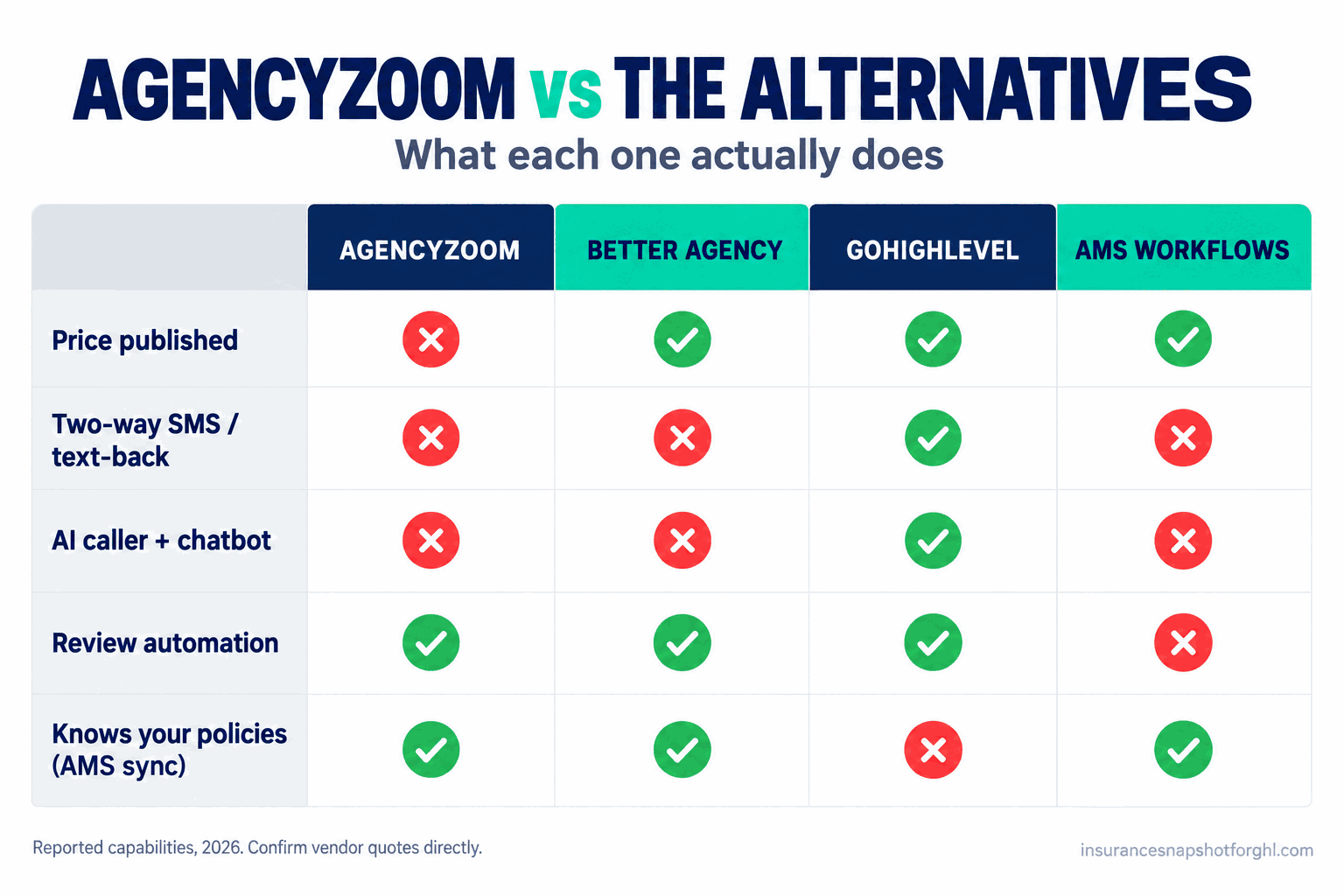
The split is simple. Insurance-native tools know your policies but are thin on marketing channels. General platforms are deep on channels but do not natively know a policy renewed. Which gap hurts less is the next section.
The reported 2026 pricing, side by side
Every number here is a reported third-party figure or a published vendor tier. AgencyZoom and HubSpot’s insurance setup still need a quote for the real number, so confirm in writing before you sign.
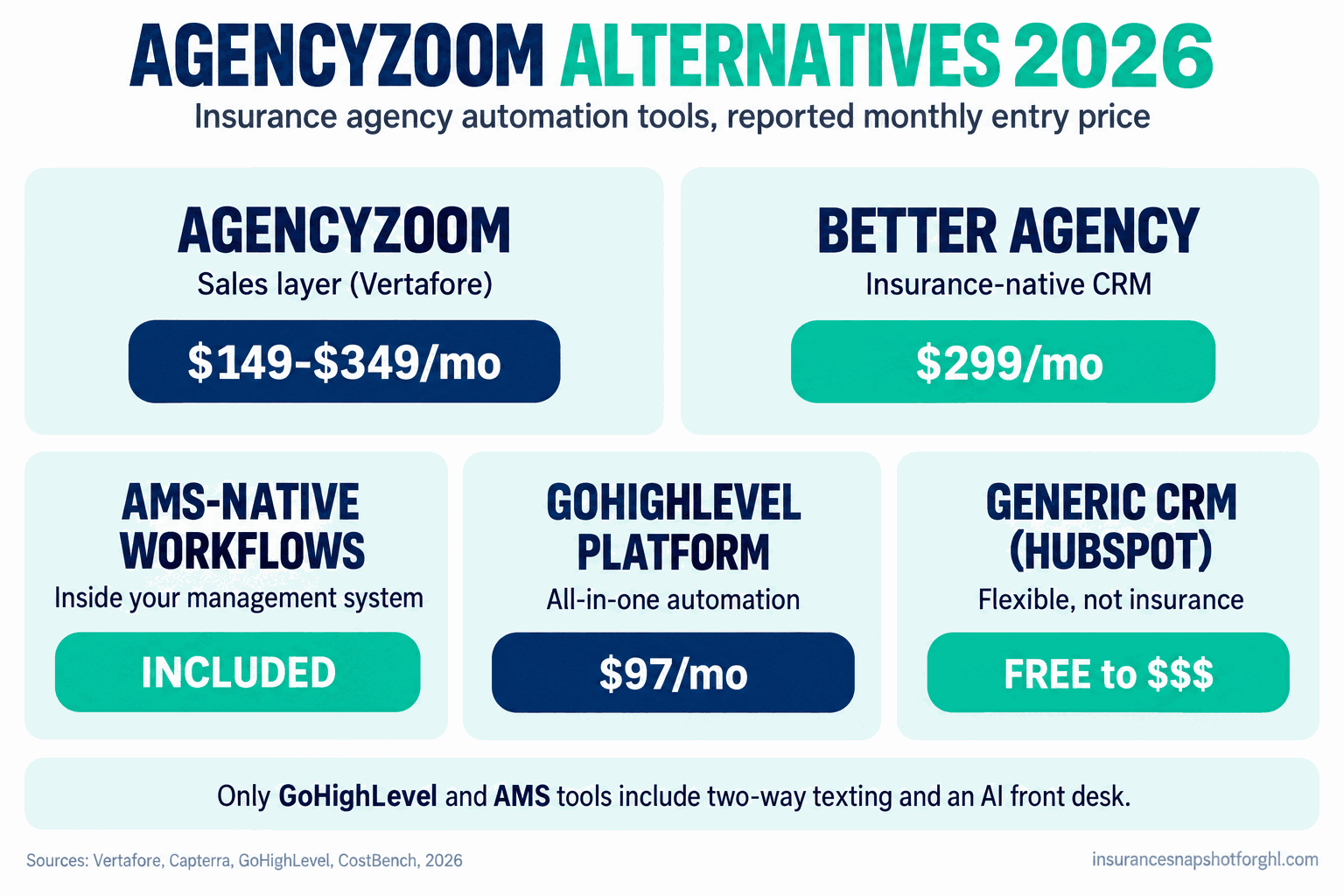
Reported monthly entry price, 2026. Sources: GoHighLevel, CostBench (AgencyZoom), Capterra (Better Agency). AMS-native workflows are bundled into your existing management-system bill.
AgencyZoom. No published price. Third-party listings put it near $149 a month at the low end and $349 at the top, with most plans bundling up to seven seats (CostBench). That seven-seat cap matters: your eighth producer is a sales call, not a line item. For the full breakdown of the tiers and hidden costs, see our AgencyZoom pricing teardown.
Better Agency. It publishes tiers that scale by user count: roughly $299 a month for one to three users, $399 for four to six, and $549 for seven to ten, with a $1 fourteen-day trial (Capterra). You get policy management, rating, email marketing, and campaign tools. Texting is typically an add-on, so budget for the messaging line on top.
AMS-native workflows. If you run EZLynx, HawkSoft, or NowCerts, you already pay for some automation: renewal tasks, activity reminders, and basic email, at zero marginal cost. The ceiling is low, though. None of them ships two-way marketing SMS, funnels, review routing, or an AI receptionist. For what you can squeeze out of the AMS alone, read how to automate renewal reminders without an AMS upgrade.
GoHighLevel platform. Published and flat: $97 a month for Starter, $297 for Unlimited, $497 for the agency SaaS plan (GoHighLevel). Unlimited means unlimited sub-accounts and contacts, so the seat math does not punish growth. You get two-way SMS, missed-call text-back, funnels, review automation, and an AI voice and chat agent in the base platform. The honest catch: it is a blank, powerful system. Out of the box it does not know your lines of business or that a policy renewed, so someone configures the insurance pipelines and consent handling, or you buy a setup that already has them.
HubSpot publishes pricing and starts free, but the automation you would use climbs fast with the Marketing Hub and seats, and nothing in it is insurance-aware.
Solo, five-producer, and large: who should pick what
The right answer genuinely changes with your size. Run the same question through three shops.
The solo agent or one-to-two-person shop. You do not need a producer leaderboard. You need the phone answered and the quote followed up while you are on a roof or in a closing. AgencyZoom’s reporting is overkill here, and Better Agency’s $299 floor is steep for one seat. The two options that fit are your AMS’s built-in reminders (free, limited) or a GoHighLevel platform at $97 with missed-call text-back and an AI receptionist on the after-hours calls. For a solo, that AI front desk pays for itself, because every missed call is a quote that went to the 1-800 number on a billboard.
The five-producer independent agency. This is the real decision point. Pipeline discipline matters at this size, so AgencyZoom and Better Agency both make sense on paper. But five producers is also five people who will not text leads back consistently, which is where a sales layer without a texting engine leaves money on the table. If you want the pipeline, the texting, the reviews, and the AI in one bill, the GoHighLevel route at $297 Unlimited usually beats stacking AgencyZoom, a texting tool, and a review tool. And watch the seven-seat cap: at five producers plus a CSR or two, you are near it.
The large agency or multi-location book. Here the AMS integration and the back-office depth of the Vertafore ecosystem start to earn their keep, and AgencyZoom Enterprise centralizes pipelines across locations. A larger shop can run a hybrid: keep AgencyZoom for pipeline and reporting, and add a separate platform for the marketing channels and AI it does not cover. The cost of a second system is small against a book that size; the follow-up it recovers is not.
The honest rule of thumb: if your pain is reporting and pipeline visibility, stay insurance-native. If your pain is leads and renewals slipping because nobody followed up, you need the channels, which means two-way SMS and an AI front desk. Most small agencies feel the second pain and buy for the first.
Steal this: the follow-up any of these should run
Whichever platform you land on, the value is in the messages it sends automatically. Here is the sequence to build, with real copy and timing, written TCPA-safe with clear identification and an opt-out. Swap in your agency name and keep the STOP language.
Missed-call text-back (fires within 1 minute of a missed call):
“Hi, this is Dana at Brightline Insurance. Sorry we missed you just now. Were you calling about a quote, a policy change, or a claim? Reply here and I’ll help. Reply STOP to opt out.”
New-quote follow-up (three texts, only after the lead opted in on your form):
Text 1, 5 minutes after the quote request: “Thanks for the quote request, [first_name]. This is Marco at Brightline. I have your info and I’m working your home-and-auto numbers now. Quick question: any tickets or claims in the last 3 years? Reply STOP to opt out.”
Text 2, next day if no reply: “Hi [first_name], Marco again at Brightline. I have a bundled number ready that looks better than what you have now. Want me to text it over or hop on a 5-minute call? Reply STOP to opt out.”
Text 3, day 4 if still no reply: “Last check-in, [first_name]. I’ll hold your quote for 7 more days before it expires. Reply YES and I’ll lock it in. Reply STOP to opt out.”
Renewal reminder (fires 30 days before the renewal date):
“Hi [first_name], your auto policy renews on [renewal_date], and the premium changed a little. Want a 10-minute review to make sure you still have the right coverage and no gaps? Reply here or book at the link. Reply STOP to opt out.”
Review request (fires 3 days after a policy binds, routed by sentiment):
“Thanks for trusting Brightline with your coverage, [first_name]. On a scale of 1 to 10, how was the experience? Reply with a number.” Replies of 9 or 10 get the Google-review link; anything lower routes to a private “tell us what we could have done better” reply, so you fix it before it becomes a public one-star.
That is the whole engine. AgencyZoom and Better Agency run parts of it, the AMS can nudge the renewal, and a GoHighLevel platform runs all of it including the missed-call text-back and the review routing. For the texting layer specifically, our guide to TCPA-safe insurance SMS has the consent flow.
The compliance rules every demo skips
A platform that texts and calls on your behalf is a compliance surface, and no sales rep walks you through it. Four things to get right before you automate a single message.
TCPA and A2P 10DLC. Every automated text needs prior express consent, clear sender identification, and a working STOP and HELP, with a higher bar for marketing than for a service note. You also have to register your campaign under A2P 10DLC or carriers filter your messages. Any tool you pick has to support consent capture and opt-out logging, because the liability is yours, not the vendor’s.
One important thing not to believe. You may still see advice that the FCC’s “one-to-one consent” rule applies to lead forms. It does not. The Eleventh Circuit vacated that rule on January 24, 2025, and the FCC removed the language later in 2025. Build your consent to the actual current standard, not to a rule that no longer exists.
NAIC Model 570 for life and annuity ads. If you sell life or annuities, any testimonial must be accurate, unedited, and disclosed as a “Paid Endorsement” when it is paid. Automation makes it easy to blast a glowing client text to your whole list, and that is where agencies get caught.
Anti-rebating limits on referral and gift campaigns. Marketing automation loves a “refer a friend, get a gift card” loop, and your state caps what you can give: Florida limits gifts to $100 per client per year, Texas to $25. Set the reward below your state’s line, because the platform will not know the rule for you. Our post on insurance marketing compliance for gifts and reviews covers the traps.
Objections
“I already pay for AgencyZoom. Why would I switch?” You might not. If the pipeline and reporting work, keep it and bolt on the texting and AI it lacks. The switch makes sense when you realize you pay for AgencyZoom plus a texting tool plus a review tool plus an answering service, and one platform does all four for less.
“Won’t a general platform miss insurance-specific stuff like policy sync?” Yes, that is the real tradeoff. A GoHighLevel platform does not natively know your book renewed unless you feed it the data or configure a pipeline that mirrors your lines. Insurance-native tools win on knowing the policy; general platforms win on reaching the client. Pick for the gap that costs you more, and see our build-it-yourself vs done-for-you comparison.
“Do I need to be technical to run one of these?” For AgencyZoom and Better Agency, no; they are turnkey. For a raw GoHighLevel account, somewhat, because it is a blank platform you configure. That is the entire reason prebuilt insurance setups exist: the breadth without the blank-canvas build.
“Won’t automated texts annoy clients or get me in TCPA trouble?” Only if you skip consent and over-send. Done right, with opt-in, identification, STOP honored instantly, and genuinely useful messages, clients prefer a text to a voicemail. And none of these tools replaces your AMS; they sit beside it. If you are weighing the management-system layer itself, our Applied Epic alternatives guide and AMS360 vs EZLynx breakdown cover that.
So which AgencyZoom alternative wins?
There is no universal winner, but there is a pattern. A solo shop should skip the sales layer and put $97 toward a platform that answers the phone and texts leads back. A five-producer agency is usually overpaying for a stack of single-purpose tools and would do better in one all-in-one platform. A large or multi-location book can keep the Vertafore depth and add a second platform for the channels it does not cover.
Across all three, remember what the dashboards hide: a pipeline that charts a stuck lead is not a system that un-sticks it. The 572,600 insurance sales agents in the U.S. (BLS, 2025) are mostly not short on leads. They are short on follow-up that happens without them. Buy for the follow-up.
Frequently asked questions
How much does AgencyZoom cost in 2026?
AgencyZoom does not publish its price, so you need a demo to get a real quote. Third-party listings report roughly $149 to $349 a month, with most plans bundling up to seven users (CostBench). Confirm your number in writing before signing.
What is the closest alternative to AgencyZoom?
Better Agency is the closest insurance-native competitor, with a comparable P&C CRM, automation, rating, and email marketing. Unlike AgencyZoom, it publishes tiers at about $299, $399, and $549 a month by user count (Capterra).
Can I replace AgencyZoom with a cheaper platform?
Often, yes. A GoHighLevel-based platform starts at $97 a month with unlimited contacts and includes two-way SMS, funnels, review automation, and an AI caller that AgencyZoom does not (GoHighLevel). The tradeoff is that it does not natively sync policy data, so you configure the insurance pipelines or buy a prebuilt setup.
Does AgencyZoom replace my agency management system?
No. AgencyZoom is a sales and engagement layer that sits next to your AMS (Vertafore). So do Better Agency and the GoHighLevel platforms. Your management system still holds the policies and accounting.
Is it TCPA-compliant to automate texts to clients?
It can be. You need prior express consent, clear sender identification, a working STOP and HELP, and A2P 10DLC registration. Note that the FCC one-to-one consent rule was vacated in January 2025 and removed later that year, so build to the current standard. See our TCPA-safe SMS guide.
Which AgencyZoom alternative is best for a small independent agency?
For one or two people, a GoHighLevel platform with an AI receptionist beats a sales-only tool, because answered calls and texted-back leads matter more than pipeline reporting. For four to seven producers, consolidating a texting, review, and pipeline stack into one all-in-one platform usually costs less than the stack it replaces.