
It is 8:15 on a Monday and you have a great idea. Rates jumped again and a dozen of your home clients are about to get a renewal shock. So you export every mobile number in your management system, paste them into a texting app, and send one friendly heads-up: “Hi, it’s your agent, your renewal is coming, call me before you shop.” Four hundred texts, done.
Here is the answer up front. Yes, an insurance agent can legally text clients. But that specific blast is three or four violations stacked on top of each other, and the law prices each one at $500 to $1,500 per message, with no cap. Texting works. It is the single best retention tool a small agency has, and done right it is completely legal. The difference between a renewal engine and a class-action magnet is a handful of rules you can learn in the time it takes to read this, in plain English, with the message copy that keeps you on the right side of the line.
In this guide: what it costs · the four rulebooks · consent · the dead one-to-one rule · quiet hours · STOP and opt-outs · A2P 10DLC · steal-this copy · objections · FAQ
What getting this wrong actually costs you
The Telephone Consumer Protection Act lets a consumer sue for $500 for every text sent without proper consent, rising to $1,500 per text if the violation is willful or knowing, with no cap on the total (FCC). It multiplies by message count, so that 400-person blast is $200,000 of exposure on paper. A small agency will rarely pay that, but plaintiff firms run automated searches for exactly this pattern.
Illustrative TCPA exposure at the $500-per-message base rate for a marketing blast sent without valid consent; willful violations triple it. Source: TCPA statutory damages (FCC).
A second cost hits far more agencies than a lawsuit: your texts simply stop arriving. Carriers now block business texts that are not properly registered (Rule 5), so you send 400, maybe 60 land, and you blame low engagement. Independent agents placed 61.5% of U.S. P&C premium in 2024 (Insurance Journal), and with 572,600 agents after the same households (BLS), the one who texts legally and reliably keeps the renewal the blaster loses twice, once to the filter and once to the law.
The four rulebooks you are under
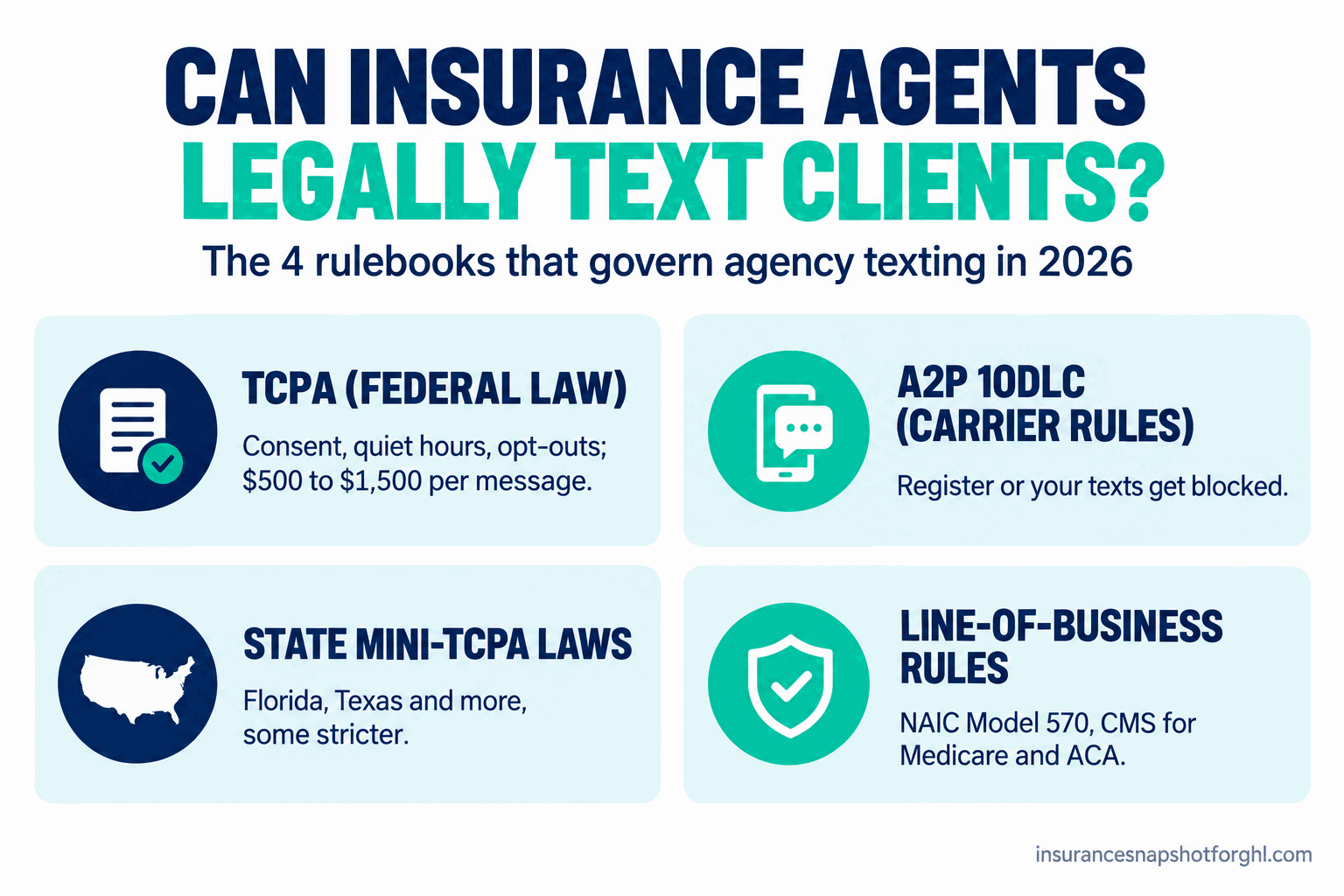
Most agents think “the texting law” is one thing. It is four, and they stack, so you satisfy all of them.
- The TCPA (federal law). The one with the per-message damages. Governs consent, quiet hours, and opt-outs, and is enforced mostly by private plaintiffs, which is why it bites small shops.
- A2P 10DLC (carrier rules). Not a law. The system carriers use to decide whether your texts deliver at all. Skip it and your messages are blocked, quietly.
- State “mini-TCPA” laws. Florida, Texas, Oklahoma, Washington and more have their own texting statutes, some stricter than federal, several with their own right to sue.
- Line-of-business rules. Sell life, annuities, Medicare, or ACA and your content is also governed by NAIC Model 570 and CMS marketing rules.
Clearing the TCPA does not clear A2P 10DLC. Here is each one.
Rule 1: Consent is the whole ballgame
Almost every TCPA problem is a consent problem. The law sorts your texts into two buckets. Service texts (a claim update, a payment reminder, a reply to a text the client sent) need only prior express consent: the client gave you their number for this kind of contact. Marketing texts (a renewal nudge, a cross-sell offer, a review request) need prior express written consent: a clear, affirmative opt-in where the client agrees to receive marketing texts and is told automated messaging may be used. No pre-checked boxes, and you have to be able to prove it, with a date and a record of what they agreed to.
Rule 2: The one-to-one rule is dead
For most of 2024, every compliance newsletter warned agents about a new FCC “one-to-one consent” rule that would have forced a separate opt-in for each company and wrecked shared marketing. It does not exist anymore. On January 24, 2025, the Eleventh Circuit, in Insurance Marketing Coalition Ltd. v. FCC, vacated the rule as beyond the FCC’s authority (Morrison Foerster; opinion). The FCC then removed the vacated language from its rules (FCC). In practice, one clear written consent can cover more than one seller as long as it discloses that automated marketing is coming, so you do not need an itemized opt-in per carrier. The written-consent standard in Rule 1 still applies in full; only the extra per-seller layer went away.
Rule 3: Quiet hours
The TCPA sets quiet hours: no marketing texts before 8am or after 9pm in the recipient’s local time (47 C.F.R. 64.1200). Local time matters across state lines: 8:30am in Ohio is 5:30am for your client who moved to Arizona, and that is a violation. Plaintiff firms spent 2025 filing class actions arguing any marketing text outside the window breaks the rule even with consent. Defense lawyers argue valid written consent makes the message not a “solicitation,” and one Delaware court agreed, but that is one district court, not settled law (Squire Patton Boggs). Do not test it. Schedule every automated marketing text for 8am to 9pm in the client’s time zone, and let service replies the client started fall where they may.
Rule 4: STOP, HELP, and opt-outs
Every person you text can make you stop, and you have to make it easy. When someone replies STOP (or END, CANCEL, QUIT, UNSUBSCRIBE, any capitalization), your system stops messaging that number and sends one final confirmation. When they reply HELP, you send who you are and how to reach you. But the TCPA also lets a consumer revoke consent by any reasonable means, not just the word STOP. If a client texts “please quit texting me,” that is a valid opt-out, and ignoring it because it was not the magic word is the kind of willful violation that turns $500 into $1,500 per message.
The operational trap is the manual list. If opt-outs live in one person’s head, someone texts an opted-out client eventually, and that single message is a clean violation. Suppression has to be automatic and apply across every campaign the instant the client replies. Where you can, flag marketing and service consent separately, so a STOP to your cross-sell campaign does not also cut off a claim update the client would want.
Rule 5: A2P 10DLC, or why your texts vanish
Nobody warns new agents about this rule, and it kills more texting programs than the TCPA ever will. A2P 10DLC is the technical name for a business sending texts from a normal 10-digit number. Carriers built a registration system, run through The Campaign Registry, where a business registers its brand and messaging campaigns before it can send (The Campaign Registry). It is not a law. It is a gate the carriers enforce, and since early 2025 they block unregistered traffic outright, with no bounce and no warning, so unregistered texts silently fail. To send reliably you register your brand (legal agency name, EIN, address), register each use case, and get approved, which usually takes a few days. Carriers also apply the CTIA content rules: no SHAFT content (sex, hate, alcohol, firearms, tobacco), clear opt-in and opt-out. Registration reduces filtering but does not eliminate it, so clean sending still matters, and a texting program is not “set up” until it is registered.
And name your agency in every marketing text, especially the first in a sequence, so a client never mistakes “Hi, your renewal is coming up” for a scam and reports you as spam. Carriers check for this at approval.
Service texts vs marketing texts
The fastest way to stay compliant is to know which bucket a text falls in before you send it.
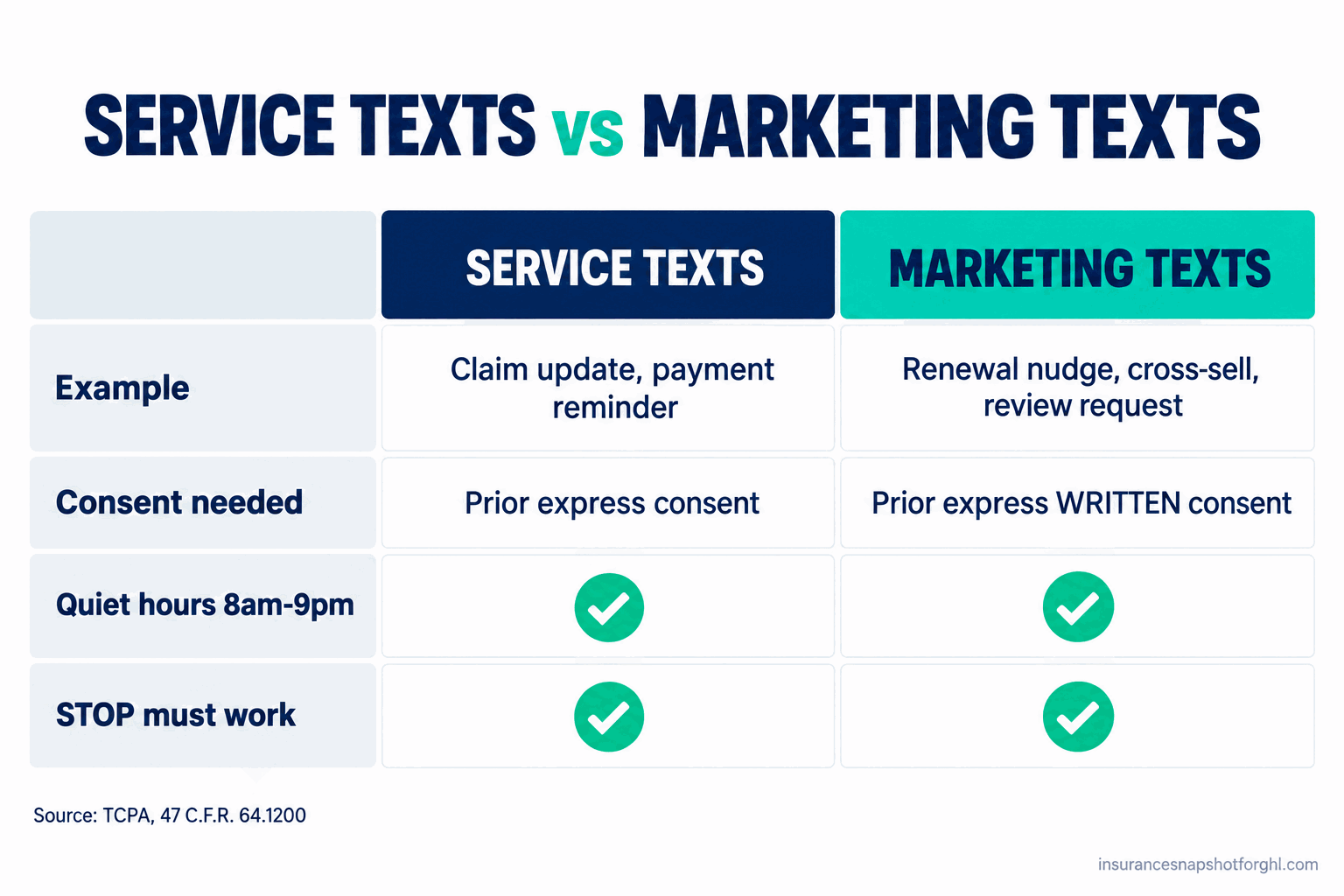
| What you’re sending | Bucket | Consent needed | Quiet hours? | STOP works? |
|---|---|---|---|---|
| Claim status the client is waiting on | Service | Prior express (they gave the number) | Treat as yes | Yes |
| Payment-failed / lapse alert | Service | Prior express | Treat as yes | Yes |
| Reply to a text the client sent | Conversational | Covered by their message | No | Yes |
| “Your renewal is coming, let’s review” | Marketing | Prior express written | Yes | Yes |
| Cross-sell offer | Marketing | Prior express written | Yes | Yes |
| Google review request | Marketing | Prior express written | Yes | Yes |
When you are not sure, treat it as marketing: comply with the stricter rules and you are safe for the service ones too.
How the rules scale: solo, five-producer, multi-location
The rulebook does not change with size, but how you comply does. The solo operator’s risk is informality: texting from a personal cell, no record of who opted in, an opt-out list that is your memory. The fix is one platform that holds consent and suppresses opt-outs automatically, plus one A2P registration under your EIN. The five-producer agency’s risk is inconsistency: a client who told one producer to stop still gets texts from another. Centralize, so everyone texts through the same registered system and opt-outs suppress across all producers at once. The multi-location shop’s risk is scale: a defect costs one message times the whole database, so you want campaigns registered per use case, timestamped consent you can produce on demand, and a written policy your E&O carrier has seen.
Steal this: compliant copy
Adapt the bracketed parts and run it by your own counsel.
Opt-in line on your quote form or website (the consent that makes marketing texts legal):
By checking this box, I agree to receive marketing and service text messages from [Agency Name] at the number provided, including messages sent by automated means. Consent is not a condition of purchase. Msg & data rates may apply. Reply STOP to opt out, HELP for help. [Terms] [Privacy].
STOP confirmation (automatic, one message only):
[Agency Name]: You’re opted out and won’t get more texts from us. Reply START to rejoin. For policy help, call [phone].
Renewal-review text (marketing, send 8am to 9pm local, written opt-ins only):
[Agency Name]: Hi [First Name], your [auto] policy renews [month]. Rates moved this year, let’s make sure yours still fits before it renews. Reply here or call [phone]. STOP to opt out.
Cross-sell text (after an auto client has a home need):
[Agency Name]: Hi [First Name], since we handle your auto, want a quick home quote to see if bundling saves you money? Reply YES and I’ll run it. STOP to opt out.
How this breaks
The failures are predictable.
- The database blast with no written consent. You have the numbers because people bought policies, not because they agreed to marketing. One annoyed recipient who knows the law, and that is $500 per message. Fix: only market to numbers with logged written opt-in.
- The purchased lead list. A vendor’s consent form rarely names your agency the way yours must, so you inherit the liability, not the vendor. Fix: get your own consent, and assume a bought opt-in is not enough.
- The personal cell phone. A producer texts from their own number: no consent log, no opt-out suppression, no A2P registration, and the records leave when they do. Fix: all client texting through the registered platform.
- The ignored “stop texting me.” A client opts out in plain English, the system misses it, three more texts go out. That is now willful. Fix: route non-keyword opt-outs to a human and honor them the same day.
- The 7am send. An automated reminder fires on your clock and lands at 6am two time zones over. Fix: schedule by the recipient’s local time, always.
Objections
“My clients gave me their numbers. Isn’t that consent?” For service texts they asked for, usually yes. For marketing texts, no. Handing you a number to service a policy is not agreeing in writing to automated promotional messages, and only written consent covers your renewal and cross-sell campaigns.
“I text from my personal cell, so none of this applies, right?” Wrong. The TCPA follows the message, not the device, so a marketing text to a non-consenting client is a violation from any phone. The personal cell is worse: no consent records, no automatic opt-out, no A2P registration, so you get maximum liability with zero proof of compliance.
“Isn’t compliance my software vendor’s job?” Your platform gives you the tools, but it cannot decide who you had consent to text or stop you pasting in a bought list. The consent, the list hygiene, and the policy are yours.
Life, Medicare, and ACA: the extra layer
Write only P&C and the four rulebooks above are your world. Touch life, annuities, Medicare, or ACA and there is a fifth layer on the content of your messages. For life and annuity marketing, NAIC Model 570 reaches your texts: claims must not mislead, and testimonials must be genuine and current, with paid endorsements disclosed as paid (NAIC Model 570). For Medicare and ACA, CMS rules tighten how you contact beneficiaries and what you can say, with penalties that run through your carrier appointments. Treat those templates as marketing material that needs the same review as a mailer. Our guide to what you can legally automate in insurance marketing covers the gift, review, and testimonial rules alongside this.
The bottom line
Can an insurance agent legally text clients? Yes, and you should, because it is the cheapest retention tool you have. The rulebook is not hard: get written consent for anything that smells like marketing, respect the 8am to 9pm window, honor every opt-out instantly, register for A2P 10DLC so your texts arrive, and say who you are in every message. Do that and texting runs quietly as a renewal and cross-sell engine. Skip it and you get the worst of both worlds, messages that do not deliver and liability that does. The agency that wins is the one that texts on purpose, with the proof to back it up.
General compliance education for insurance agencies, not legal advice. TCPA, state, and carrier-marketing rules change and are being actively litigated. Confirm your own texting program with your attorney, your E&O carrier, and your compliance counsel before you send.
FAQ
Can insurance agents legally text their clients in 2026?
Yes. Service texts the client asked for need prior express consent, which they give by providing their number. Marketing texts, like renewal nudges, cross-sell offers, and review requests, need prior express written consent: a clear, logged opt-in that discloses automated messaging. You also have to honor opt-outs, respect quiet hours, and register for A2P 10DLC so your texts deliver.
Is a phone number in my management system enough consent to text marketing?
No. A number collected because someone bought a policy is not written consent to market to them. The TCPA requires prior express written consent for marketing: a specific, affirmative opt-in that discloses automated messages, with a record you can produce. Promotional texts to numbers without a logged marketing opt-in are the most common TCPA violation small agencies commit.
What happened to the FCC one-to-one consent rule?
It was struck down. On January 24, 2025, the Eleventh Circuit, in Insurance Marketing Coalition v. FCC, vacated the one-to-one consent rule, and the FCC then removed it from its rules. You no longer need a separate opt-in for every carrier or seller. The requirement for prior express written consent for marketing still applies in full.
What are TCPA quiet hours for texting clients?
You generally may not send marketing texts before 8am or after 9pm in the recipient's local time zone. Whether valid written consent cancels quiet hours is being litigated and is not settled. The safe practice is to schedule all automated marketing texts for 8am to 9pm in the client's local time, regardless of consent.
Why aren't my business texts being delivered?
Most likely you are not registered under A2P 10DLC. Carriers require businesses to register their brand and messaging use cases through The Campaign Registry, and since early 2025 they block unregistered traffic outright, with no error message. Register through your texting platform, and keep opt-in, opt-out, and content clean, because registration reduces filtering but does not fully eliminate it.
About the author
Evan Whitfield is an insurance compliance and onboarding specialist at Insurance Snapshot for GHL, based in Columbus, Ohio. He focuses on the parts of insurance automation that get agencies in trouble if done carelessly, consent capture, STOP and HELP handling, CMS Medicare-marketing boundaries, and the disclosure language that has to sit inside an SMS. He writes practical guidance for agencies that want to automate without a compliance headache later. Editorial byline only. Evan is not a licensed agent or attorney and does not provide legal advice; confirm your own program with your own counsel.
Want the texting layer built and registered for you? See how the Snapshot is priced, book a 30-minute demo, or read the renewal cadence it runs.