
It is a Tuesday morning and a client calls, shaken, because a pipe let go overnight and the kitchen ceiling is on the floor. You take the report, you file it, the carrier takes over, the repair drags on, and you do not speak to that household again until the renewal notice goes out eight months later at a higher premium. They do not call to argue. They quietly move auto and home to the agent down the street who answered when they needed one.
Here is the answer up front. A claim is the single highest-risk retention moment in your entire book. The agency that follows up during and after the claim keeps the client; the one that files and forgets loses them. It is a short, repeatable sequence of touches from first notice of loss to a post-claim review, most of which software can run for you. Set it up once and it defends every claim, protects your E&O file, and turns the worst week of a client’s year into the reason they never leave.
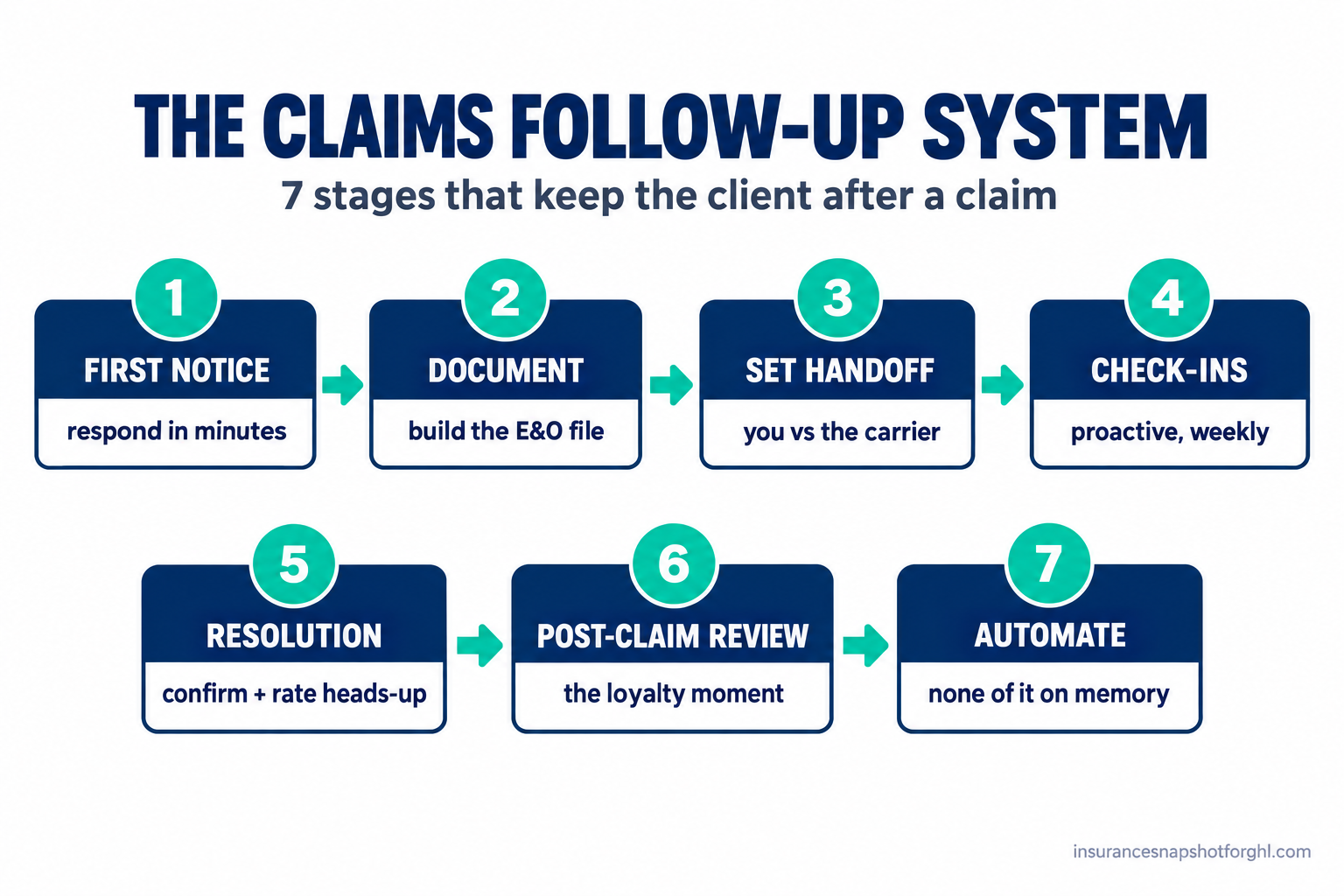
Table of contents
- Why a claim is where you keep or lose the client
- What a dropped claim costs you
- The claims follow-up system: seven stages
- The seven stages in detail
- Steal this: the full message sequence
- Solo, five-producer, and multi-location shops
- Keeping claim follow-up compliant
- Objections, answered
- FAQ
Why a claim is where you keep or lose the client
Most of the year a client has no reason to think about you. A claim changes that overnight. For one to six weeks they pay close attention to how they are treated, and decide whether the agency they pay every month is worth keeping. The data is clean. Accenture surveyed 6,754 policyholders across 25 countries and found about 31% were not fully satisfied with how a recent home or auto claim was handled. Of those, 30% had already switched carriers and another 47% were considering it: 77% of your unhappy claimants gone or halfway out the door (Accenture). An earlier global survey put it at 83% (Insurance Journal).
What makes a claim satisfying is not the size of the check. J.D. Power’s 2025 U.S. Property Claims Satisfaction Study (5,178 homeowners who filed a claim) put overall satisfaction at 682 on a 1,000-point scale, but the biggest swing was communication: 777 when customers found it very easy to reach their insurer, and 337 when they found it difficult (Insurance Journal). A 440-point gap, driven by whether someone picked up and kept them informed.
That is the opening independent agencies have. The carrier owns the file and the payout and is not great at contact. You can be: you are the human the client already trusts, and the follow-up the carrier skips is the one you can own.
What a dropped claim costs you
The cost of filing and forgetting is bigger and quieter than it looks.
The household you spent years to earn. A client with a claim in flight is your most fragile account and your most valuable. Losing them is not one policy; it is the auto, home, umbrella, and the referrals they would have sent. With a record 57% of auto customers shopping their policy last year (J.D. Power), a shaken claimant is one competitor call from gone. Defending that household is far cheaper than replacing it: a 5% lift in retention produces more than a 25% profit increase (Bain & Company), and independent agents place 61.5% of all U.S. P&C premium on books like yours (Big “I”).
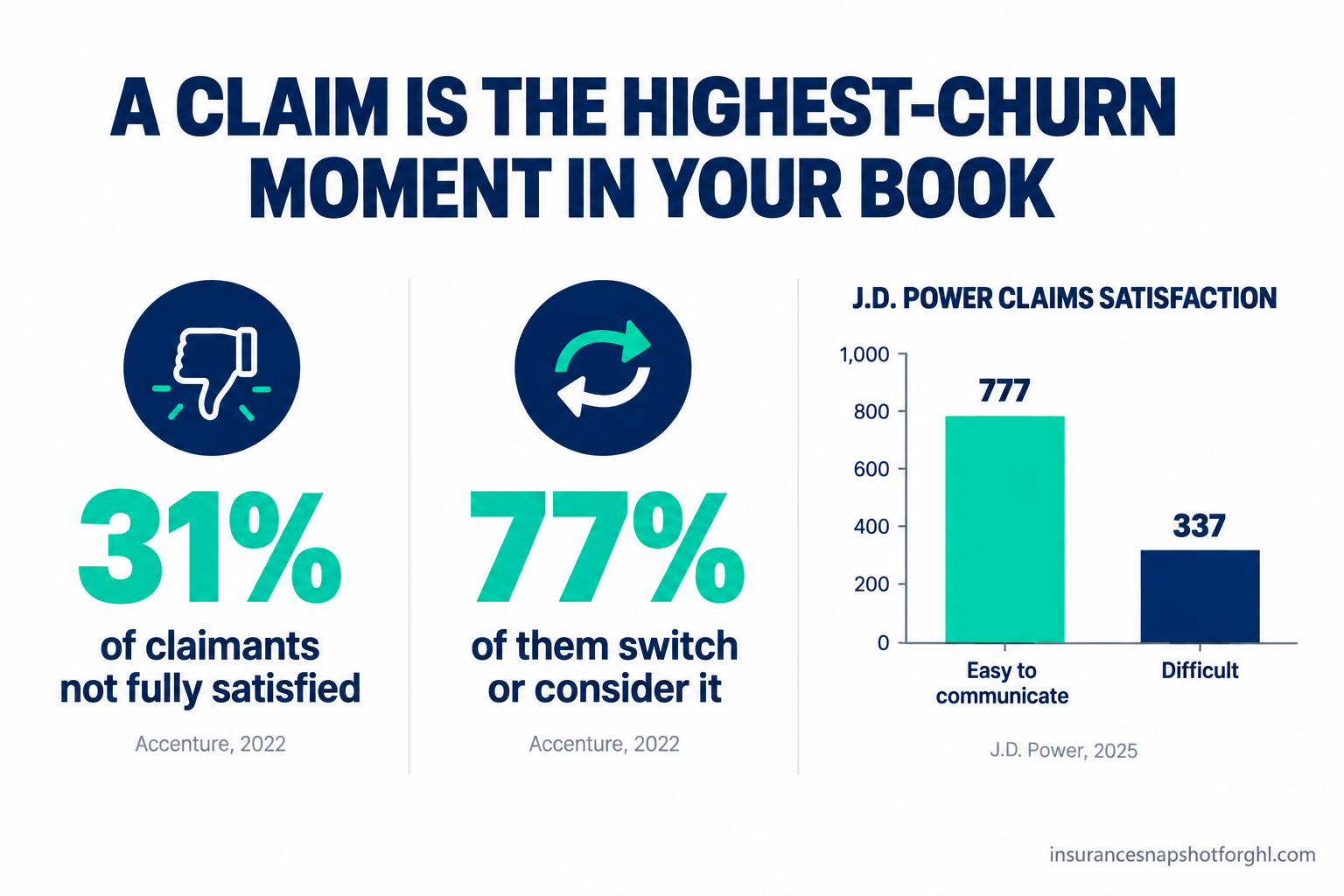
Sources: Accenture (2022); J.D. Power Property Claims Satisfaction Study (2025).
Your E&O exposure. A claim is also when an unhappy client looks for someone to blame. If coverage was short or an exclusion bites, the gap in your file turns a bad claim into a failure-to-procure allegation. The same follow-up that keeps the client builds the contemporaneous record that protects you, the whole point of good E&O documentation.
Your own time, spent badly. With the median insurance sales agent earning about $62,280 a year (BLS, May 2025), the expensive part is not the two-minute check-in text; it is remembering to send it on every open claim, every week, by hand. Software removes that, which is why most agencies never follow up.
The claims follow-up system: seven stages
Claim follow-up fails when it depends on anyone remembering. Built as a pipeline, it does not. The seven stages:
- Respond to the first notice of loss, fast and warm.
- Document the file so the E&O record writes itself.
- Set the handoff so the client knows what you do versus the carrier.
- Run proactive status check-ins while the claim is open.
- Handle the resolution conversation when it closes.
- Run the post-claim review, the loyalty moment most agencies skip.
- Automate the loop so none of it depends on memory.
Stages one, three, five, and six have a human moment. The rest is logistics a workflow handles.
Stage 1: Respond to the first notice of loss
Speed and tone in the first hour set the whole claim. When a client reports a loss, by any channel, at any hour, the first response should go out fast: acknowledge this is stressful, confirm you have it, and say what happens next and when. An after-hours intake and routing setup means a 9pm pipe burst gets an immediate, human-sounding acknowledgment instead of voicemail.
How it breaks: the silent first night. A loss reported after hours with no response until the next afternoon tells the client, on day one, that they are on their own. An automatic first-touch confirms receipt and sets the first call.
Stage 2: Document the file as you go
Every claim touch should land in the client record automatically: the report, the time, what was said, what you filed, what you advised, and what you did not. It is the contemporaneous file that decides an E&O dispute, and it is nearly impossible to reconstruct later. A CRM and workflow setup that timestamps each message and status change builds that record as a byproduct of the follow-up.
How it breaks: the memory file. If documentation waits until the claim closes, or lives in one producer’s inbox, the detail that matters is gone. Log contemporaneously or you do not really have a file.
Stage 3: Set the handoff expectations
Most claim frustration is really confusion about who does what. The client does not know whether the adjuster, the carrier, or you call next, so every delay feels like someone dropped the ball. Fix it in the first conversation: the carrier assigns an adjuster and controls the payout and timeline, you are their advocate, and here is roughly how long each step takes. Then put it in writing. A short recap naming the adjuster, the claim number, and the expected next step removes most anxious calls.
How it breaks: the client thinks you control the timeline. When the adjuster is slow and the client does not understand the split, the anger lands on you, the person they can actually reach. Name the division of labor early and “why is this taking so long” becomes “I know who to ask.”
Stage 4: Run proactive status check-ins
This is the stage that separates the agency that keeps the client from the one that loses them, and it is pure logistics. While a claim is open, a short check-in goes out on a set rhythm: a few days in, then weekly until it closes. The message does not need news. It needs to prove someone is watching: “Just checking the adjuster reached you, here is my direct line if anything stalls.” That is the behavior behind J.D. Power’s 777-versus-337 communication gap. Tie the cadence to claim status so check-ins stop at close and escalate to a live call if something stalls.
How it breaks: the cadence runs on memory. Nobody can track weekly check-ins across every open claim by hand, so it quietly stops, usually on the longest claims. Automate it off the claim’s open status.
Stage 5: Handle the resolution conversation
When the claim closes, do not let the carrier’s payment be the last word. Confirm the settlement landed and the repair is scheduled, and warn them about what they feel later: the deductible, and the chance the claim affects their renewal premium. Saying that out loud now stops a renewal surprise from reading as a betrayal. Pair this with your renewal cadence so the post-claim client is flagged for a proactive rate conversation, not an automated bill.
How it breaks: the claim just ends. No closing call, no warning about the renewal, so the first thing the client hears post-claim is a higher premium with no explanation. That is the exact sequence that sends a loyal household shopping.
Stage 6: Run the post-claim review
A few weeks after a claim closes, you have something rare: a client who just watched their coverage do its job and feels it. That is the moment for a short review. Thank them, confirm the repair held, re-check that limits and deductibles still fit, and, only if the outcome was genuinely good, ask for a review. A claim handled well is the most credible review a prospect will ever read, raw material for harvesting Google reviews that convert. If the claim went badly, this contact is a save call, logged and escalated, not a review request.
How it breaks: asking everyone for a review. Firing a request at every closed claim, even the bad ones, harvests one-star reviews and burns trust. Gate the ask on the outcome: good experiences to the review request, bad ones to a human save call.
Stage 7: Automate the loop
Notice how little of stages one through six is judgment. The acknowledgment, the handoff recap, the weekly check-in, the stop-when-closed logic, the outcome-gated review ask: all of it is rules. The hard phone call and the real advice are the only share that should need a person. Agencies skip claim follow-up not because they doubt it works, but because doing it reliably, on every claim, by hand, is a job no small shop has the staff for. A workflow that keys off claim status, built once on a platform like GoHighLevel with TCPA-safe SMS, does the remembering so your people can do the talking.
A 440-point satisfaction gap driven by contact, not payout. Source: J.D. Power 2025 U.S. Property Claims Satisfaction Study, via Insurance Journal.
Steal this: the full claims message sequence
Adapt the names, keep the timing. Every text goes only to consented clients and carries opt-out language.
First-notice acknowledgment (within minutes of any loss report):
Hi {first name}, this is {agency}. I have your report about {the loss} and I am so sorry this happened. I am on it. I will call you by {time} to walk through next steps. If it is urgent before then, reply here or call {direct line}.
Handoff recap (after the first real call):
Thanks for talking it through, {first name}. Your claim number is {number}. {Carrier} will assign an adjuster who handles the inspection and payout, usually within {X} business days. I am your contact for anything that stalls, and I will check in along the way, so you do not have to chase me.
Status check-in (a few days in, then weekly while open):
Hi {first name}, just checking the adjuster from {carrier} reached out and the inspection is set. Anything feeling stuck? Reply here or call {direct line} and I will push on it.
Resolution confirmation (when the claim closes):
Glad to see your claim closed, {first name}. Did the payment come through and is the repair done or scheduled? One heads-up so nothing surprises you: a claim can affect your renewal premium. When yours comes up I will review it with you first.
Post-claim review, good outcome (two to three weeks after close):
{First name}, really glad we got you taken care of. If you have 60 seconds, a short review of how the claim went would mean a lot and helps other families know who to call when something goes wrong: {review link}. No pressure either way.
Save-call trigger, bad outcome (internal, routes to a person):
Claim closed with a low satisfaction signal. Do not send the review request. Assign {producer} to call within 24 hours, log it, and flag the account for the renewal review.
Loaded into a workflow keyed to claim status, the sequence runs itself; your staff step in only for the first call, a stall, and the save.
How solo, five-producer, and multi-location shops run it
The system is the same. Who touches which stage is not.
The solo operator. Automation is the only way this happens at all. Let the workflow own every logistics stage, and personally take only the first call and any stall. Set the stall threshold generously, say ten days, so you are pulled in only when a claim actually needs you.
The five-producer agency. Assign each claim an owner, usually the producer or CSR on the account, and let the system notify that owner on the human stages while handling the texts centrally. Add one rule that matters: a claim with no status change past your threshold auto-escalates to a manager, so a swamped producer cannot let a fragile claim go dark.
The multi-location shop. Consistency is the whole game, because one location that files-and-forgets drags the brand’s reputation. Standardize the templates and cadence centrally so every office runs the identical sequence, but keep the direct line and signature local. Roll the per-location check-in rates up to one dashboard; the lowest usually has the softest retention.
Keeping claim follow-up compliant
Claim follow-up touches a client’s phone, so the rules that govern agency texting apply.
TCPA and A2P 10DLC. Any automated or templated text needs prior express consent, a registered 10DLC campaign, and working STOP/HELP handling. Claim status is closer to transactional than promotional, but do not treat that as a loophole: capture consent at intake, keep the content about the claim, and honor opt-outs instantly (TCPA-safe insurance SMS). And be clear, there is no FCC one-to-one consent rule in force; it was vacated by the Eleventh Circuit in January 2025 and the agency removed the language, so ignore any vendor still selling you on it (FCC).
Anti-rebating. A post-claim thank-you is fine. A gift to thank a client for a review or a referral can cross into rebating, and the limits are strict and local: Florida caps client gifts at $100 per person per year, Texas at $25. Keep appreciation within your state’s limit.
Reviews and testimonials. Never pay for a review and never edit one. If you sell life or annuity products and solicit a testimonial, NAIC Model 570 requires it to be accurate, unedited, and disclosed as a “Paid Endorsement” if any compensation changed hands (NAIC). If you write Medicare or ACA lines, CMS marketing rules may also apply to how you contact those clients.
Objections, answered
“Won’t automated claim texts feel cold when someone just had a loss?” They feel cold only if they read like marketing. Written in the client’s name, from their agent’s number, confirming you have their claim, a text is the opposite of cold. It is proof someone is paying attention at the moment they feel abandoned. The impersonal claim is the one where nobody reaches out.
“The carrier handles the claim. Why is this my job?” Because the carrier handles the file and you handle the relationship, and the client renews with the relationship. The carrier will not call to see how your client is holding up, warn them about the renewal, or ask for a review. The whole reason a client pays an independent agent instead of buying direct is to have a human in their corner when something goes wrong.
“I already log claims in my AMS.” Your AMS records that a claim exists; it does not text on day three, escalate a stall, confirm resolution, or gate a review. This system sits on top of whatever you track claims in and adds the one thing an AMS does not: proactive, scheduled, two-way contact.
FAQ
How soon should I respond when a client reports a claim?
Within minutes, even if it is just an acknowledgment. A fast, warm confirmation that you have the report and will call by a specific time removes the day-one fear that the client is on their own.
What should a claim status check-in actually say?
It does not need news. It needs to prove someone is watching. A short message a few days in, then weekly, confirming the adjuster made contact and offering your direct line if anything stalls. That steady contact drives J.D. Power's 440-point communication gap.
Should I ask every client for a review after their claim closes?
No. Gate the request on the outcome. Route good experiences to a review ask a few weeks after close, and bad ones to a logged save call instead. Asking everyone harvests one-star reviews and burns trust.
Is texting clients about their claim a TCPA problem?
It is governed by TCPA and A2P 10DLC. Capture consent at intake, register a 10DLC campaign, keep the content about the claim, and honor STOP instantly. Note there is no FCC one-to-one consent rule in force; it was vacated in 2025.
Can a one-person agency really run this on every claim?
Yes, because six of the seven stages are automation. A solo shop lets the workflow own the acknowledgment, handoff recap, check-ins, resolution confirm, and review ask, and personally takes only the first call and any stall escalation.
Claim follow-up is the rare retention play that costs almost nothing to run and defends the accounts you least want to lose. Build it once, key it to claim status, and the worst week of your client’s year becomes the reason they stay.