
It is 9:10am and there is a certified letter on your desk from a law firm you have never heard of. A client you wrote four years ago had a fire, the dwelling limit did not cover the rebuild, and they say you never warned them it was low. You remember telling them. But the producer who handled it has left, and the account holds a dec page, a signed application, and nothing else. No note. No email. No proof.
Here is the answer up front: an E&O claim is almost never lost on what you did, but on what you cannot prove you did. The agencies that win are the ones whose file shows, in writing and with a date on it, that they had the conversation, made the recommendation, and the client chose otherwise. Documentation is not paperwork you do after the real work. For your E&O, it is the real work.
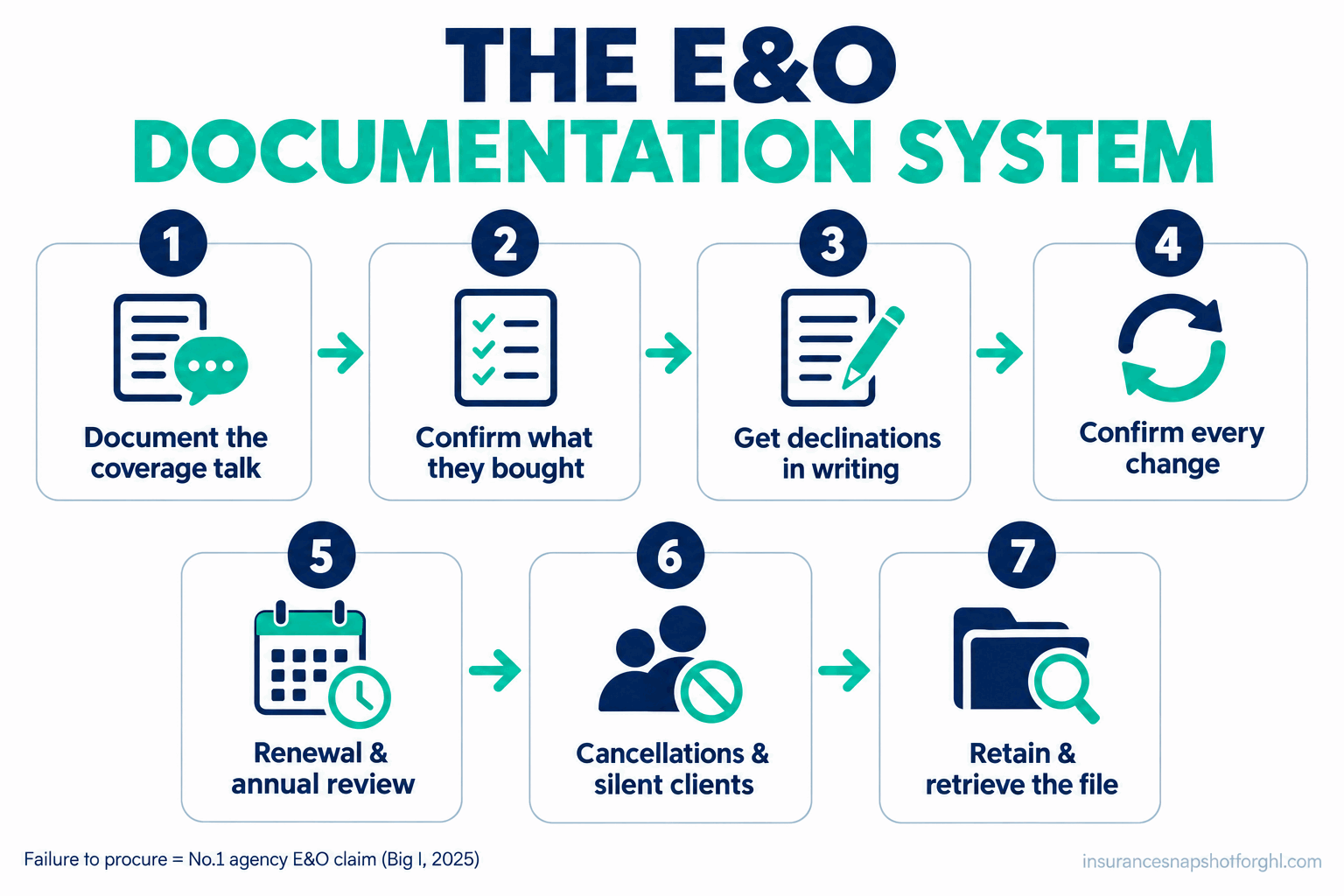
Table of contents
- Why documentation decides the E&O claim
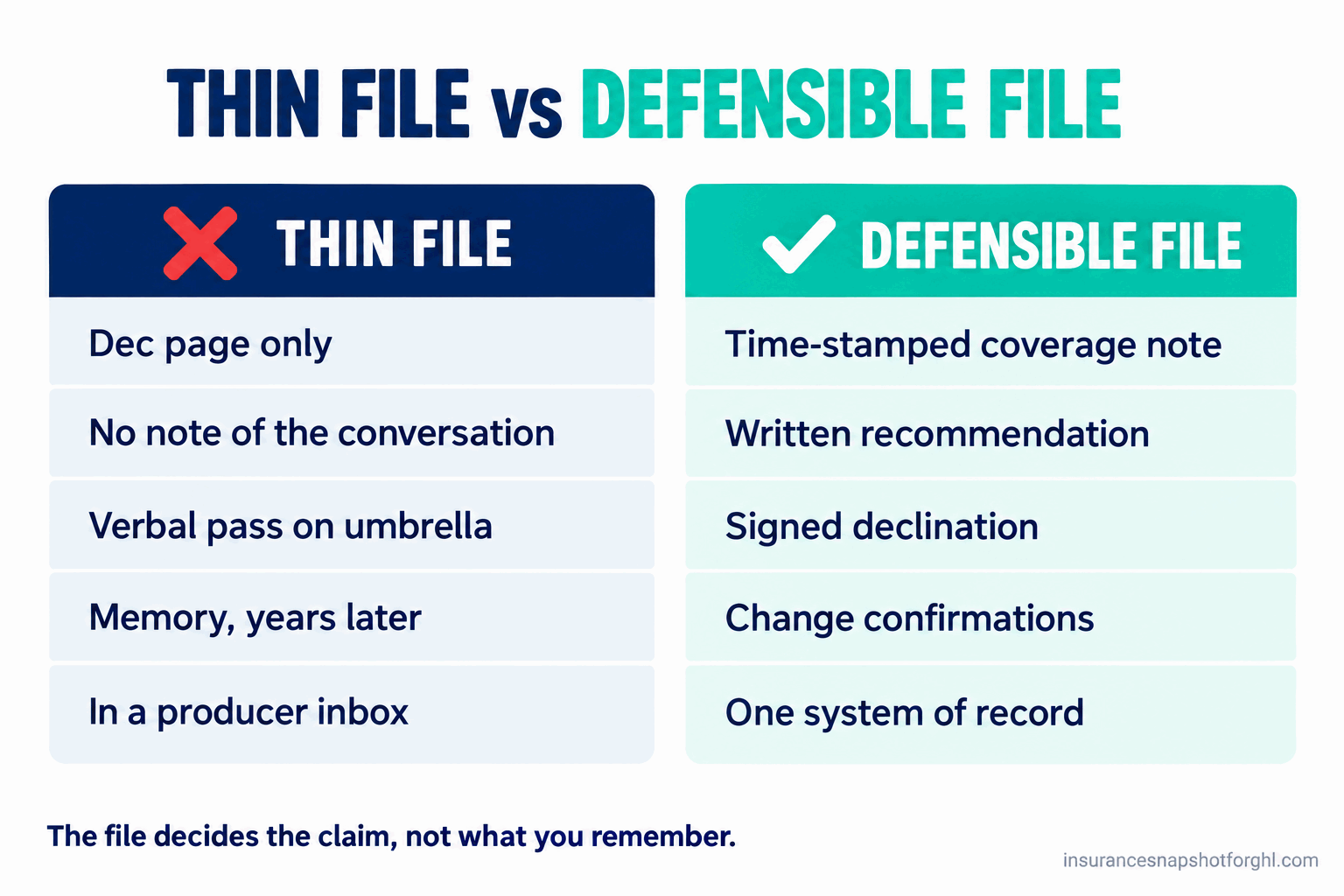
- What a thin file actually costs you
- The one rule: contemporaneous, specific, time-stamped
- Stage 1: Document the coverage conversation
- Stage 2: Confirm what they bought and what they skipped
- Stage 3: Get every declination in writing (steal this copy)
- Stage 4: Confirm every change
- Stage 5: Document the renewal and annual review
- Stage 6: Cancellations, non-renewals, and the silent client
- Stage 7: Retain and retrieve the file
- Solo, five-producer, and large: who documents what
- The compliance and privacy layer
- Objections
- The claim you won
- FAQ
Why documentation decides the E&O claim
Start with the claims data. Failure to procure or to give sufficient coverage is the No. 1 loss driver for agency E&O, per Amanda Juratovic, the Big “I” assistant VP of E&O operations, who reported a sharp 2025 uptick in frequency and severity (IA Magazine). One analysis of Big “I” member data puts it at about 24% of P&C agent claims.
Nearly all of those are a dispute about what was said and advised. The client says “you never told me I needed more.” You say “I did.” With no file, it is your word against a sympathetic plaintiff whose house burned down. Nancy Germond, the Big “I” executive director of risk management, calls documentation “the star of the show.” David Walker, an expert witness for agent E&O carriers, puts it in a line: communication equals avoidance, documentation equals defensibility (IA Magazine).
You also run a channel with real exposure. Independent agents place 61.5% of all U.S. P&C premium (Insurance Journal), and in commercial lines, where Swiss Re says the biggest claims live, the independent share is about 87%.
Independent-agent share of U.S. P&C premium by segment, 2024. The channel dominates commercial lines, exactly where Swiss Re reports the largest E&O claims, so documentation matters most on the accounts with the biggest limits. Source: Big “I” 2025 Market Share Report via Insurance Journal.
What a thin file actually costs you
Run the math. An E&O claim that goes to defense can cost tens of thousands in legal fees before a dollar of settlement, and a settlement on an underinsured dwelling can run into six figures. The fix costs a few minutes per account, the cheapest insurance you will ever buy on your own business. And the underinsurance it guards against is not rare: researchers cited by the Big “I” estimate about three-quarters of homeowners may lack enough coverage to fully rebuild after a disaster (IA Magazine). Every one is a failure-to-procure claim waiting for a trigger, and the file decides whether it lands on you or the client who chose the limit.
The one rule: contemporaneous, specific, time-stamped
Three properties make a note worth defending, and one missing any of them is worth far less.
Contemporaneous. Written the same day. A note created the week a claim is filed looks exactly like what it is; a note time-stamped two years earlier is almost impossible to attack.
Specific. “Discussed coverage” proves nothing. “Recommended $500K dwelling per the replacement-cost estimate; client chose $350K to hold the premium; explained the gap” proves everything. Name who, what, when, and the next step.
Time-stamped and unalterable. This is where your AMS earns its keep. System notes carry a date and time that cannot be changed later, far more persuasive than a paper file somebody could have back-dated (Big “I” New York). Log every note so it lives on the account, not in an inbox.
Stage 1: Document the coverage conversation
The first exposure is the first conversation. Whenever you take an application or review a risk, those judgments are what a future claim second-guesses.
Capture, the same day: the lines and limits discussed, the exposures you spotted (a pool, a teen driver, a home business, a boat, a rental), what you recommended, and what the client decided. A coverage checklist stored in the file, with notes from the conversation, is among the most persuasive documents an agency can have: it shows you walked the client through the exposures, not just quoted what they asked for.
Failure mode: writing the note only when something feels risky. The claim you lose is the one on the “routine” account you did not document. Make the note automatic on every new business, not a judgment call in the moment.
Stage 2: Confirm what they bought and what they skipped
The internal note protects you. A written confirmation protects you twice: it puts the facts in front of the person who might later dispute them, while they can still correct the record. After you bind, email what you have and what you chose not to have to hold the premium, leading with the declined items. Silence then becomes part of your defense, and a reply like “actually, add the umbrella” catches a gap before it becomes a claim.
Stage 3: Get every declination in writing (steal this copy)
This is the stage that wins the most claims. A client turning down coverage you recommended, or picking a limit below what you advised, is the whole ballgame in a failure-to-procure claim. Germond’s guidance is direct: if a client declines coverage, keep a signed declination, or at minimum proof a declination form was sent (IA Magazine).
Some declinations are statutory. UM/UIM, and in many states PIP, require a signed selection or rejection, and a missing signature is a classic way agencies end up owing the declined coverage. Others are discretionary but just as important: umbrella, water backup, higher dwelling limits, flood. Get them all, signed where you can.
Failure mode: accepting a verbal “nah, I’m good.” A verbal declination is worth almost nothing two years later. Convert every “no” into a dated email at minimum, and a signed form for anything statutory, which your state requires the insured to select or reject in writing, never issuing the policy without it.
Stage 4: Confirm every change
Mid-term changes are quiet landmines. A client calls to “drop the extra car” or “lower my limits to save money,” you make the change, and nobody writes down why. The dropped coverage is then exactly what a claim needs, and the client remembers asking you to save money, not to remove protection.
Confirm every change in writing, the same day, stating plainly what it does to their coverage. Signed applications, transmittals, and confirming emails are among the key documents that defend a claim (Big “I” New York).
Failure mode: making the change faster than you document it. The gap between “done” and “documented” is where the claim lives. If you cannot write the confirmation now, the change waits.
Stage 5: Document the renewal and annual review
Exposures change every year. The client finishes the basement, buys a rental, starts a side business in the garage. Renew on autopilot while the coverage no longer fits the risk and you own that gap. Germond recommends annual coverage reviews for exactly this reason.
You do not need a sit-down on every account. You need a documented touch: a review note confirming you looked, and a short client email asking whether anything changed this year. Even an unanswered review email defends you: it shows you offered the review and the client reported nothing.
Failure mode: treating the renewal as a billing event. A renewal is a fresh coverage decision, and an undocumented one is a fresh exposure. Log the review, send the ask, note the reply or the non-reply.
Stage 6: Cancellations, non-renewals, and the silent client
The end of a relationship is where files go thin and claims go deep. Three moments need documentation most and usually get it least.
Cancellations. When a client cancels or lets a policy lapse, document that you told them what losing coverage means and the date it ends. The client who cancels to save money and then has a loss will say you should have stopped them; your note showing you warned them ends that.
Non-renewals. When a carrier non-renews a client, your re-placement is an E&O-sensitive event: a lapse in the seam creates a coverage gap. Document the notice date, your contact, the options presented, and the bind so there is no unexplained window. Our re-placement playbook for when a carrier drops your book and the customer retention playbook cover the rest.
The silent client. The most dangerous account stops answering a renewal or payment reminder. Document every attempt to reach them. If a policy cancels for non-pay after three warnings, your log of those warnings is the difference between “the agency dropped the ball” and “the client was warned and did not respond.” Automated reminders that log every send build that record for you.
Failure mode: letting a quiet client go quietly. Without a trail of attempts, a lapse looks like your failure.
Stage 7: Retain and retrieve the file
A documented file you cannot find, or deleted too soon, is the same as no file. Two rules.
Keep it long enough. A claim can surface years after the work. In New York the limitations period for claims against agents can run as long as six years, and Big “I” New York recommends keeping file materials, emails and system notes included, for at least seven years (Big “I” New York). Periods vary by state and claim type, so retain for the longest that applies.
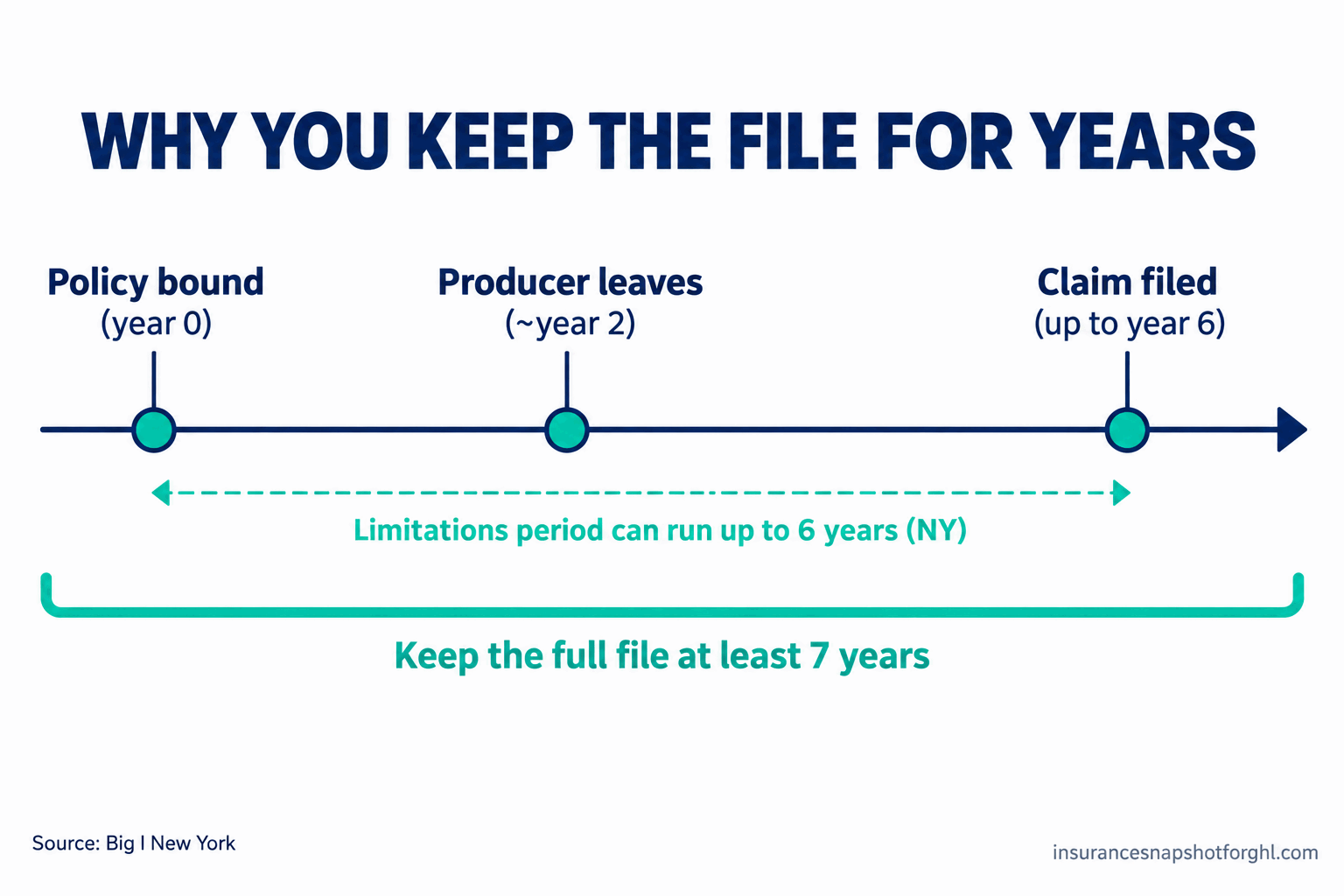
Make it retrievable. The file has to come back whole, on demand, which means one system of record, not a mix of inbox, drawer, and sticky note. E&O loss-control guidance is consistent: a disciplined, retrievable file is the backbone of the defense (Utica National).
Failure mode: storing the proof in the one place that leaves with the person. When a producer resigns and their inbox is wiped, every undocumented conversation walks out with them. Keep the record in the agency’s system.
Solo, five-producer, and large: who documents what
The system is the same. Who runs it, and where it breaks, changes with your size.
The solo operator. You are producer, service team, and file clerk, so documentation is the first thing that slips when you are busy. Automate it, and let templated confirmations and logged reminders carry the routine. The solo shop that loses the claim is the one that “meant to write it up later.”
The five-producer agency. Your risk is inconsistency, one producer documenting everything, another nothing, the claim landing on the second one’s account. Write a procedures manual, run internal audits that sample files against it (a practice the Big “I” recommends), and share the templates.
The large agency. Your constraint is visibility and turnover, so build documentation into the workflow: a new-business step that is not complete until the declination form is attached, a renewal stage that requires a logged review. When documentation is a required field, not a good habit, it survives staff changes.
The compliance and privacy layer
Texting confirmations is regulated. If you send change or renewal confirmations by SMS, you need A2P 10DLC registration, prior express consent, and a working STOP opt-out on every message. One correction on something you may have heard: the FCC’s one-to-one consent rule was vacated by the 11th Circuit on January 24, 2025, and the FCC removed the rule text later that year, so consent reverts to the prior standard. Our field guide to TCPA-safe SMS covers the setup.
Anti-rebating still applies to everything else. It does not touch documentation, but if your retention efforts include client gifts, the limits vary by state (Florida caps gifts at $100 a year, Texas at $25). Our insurance marketing compliance guide has the details.
Objections
“I don’t have time to document every conversation.” You do not have time for the claim either, and it takes vastly longer. Templated confirmations and logged reminders handle most of it, and the 90-second note is the only manual part.
“My clients trust me, they’d never sue.” Most E&O claims do not come from angry clients. They come from a loss the client cannot afford, where their insurer, attorney, or family looks for someone to recover from. Your relationship does not testify for you four years later. The file does.
“We already use an AMS, isn’t that enough?” The AMS is where the file lives and what makes it unalterable and retrievable, but it does not write the note or send the confirmation. The discipline, done by everyone, is still yours to build.
The claim you won
Picture that certified letter again, but with the file you should have had. You open the account and there it is: a dated note recommending the higher dwelling limit, an email stating the client chose $400K to hold the premium, a declination confirmation with their “confirmed” reply. Your E&O carrier reads it, calls the plaintiff’s attorney, and the claim goes away, because there is nothing to argue about. You did your job, and you can prove it.
That is the whole difference. Not whether you are a good agent, but whether the file can speak for you when the conversation is years old. Build the system once, let the routine run itself, and the next certified letter is a bad morning, not a bad year.
Start with the companion piece on how much E&O a small agency actually needs, then read how to automate insurance document collection and the client onboarding playbook.
What is the most important thing to document to prevent an E&O claim?
A client's declination of coverage you recommended. Failure to procure is the No. 1 agency E&O claim, so a signed declination, or at minimum a dated email confirming what the client turned down, is the single highest-value record you can keep. Get a signed form for anything statutory, like UM/UIM or PIP rejections.
How long should an agency keep client files for E&O purposes?
Long enough to cover your state's limitations period, which can run several years. Big 'I' New York recommends keeping file materials, emails and system notes included, for at least seven years. Periods vary by state and claim type, so confirm with counsel or your carrier and retain for the longest that applies.
Are emails and system notes enough, or do I need signatures?
For most discretionary declinations and change confirmations, a dated email the client can reply to is strong documentation, especially when it is logged in your AMS with an unalterable time stamp. For statutory rejections like UM/UIM or PIP, you need the signed form your state requires, not just an email.
Why is a contemporaneous note better than a detailed memory?
A note written the same day carries a time stamp that cannot be faked, while a memory rebuilt two years later is easy for a plaintiff's attorney to attack. The short, specific note made when the conversation happened wins the defense.
What should I document when a client cancels or a policy lapses?
That you explained what losing the coverage means, the date it ends, and every attempt you made to reach a non-responsive client. If they cancel to save money and then have a loss, your note showing you warned them, and they chose to proceed, is what defends you.