
It is the second week of January and you are reading your December cancellation report. One line stops you: a household that carried auto and home with you for four years, gone to a direct writer over a $340 difference on the home renewal. You pull the file. The last time anyone spoke to them was the renewal notice, fourteen months ago. When the competitor called, there was nothing holding them.
Here is the answer up front. The fastest way to stop that is a once-a-year policy review on every household, run as an automated system instead of a thing you mean to get to. It defends the renewal before the rate ever lands, it is where a monoline customer becomes a multi-line household, and it is the cleanest proof you have for your E&O file. Most small agencies never run it, not because they doubt it works, but because booking a few hundred reviews a year by hand is a job nobody has time for. So let software do the remembering.
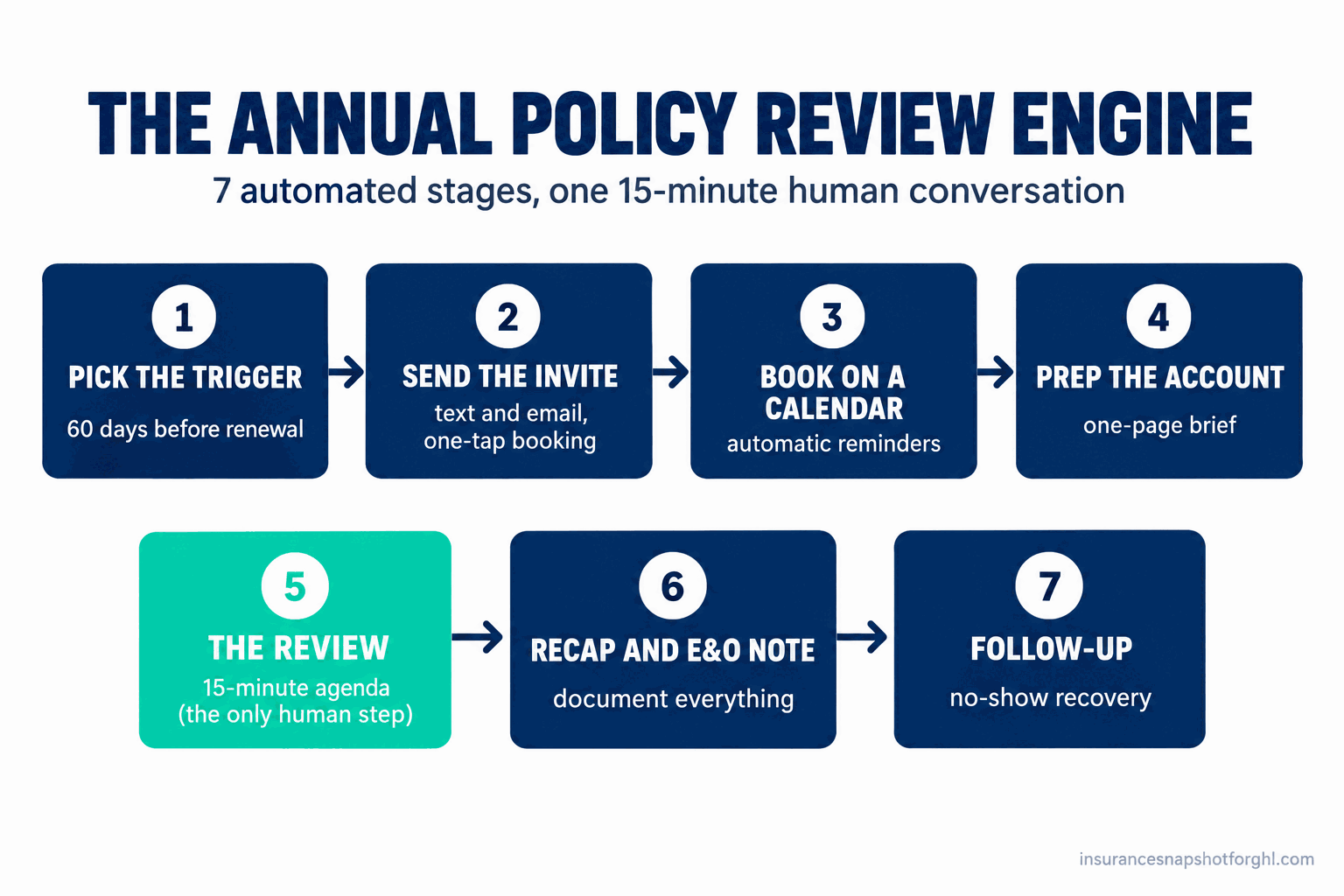
Table of contents
- What an annual policy review actually is
- What skipping reviews costs you
- The annual review engine: seven stages
- The seven stages in detail
- Steal this: the full message sequence
- Solo, five-producer, and multi-location shops
- Keeping annual reviews compliant
- Objections, answered
- FAQ
What an annual policy review actually is
It is a short, scheduled conversation, usually 15 minutes, where you check three things once a year: does the household’s coverage still match their life, has anything changed, and are there gaps or lines worth discussing. It is not a renewal notice and not a cold cross-sell call. It is the one contact in the year with nothing to sell.
Timing is why it works. Households do not decide to shop at renewal; they decide months earlier, based on whether they feel like a client or a line item. J.D. Power’s 2025 shopping study found a record 57% of auto customers shopped last year, and that even high-value, multi-policy households are now at renewal risk. The review gets ahead of that, and it is the natural home for the two things that keep a household: catching a coverage gap before it becomes a claim problem, and spotting the next line to write.
What skipping reviews costs you
The cost of not running reviews is larger and quieter than most owners think.
Coverage gaps you never caught. Rebuild costs have climbed and most clients have not kept up. The American Property Casualty Insurance Association estimates about two in three US homes may be underinsured, and the Insurance Information Institute reports only 30% of homeowners have raised coverage to match higher replacement costs (Insurance Business). Each is a client headed for a terrible claim who will blame you and leave. A review catches it while it is a quick endorsement.
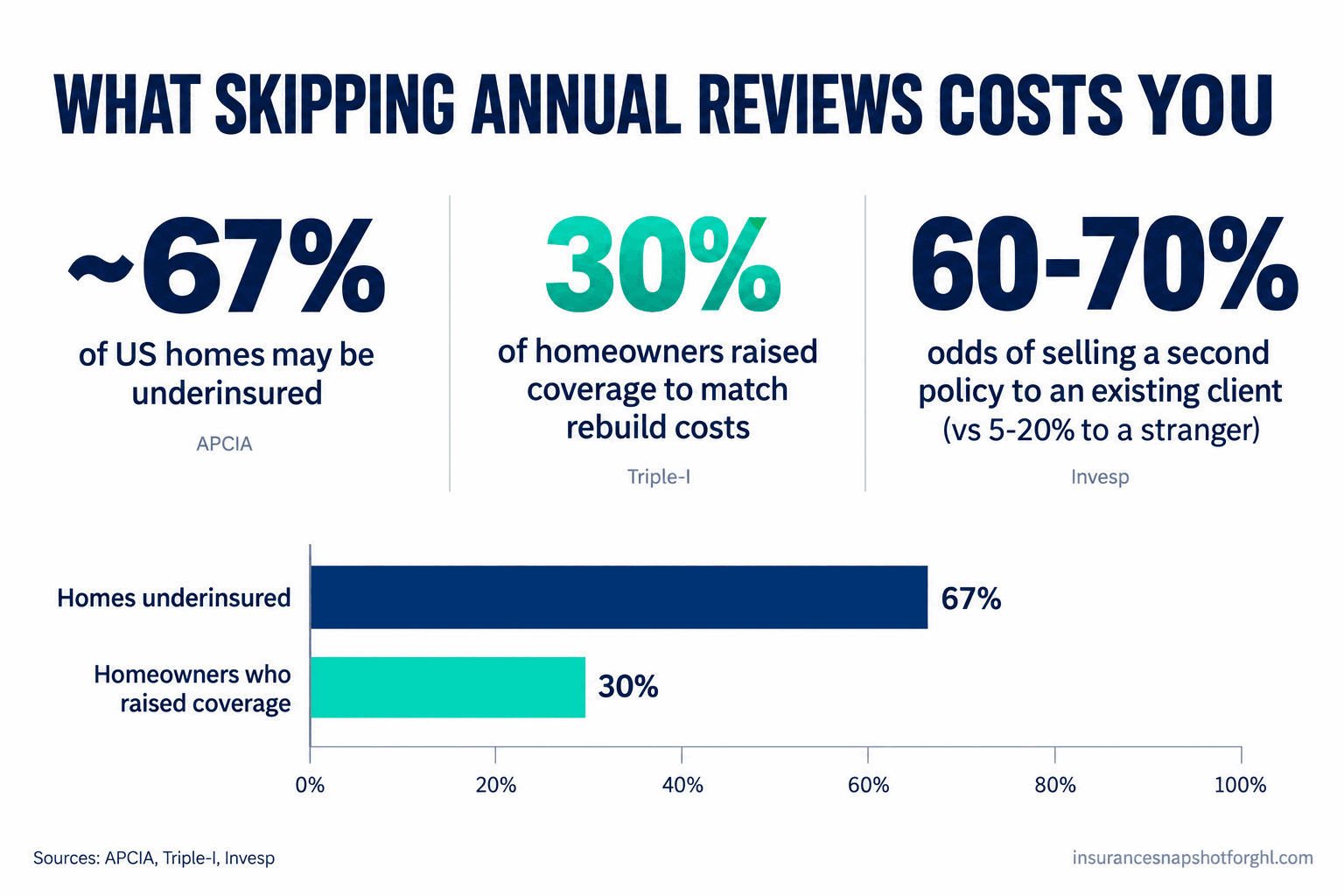
Sources: APCIA and Triple-I, via Insurance Business (Dec 2025); Invesp.
Second policies you never wrote. You are 60 to 70% likely to sell a second policy to an existing client versus 5 to 20% to a cold prospect (Invesp). A monoline household is the cheapest premium you will ever write, and independent agents already place 61.5% of all US P&C premium (Big “I”), so defending that book beats chasing new logos. In financial services, a 5% retention gain produces more than a 25% profit increase (Bain & Company).
Your own time. The median insurance sales agent earns about $62,280 a year, roughly $29.94 an hour (BLS, May 2025). The expensive part is not the 15-minute review; it is the hour of phone tag to book each one, times a few hundred households. That is the cost automation removes.
The annual review engine: seven stages
A review program is a pipeline, not a single action. Here are the seven stages:
- Pick the trigger and build the list of who gets a review this month.
- The invite goes out by text and email with an offer to book.
- Booking happens on a calendar, not by phone tag, with reminders.
- Prep pulls the account so the producer walks in informed.
- The review itself, run from a tight agenda.
- The recap goes to the client and the E&O note gets written.
- Follow-up catches no-shows and triggers the next action.
Six of the seven are logistics, not conversation. Your licensed staff only show up for stage five. Everything around it is what software handles so a human never has to.
Stage 1: Pick the trigger and build the list
The engine keys off one decision: when does a household become eligible? Trigger on the policy anniversary, which spreads reviews evenly across the year, or 60 days before renewal, which ties the review to peak retention risk. For most personal-lines books, 60 days pre-renewal wins: it lands the conversation while there is still time to re-shop, adjust coverage, or bundle before the notice goes out. Segment the list so the invite can flex: monoline versus multi-line, and high-premium households that deserve a producer call.
How it breaks: dirty dates. If renewal dates are missing or wrong, the trigger fires on the wrong week or not at all, and the engine quietly does nothing. Run a data-hygiene pass first so every active policy has an accurate renewal date and a line-of-business tag.
Stage 2: The invite
The invite is a short, warm message offering the review and making booking one tap. Send a text with an email backup: text gets read, email carries detail. Send the first invite at 60 days, a reminder at 45 if not booked, and a final nudge at 30. Three touches, then stop.
How it breaks: sending it like a marketing blast. If it reads like a promotion, it gets ignored or reported. Write it like a note from the person who handles their account. Every text carries opt-out language and goes only to clients who have consented.
Stage 3: Booking without the phone tag
This stage kills manual programs, so automate it first. The invite links to a live calendar that shows open slots, lets the client pick, books it, and sends confirmations and reminders automatically. The appointment automation handles the calendar and reminders. Set two reminders, one 24 hours before and one the morning of; a same-day text sharply cuts no-shows.
How it breaks: too much friction. A calendar asking for a dozen fields, or slots three weeks out, gets abandoned. Keep it to name, time, and phone, offer the next ten business days, and default to a phone review with video or in-person optional.
Stage 4: Prep the account before the call
A review where the producer is seeing the account live, for the first time, feels as bad as it sounds. When a review books, an automation assembles a one-page brief: current policies and limits, renewal dates, flagged coverage gaps, life-event signals, and the obvious cross-sell openings (auto with no home, home with no umbrella, business owner with only personal lines). The CRM and workflow automation tags the account and drops the brief where the producer sees it the morning of.
How it breaks: no prep, so the review becomes small talk. Without the brief, producers default to “everything still good?”, the client says “yep,” and the highest-value touch of the year is wasted. The brief forces the gap and the cross-sell onto the table.
Stage 5: The review itself
The one stage a human owns, run from a tight agenda so it stays 15 minutes:
- Confirm the basics. Who is in the household, what is insured, what changed. New driver, renovation, home office, marriage, baby, retirement. Each is a coverage change and often a new line.
- Check adequacy. Walk the big exposures. Is the dwelling limit keeping up with rebuild costs? Does auto liability match their assets? Any umbrella? Frame it as protection, not upsell.
- Surface the gaps and lines. If they are monoline: “You have your auto with us. Can I take a quick look at what you are paying on the home?” It does not feel like a pitch inside a review they agreed to.
- Get ahead of the rate. If an increase is coming, say so now, with context. J.D. Power’s 2024 home study found satisfaction dropped to 594 versus 686 on a 1,000-point scale after an insurer-initiated increase, but proactive communication sharply cut how many shopped (J.D. Power).
- Confirm next steps.
How it breaks: it turns into a sales ambush. The moment a client feels the review was a pretext to sell them life insurance, the trust it was meant to build is gone. Lead with service; the cross-sell is an outcome of a good review, never its purpose.
A roughly 10-point retention gap from one more policy. Source: J.D. Power U.S. Home Insurance Study, via BusinessWire.
Stage 6: The recap and the E&O trail
The review is not done when the call ends. Two things happen, both automatable. First, a recap goes to the client confirming what you discussed, what you are changing, and what they need to do. Second, and agencies forget this one, the review gets documented in the file: what you reviewed, recommended, and what the client chose, including what they declined. If a client turns down an umbrella or keeps a low dwelling limit, that note protects you when the claim comes in short. A documented review is one of the cleanest pieces of E&O evidence you can have (how much E&O a small agency needs).
How it breaks: the recap goes out but the file note never gets written. Make documentation part of the workflow, not a thing the producer does “later”, because later is where E&O trails go to die.
Stage 7: Follow-up and no-show recovery
Some clients will not book, and some book and do not show. Neither is a dead end with a recovery path. For no-shows, a message goes out within the hour. For non-bookers, the file stays tagged and the review offer rolls into the renewal cadence so the conversation happens either way. A smooth review is also the right moment to trigger a review-request ask and, where appropriate, a referral ask.
How it breaks: one no-show and you give up. Automated, the recovery message fires every time, and a meaningful share of no-shows rebook off that single text. The point of a system is that nothing falls through, even the parts a busy human would let slide.
Steal this: the full message sequence
Adapt the voice, keep the opt-out language, and make sure every recipient has consented. Written for SMS with an email backup carrying the same message in longer form.
60-day invite (text):
Hi [First Name], it is [Producer] at [Agency]. Your [policy type] renews in a couple of months and I would like to do a quick 15-minute review to make sure your coverage still fits before anything changes. Grab a time: [link]. Reply STOP to opt out.
45-day reminder (if not booked):
Hi [First Name], [Producer] again. Still happy to run that quick coverage review, no cost and no pressure. My calendar: [link]. Reply STOP to opt out.
24-hour confirmation:
Reminder: your policy review with [Agency] is tomorrow at [time], about 15 minutes. Need to move it? [link]. See you then.
No-show recovery (within the hour):
Hi [First Name], looks like we missed each other. No problem at all. Pick a new time whenever it suits you: [link].
Post-review recap (email):
Hi [First Name], thanks for the time today. Quick recap: [policies reviewed]. Here is what we are doing: [action items]. And what you chose to hold for now: [declined items]. Anything changes, text me anytime. Talk soon, [Producer].
That last line, recording what the client declined, is a courtesy and your E&O trail at once. Keep it.
How solo, five-producer, and multi-location shops run it
The engine is the same. Who does stage five, and how much, changes with the shop.
The solo operator. You are the producer, the service team, and the one reading the cancellation report, so the program has to protect your time. Default every review to a self-booked phone call, lean on the automation for the whole logistics chain, and reserve live reviews for your top 20% of households by premium. Run invites in small weekly batches, never one annual blast. The system remembers so you do not have to.
The five-producer agency. Now it is an assignment problem. Route each review to the producer who owns the household, drop the prep brief in their queue the morning of, and track an annual-review completion rate per producer. This is where mid-size programs quietly die: everyone assumes someone else is doing it. Make it a number on the board. A dedicated GHL VA can own the booking and prep layer so producers only show up for the conversation.
The multi-location shop. You are running the engine across teams with different calendars and capacity. Centralize the trigger and templates so every location invites consistently, but route booking to each location’s own calendar. Watch completion rate by location: the spread between your best and worst office is wider than anyone thinks and maps straight onto retention. The review is one lever in the full retention system.
Keeping annual reviews compliant
Automated outreach lives inside a few rules. None are hard; getting one wrong is expensive.
TCPA and consent. Every text goes only to clients who consented, carries clear opt-out language (STOP), and honors every opt-out immediately. Texting at scale means A2P 10DLC registration for your numbers; the mechanics are in TCPA-safe SMS for insurance agencies. One point worth stating plainly, because bad information is going around: there is no FCC one-to-one consent rule in force. It was vacated by the Eleventh Circuit in January 2025. Standard prior express written consent for marketing texts still applies, so capture it and keep the records.
Anti-rebating. Do not attach a gift or incentive to showing up. State anti-rebating laws cap client gifts at low amounts that vary by state (Florida caps client gifts at $100 a year, Texas at $25). A review is a service, not something you pay people to attend. We cover the gift-and-review rules in insurance marketing compliance.
Life, annuity, and Medicare. If a review touches life or annuity and you use client testimonials in marketing, NAIC Model 570 governs them: they must be accurate, unedited, and disclose a paid endorsement (NAIC). If you sell Medicare or ACA, keep contact and messaging inside CMS marketing rules.
Objections, answered
“Won’t clients find a yearly review annoying?” The opposite, framed as service. One warm, nothing-to-sell contact a year makes a client feel looked after. What annoys people is the reverse: silence for fourteen months, then a rate increase.
“I don’t have time to review hundreds of households.” You do not review them all at once, and you do not do the logistics. Invites go out in weekly batches, booking runs on a calendar, reminders fire themselves, and you show up only for the conversations that get booked. The meetings are the part that makes you money.
“My agency management system can’t do this.” Most cannot, and that is fine, because this does not live in your AMS. The trigger reads a renewal date; outreach and booking run in a CRM layer on top. You do not rip out Applied Epic, AMS360, or EZLynx, you bolt the engine on. We walk through that in automating renewal reminders without an AMS upgrade.
“We already send a renewal notice. Isn’t that enough?” The notice is the thing the review exists to get ahead of. If it is the first time a client hears from you all year and it carries an increase, you are introducing yourself with bad news. The review makes the notice a formality.
FAQ
What is an annual insurance policy review?
A short, scheduled conversation, usually about 15 minutes, where an agency checks once a year whether a client's coverage still fits their life, whether anything has changed, and whether there are gaps or added lines worth discussing. It is a service and retention touch, not a renewal notice, usually run 60 days before renewal.
How do you automate annual policy reviews?
The review stays human; everything around it automates. A workflow triggers off the renewal date to build the list, sends an invite by text and email, books the review on a self-service calendar with reminders, assembles a prep brief, sends a recap, documents the review, and recovers no-shows. Staff only show up for the 15-minute call.
When should you schedule a client's annual review?
For most personal-lines books, 60 days before renewal is the strongest trigger: it lands the conversation while there is still time to re-shop, adjust coverage, or bundle before the notice. Triggering on the policy anniversary is a fine alternative that spreads reviews evenly across the year.
Do annual reviews actually improve retention?
They are one of the strongest retention levers available. The review makes a renewal a non-event, catches coverage gaps, and is the natural moment to round out a household. Multi-line households retain far better than monoline, and a 5% retention gain produces more than a 25% profit increase in financial services (Bain & Company).
Is it compliant to text clients about a policy review?
Yes, with the rules followed: text only clients who consented, include clear opt-out language and honor STOP, and register numbers for A2P 10DLC if texting at scale. Do not attach a gift to attending, because state anti-rebating laws cap client gifts. There is no FCC one-to-one consent rule in force; it was vacated in January 2025. Standard prior express written consent still applies.
What should be on an annual review agenda?
Confirm the household and what is insured, check for life changes, review whether coverage limits still match the client's exposures (especially dwelling limits against rising rebuild costs), surface gaps or added lines, get ahead of any coming rate increase, and confirm next steps. Afterward, send a recap and document what was reviewed and declined.
About the author
Priya Raman is an Insurance Agency Growth Strategist who works with independent and captive agencies on turning an existing book into recurring, multi-line revenue and keeping every policy on the books. She came up running marketing for a multi-line agency, so she thinks in terms of retention by line, premium written, and producer capacity. Editorial byline only. Priya is not a licensed agent and does not quote, bind, or sell insurance.
Related posts
- Insurance customer retention: the 2026 playbook: the full set of retention levers the review sits inside.
- The renewal cadence that actually works (120/60/30/7): the sequence the review offer plugs into.
- The 48-hour auto-to-home cross-sell: turn the review’s cross-sell openings into bound households.
- Automate renewal reminders without an AMS upgrade: run the engine on top of your current system.
- How much E&O a small agency actually needs: why a documented review protects you.
Want the annual-review engine without building it? See what’s in the Insurance Snapshot for GHL, book a demo, or grab GoHighLevel with our partner bonuses.