
For a Pittsburgh insurance agency, a no-show isn’t a blank spot on the calendar — it’s a quote-ready buyer or a policyholder review that quietly walked out the door. A missed quote call or annual-review appointment is a producer hour you paid for and got nothing back, plus a lead who is now one Google search away from the next agent. The fix isn’t nagging people harder. It’s an automated reminder-and-recovery system that confirms the booking, reminds the client the right number of times, lets them reschedule in one tap, and chases the ones who still slip — without a producer lifting a finger.
This is the operator playbook: why no-shows hit Pittsburgh agencies harder than most, what an empty appointment slot actually costs, and the exact step-by-step automation that turns “didn’t show” into “rebooked.”
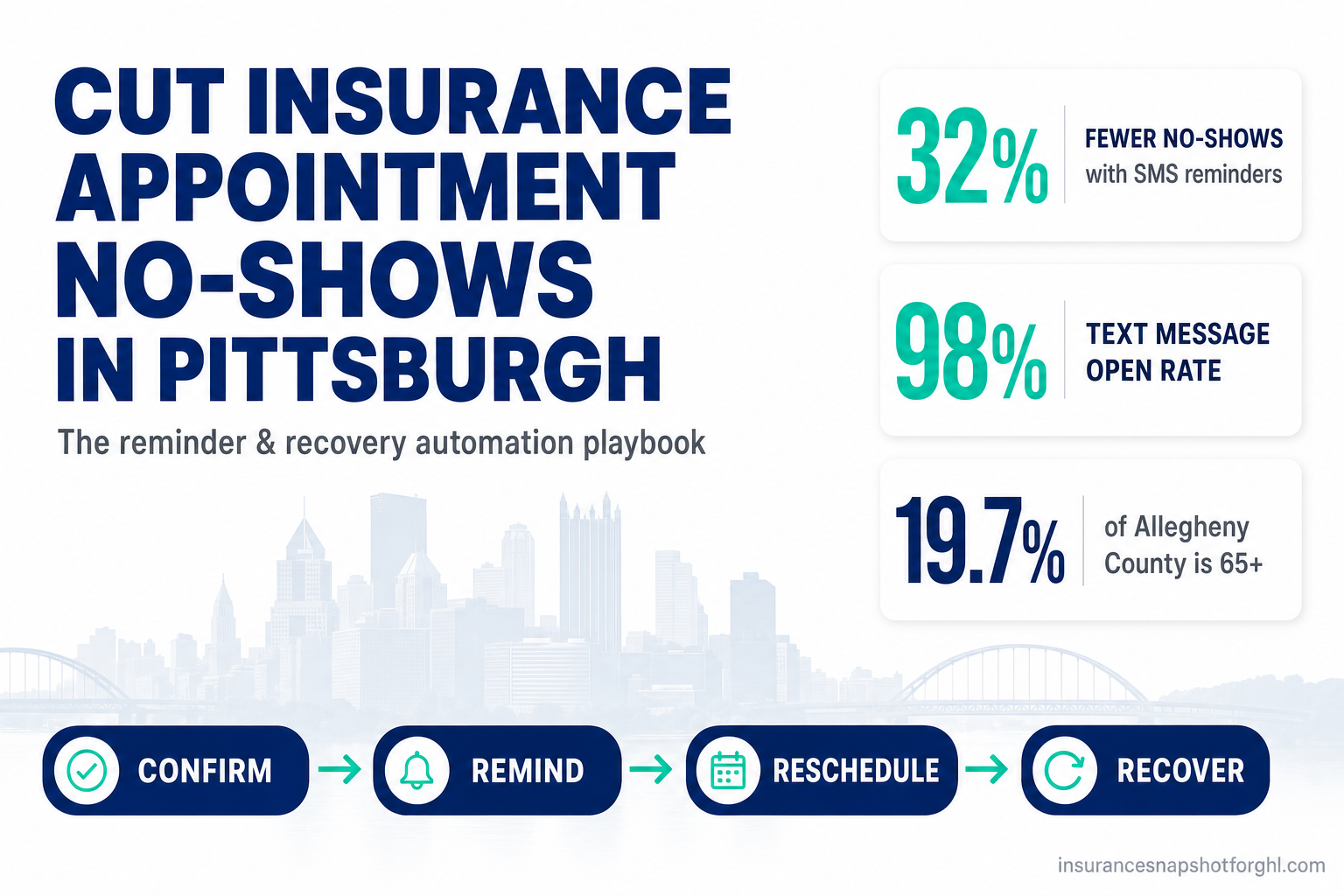
Table of contents
- Why no-shows hit Pittsburgh insurance agencies harder
- What an empty appointment slot actually costs
- Why reminders beat willpower: the data
- The no-show automation playbook (step by step)
- Tuning it for Pittsburgh: Medicare AEP and annual reviews
- Keeping it compliant: TCPA and CMS
- Manual reminders vs automated recovery
- FAQ
Why no-shows hit Pittsburgh insurance agencies harder
Every agency loses a few appointments. The question is how many, and whether you have a system catching them. Benchmarked data from the Medical Group Management Association puts a well-run service practice at a 5–7% no-show rate, while busier or higher-volume operations regularly run 10–30% (MGMA; Zocdoc). Those are healthcare appointment benchmarks, but the mechanics are identical to an insurance agency’s calendar: scheduled one-on-one time that only pays off if the person shows up.
Pittsburgh sharpens the problem because of who’s on the calendar. The metro’s median age is 42.8 — the oldest of any large U.S. metro area — and 19.7% of Allegheny County residents are 65 or older, one of the highest concentrations in the country (Census Reporter, ACS data). Statewide, 20.4% of Pennsylvanians are 65+, versus roughly 18% nationally (U.S. Census Bureau).
That demographic tilt means a Pittsburgh agency’s book leans heavily on the appointment-driven lines: Medicare Supplement and Advantage consultations, T65 planning calls, life needs-analysis meetings, and annual policy reviews. Those aren’t quick transactional quotes — they’re booked, calendared conversations. When one no-shows, you don’t just lose a slot; you lose a scheduled step in a relationship that was supposed to lead to a bind, a cross-sell, or a retained renewal.
What an empty appointment slot actually costs
The cost of a no-show is never just the empty half-hour. It’s the compounding value behind the person who didn’t show.
Start with acquisition. It costs an estimated 7–9x more to acquire a new insurance customer than to keep an existing one (industry data via Ringy), so a no-show on a new-quote appointment burns the marketing dollars you already spent to book it — and a no-show on an existing-client review puts a renewal and its cross-sell potential at risk. Either way, the empty slot sits on top of a real, sunk cost.
Then there’s the follow-up problem. When someone misses, most agencies do nothing fast — and speed is everything. The landmark Lead Response Management study (Dr. James Oldroyd, MIT Sloan) found that reaching a lead within 5 minutes instead of 30 makes you about 21x more likely to qualify them (Lead Response Management), while Harvard Business Review’s audit of thousands of companies found the median first response to an inbound lead was 42 hours (HBR). A no-show that gets a manual callback “sometime tomorrow” is usually a lead already gone.
Now layer in the missed-call problem behind rescheduling. When a client who missed tries to call back — or when you call them — a live human often isn’t there to catch it. A study of 85 businesses across 58 industries found only 37.8% of inbound calls were answered live, with the rest going to voicemail or unanswered (411 Locals) — and only about 1 in 5 callers bother leaving a voicemail (SellCell). Phone tag is where recovered appointments go to die. We break the broader lead-value math down in our guide to what insurance leads really cost, and the follow-up mechanics in the speed-to-lead playbook.
Why reminders beat willpower: the data
The instinct is to blame the client — “they forgot,” “they flaked.” The data says the fix is systemic, not motivational: remind people on a channel they actually see, at the right times, and no-shows fall.
Two things make text the reminder channel that works. First, text messages see roughly a 98% open rate compared to about 25% for email, and 95% are read within 90 seconds of delivery (Omnisend; Kenect). Second, people reply to texts — average SMS response rates run around 45% versus roughly 6% for email (Textmagic) — which is exactly what you want when a reminder needs to become a confirmation or a reschedule.
Put reminders on that channel and the outcome shows up in the no-show numbers. The peer-reviewed evidence is consistent: SMS reminders cut non-attendance from 11.4% to 7.8% at Geneva University Hospitals (Applied Sciences), from 38.1% to 23.5% in a randomized pediatric-clinic trial (PMC), and a large 2025 program that layered an automated voice call on top of texts trimmed no-shows a further 1.7 points, from 11.3% to 9.6% (NEJM Catalyst). Vendor analyses land in the same range, with one study summarized as no-shows 38% lower among patients who got a text reminder (Klara). The takeaway for an agency is simple: a reminder the client actually reads, sent more than once, moves the number.
The no-show automation playbook (step by step)
Here’s the system we install as part of the snapshot’s appointment automation. Each step is a workflow, not a person’s to-do — that’s the whole point. It runs the same way at 9 a.m. Monday and 9 p.m. during AEP.
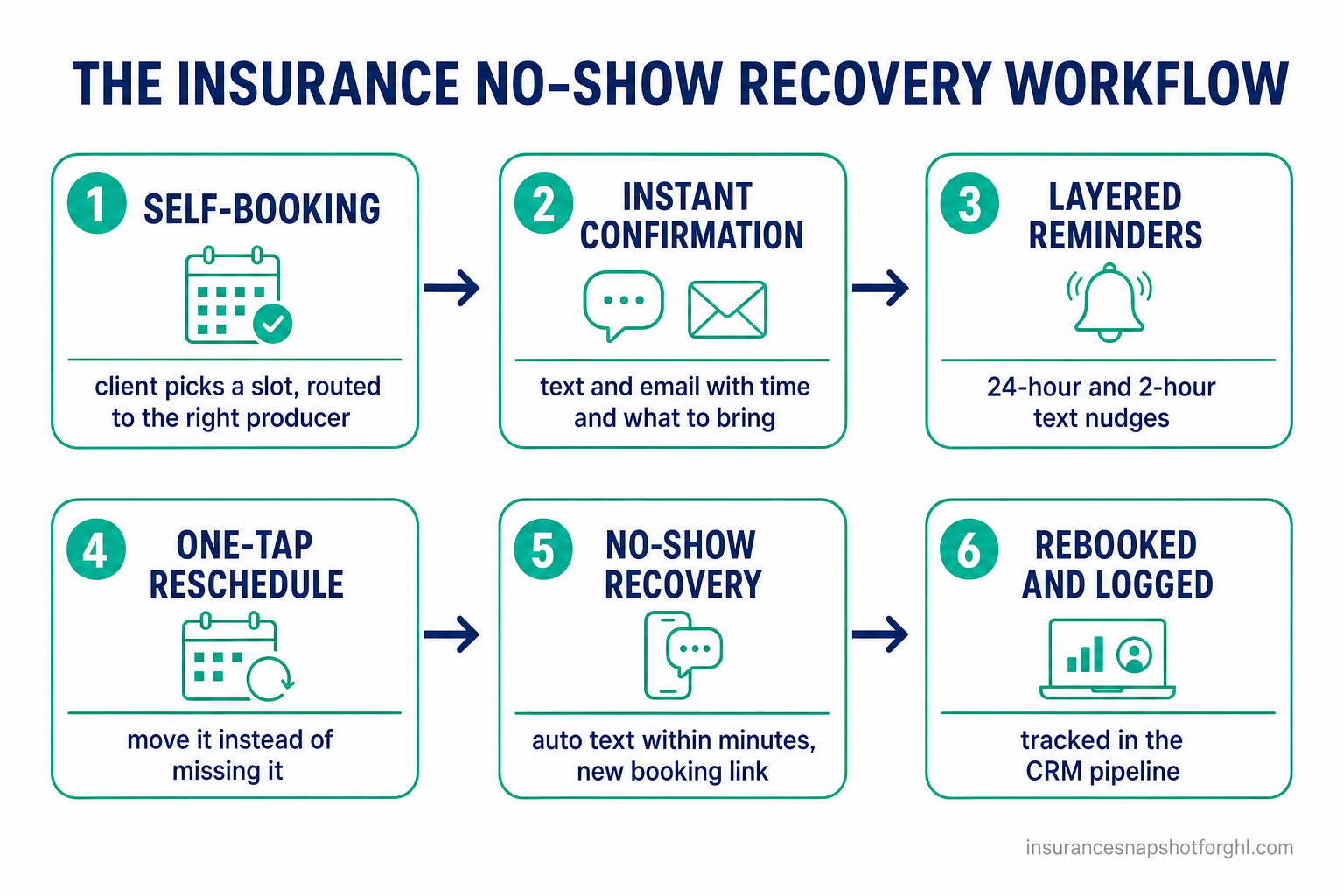
1. Producer-aware self-booking. The fewer steps between “I’m interested” and “it’s on the calendar,” the more appointments actually happen. Prospects and policyholders pick a real open slot themselves, and the booking routes to the right producer by line of business and availability — so a T65 call lands with your Medicare specialist, not a personal-lines producer. No phone tag to schedule in the first place.
2. Instant confirmation. The moment a slot is booked, an automated confirmation goes out by text and email with the time, the producer, and what to bring (current dec page, Medicare card, drug list). A booking that’s confirmed in writing on a channel the client reads is already less likely to be forgotten.
3. Layered reminders — not one, not ten. The system sends a short reminder sequence: a day-before text, a morning-of or two-hours-before nudge, each with the appointment details and a link. Because text open rates sit near 98% and reads happen within 90 seconds, these land — and each one is a chance to confirm or reschedule instead of ghost.
4. One-tap reschedule. Plans change, especially for older clients juggling doctor visits and family. Every reminder carries a one-tap reschedule link so a client who can’t make it moves the appointment instead of just not showing. A reschedule keeps the lead alive and your calendar accurate; a silent no-show does neither.
5. Automated no-show recovery. When someone still misses, an automated recovery sequence fires within minutes — a friendly “we missed you, grab a new time” text and email with the booking link — instead of waiting on a producer to notice and call back tomorrow. This is where the speed-to-lead math pays off: fast, automatic outreach turns a dead slot into a rebooked one. If a two-way reply comes in, it can route to a producer or the AI caller to close the loop.
6. Everything logged in the CRM. Booked, confirmed, reminded, no-showed, recovered, rebooked — each state is tracked on the contact record and the pipeline, so you can finally measure your show-rate and see recovery working. The reminder and recovery texts run on the same TCPA-safe SMS layer as the rest of the snapshot.
Tuning it for Pittsburgh: Medicare AEP and annual reviews
For a Pittsburgh agency, the appointment calendar peaks with the senior-market seasons — which is precisely when a no-show system earns its keep. Medicare’s Annual Enrollment Period runs October 15 to December 7 every year (Medicare.gov), and the market is enormous and growing: Medicare Advantage enrollment reached roughly 36 million in 2026, up about 1.1 million (≈3%) year over year (KFF).
During those eight weeks, an AEP-focused agency’s calendar is wall-to-wall consultations, and every no-show is a plan-selection appointment you can’t easily re-slot before the deadline. The same holds year-round for T65 birthdays and annual policy reviews — the appointments that drive retention and cross-sell. Automating reminders and recovery means your producers spend the season advising, not chasing people who forgot. Pair it with the seasonal timing in our Medicare AEP campaign guide and the retention mechanics in insurance customer retention.
And the demand is there to fill a well-run calendar: 57% of auto customers shopped their policy in the past year, a record high, with 47% buying digitally, 35% through an agent, and 17% via a call center (J.D. Power 2025). More shopping means more booked quote calls hitting your calendar — and more reason to make sure they actually happen.
Keeping it compliant: TCPA and CMS
Automated texts to clients live under the TCPA, and Medicare outreach lives under CMS marketing rules — so the reminder and recovery layer has to be built to respect both. That means capturing consent at booking, honoring STOP/HELP on every text, keeping messages transactional and appropriately timed, and staying inside CMS boundaries for anything Medicare-related. The snapshot ships with TCPA-safe consent capture and opt-out handling baked into the SMS layer; we go deep on it in the TCPA-safe insurance SMS field guide.
Manual reminders vs automated recovery
Most agencies technically “do reminders” — a front-desk person calling down tomorrow’s list when they have a minute. The gap isn’t effort; it’s coverage and speed. Here’s the honest comparison.
Manual reminders vs. automated no-show recovery
| Plan | Manual reminders | Automated reminder + recovery recommended |
|---|---|---|
| Price | Front-desk time | Runs itself, 24/7 |
| Feature 1 | Depends on someone remembering to call | Confirmation + layered text/email reminders |
| Feature 2 | Usually one call, easy to skip when busy | One-tap reschedule on every message |
| Feature 3 | Missed calls hit voicemail — phone tag | No-show recovery fires within minutes |
| Feature 4 | No-shows recovered 'tomorrow,' if at all | Producer-aware routing by line & availability |
| Feature 5 | Show-rate never actually measured | Every state logged — show-rate is visible |
| See appointment automation |
The goal isn’t to replace your front desk — it’s to make sure a booked appointment never slips because someone was too busy to make a reminder call. The automation handles confirm-remind-reschedule-recover; your producers handle the conversation that binds and retains.
If you’d rather see it wired into a full agency setup first — quote funnels, renewal cadences, the AI receptionist, and appointment automation together — start with our Medicare Supplements service page or talk to a real person. Your calendar is going to fill up this AEP. The only question is how much of it actually shows.
FAQ
What is appointment no-show automation for an insurance agency?
It's a set of automated workflows that reduce missed appointments and recover the ones that still happen. When a prospect or client books a quote call or policy review, the system sends an instant written confirmation, a layered sequence of text and email reminders before the appointment, and a one-tap reschedule link on every message. If someone still no-shows, an automated recovery sequence reaches back out within minutes with a link to grab a new time — instead of relying on a producer to notice and call back later.
How much do SMS reminders actually reduce no-shows?
The peer-reviewed evidence is consistent. An SMS reminder system cut non-attendance from 11.4% to 7.8% at Geneva University Hospitals, a randomized pediatric-clinic trial cut no-shows from 38.1% to 23.5%, and a 2025 program layering an automated voice call on top of texts trimmed them a further 1.7 points. The exact reduction depends on your baseline and audience, but text reminders reliably move the number because texts see roughly a 98% open rate and are read within 90 seconds.
Why does this matter more for a Pittsburgh agency specifically?
Pittsburgh has the oldest median age of any large U.S. metro (42.8), and about 19.7% of Allegheny County residents are 65 or older. That means local agencies lean heavily on appointment-driven senior lines — Medicare Advantage and Supplement consultations, T65 planning, and annual reviews — especially during the October 15 to December 7 AEP window. Those booked conversations drive retention and cross-sell, so a no-show there costs more than a missed transactional quote.
Will automated reminders violate TCPA or CMS Medicare rules?
Not when they're built correctly. The Insurance Snapshot's SMS layer captures consent at booking, honors STOP and HELP opt-outs on every message, keeps reminders transactional and appropriately timed, and is designed to stay inside CMS marketing boundaries for Medicare-related outreach. Compliance ultimately belongs to each agency, but the automation is built to keep you inside the lines rather than create a problem. See our TCPA-safe insurance SMS guide for the details.
Does appointment automation replace my front-desk staff?
No — it removes the busywork that causes missed appointments. Your team stops manually calling reminder lists and chasing no-shows by phone (where most callbacks hit voicemail and die in phone tag), and instead spends time on the appointments that actually happen. The system handles confirm, remind, reschedule, and recover; your licensed producers handle advising, quoting, and binding.
How long does it take to set up and what does it include?
Appointment automation is part of the Insurance Snapshot, which installs into your GoHighLevel account in about 24 hours. It's connected to your producer calendars with reminder cadences, one-tap reschedule links, and no-show recovery all configured to your team — alongside the rest of the snapshot's AI caller, chatbot, SMS automation, review and booking automations, and insurance CRM. See current pricing on the pricing page or book a 15-minute demo to watch a live reminder-and-recovery flow.
About the author
Andre Bellamy is a GHL Automation Lead for the Insurance Practice at Insurance Snapshot for GHL. He spends his days inside agency accounts wiring the workflows that turn a booked slot into a kept appointment — self-booking, reminder cadences, reschedule links, and the no-show recovery that decides whether a calendar full of AEP consultations actually shows up. He writes about the operational mechanics of insurance growth, from response times to renewal cadences. Editorial byline only — Andre is not a licensed agent and does not quote, bind, or sell insurance.
Want a calendar that fills itself and reminds every client without a producer lifting a finger? See appointment automation, get the Insurance Snapshot, or book a quick walkthrough.