
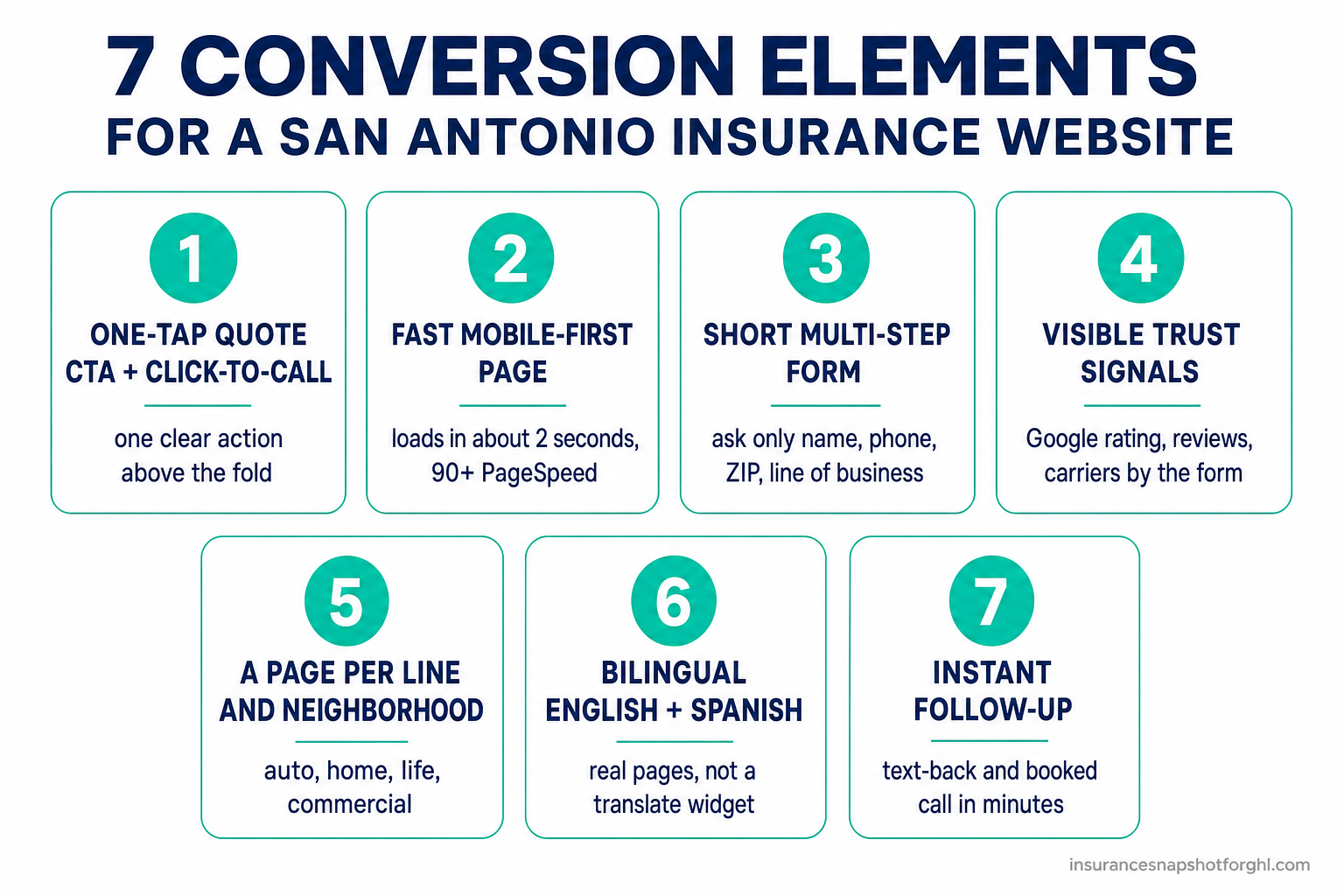
Most San Antonio insurance agency websites convert only a small slice of the people who land on them — and the fix is rarely more traffic. It’s the seven conversion elements that turn a quote-shopper into a booked call: a one-tap quote CTA and click-to-call above the fold, a fast mobile page, a short multi-step quote form, visible trust signals, a real page for every line and neighborhood you write, a bilingual (English + Spanish) path, and instant follow-up. Get those right and the same ad spend and the same Google traffic produce materially more quote requests — because you stop leaking the shoppers you already paid to attract.
This is the operator’s playbook for a San Antonio agency: what “conversion” actually means for an agency site, why so much quote-intent traffic slips away, and the seven fixes — in priority order — that make your website behave like your best producer instead of a digital brochure.
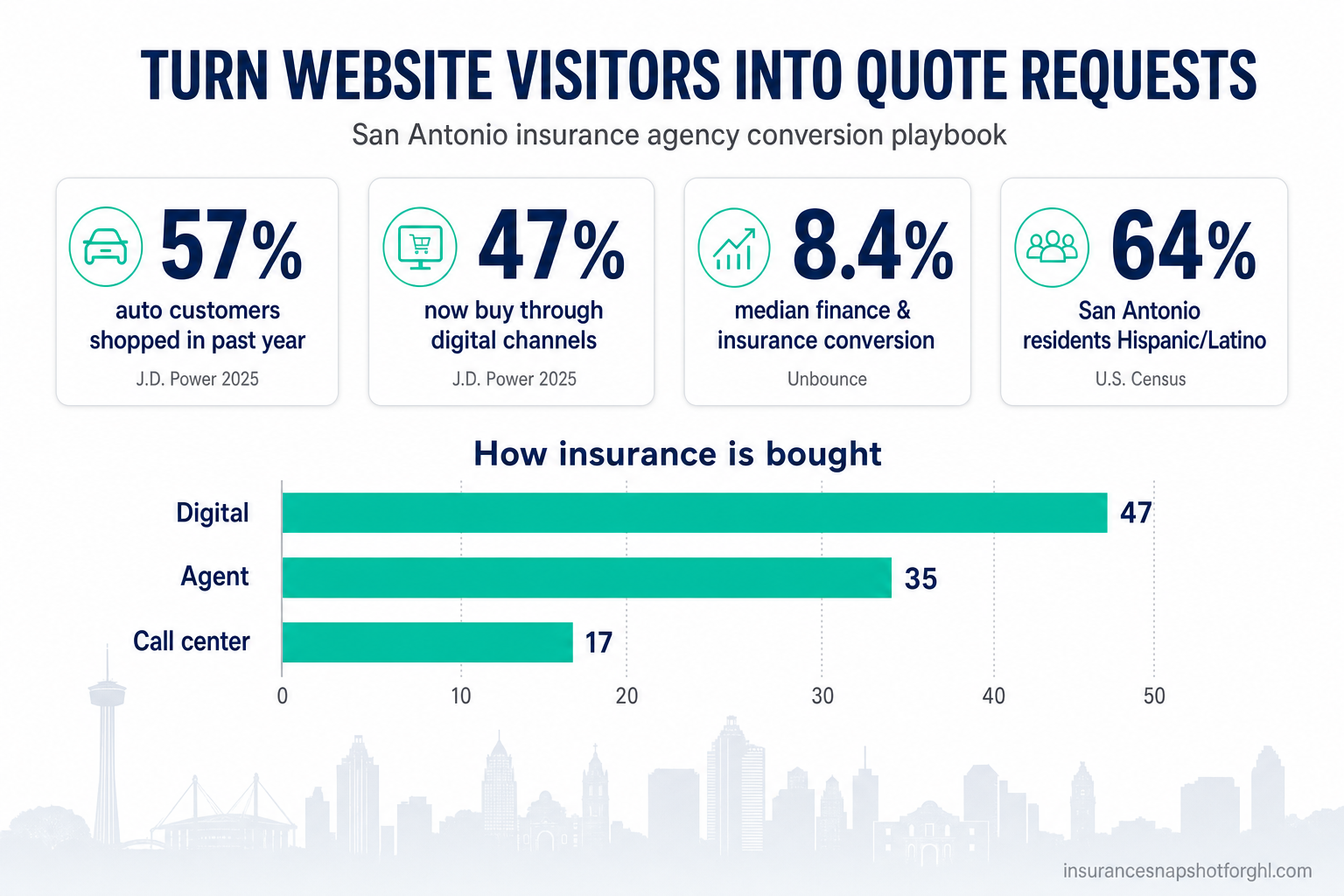
Table of contents
- What “conversion” actually means for an agency site
- Why San Antonio insurance sites leak quote requests
- The 7 conversion elements, in priority order
- The bilingual advantage most agencies skip
- Brochure site vs. conversion-built site
- DIY, template, or done-for-you?
- FAQ
What “conversion” actually means for an agency site
For an insurance agency, a website “conversion” is a single, countable event: a shopper asks you for a quote or books a call. Not a pageview, not a newsletter signup — a named prospect with a line of business and a way to reach them. Everything on the page either moves someone toward that action or gets in the way.
The benchmark to measure against is real and public. Across tens of thousands of pages, the median landing-page conversion rate for the finance & insurance category is about 8.4% (Unbounce Conversion Benchmark Report, analyzing 57M+ conversions across 41,000 pages). If 1,000 quote-intent visitors reach your site in a month and 84 request a quote, you’re at the median. If 20 do, you’re leaking roughly three out of every four leads you could be capturing — and no amount of extra Google Ads spend fixes a page that leaks.
That’s the reframe San Antonio agencies need. Most agency-website conversations start with “we need more traffic.” Usually the cheaper, faster win is raising the conversion rate on the traffic you already have.
Why San Antonio insurance sites leak quote requests
Insurance is now bought digitally, and it’s bought while shopping. J.D. Power’s 2025 research found 57% of auto insurance customers actively shopped for a new policy in the past year — the highest rate ever recorded (J.D. Power 2025 U.S. Insurance Shopping Study), and that digital channels are now the #1 way customers buy, ahead of agents and call centers (J.D. Power 2025 U.S. Insurance Digital Experience Study).
How U.S. insurance customers now purchase a policy, by channel (%). Digital is now the #1 channel, ahead of agents and call centers. Source: J.D. Power 2025 U.S. Insurance Digital Experience Study.
A San Antonio shopper comparing carriers after a rate hike does it on a phone, across several open tabs, often after hours. Your site has seconds to earn the tap. Two leaks dominate.
The first is speed. Google’s benchmark finding is blunt: 53% of mobile visitors abandon a page that takes longer than three seconds to load (Think with Google). As mobile load time climbs, the probability that a visitor bounces rises steeply.
Increase in the probability of a mobile visitor bouncing as page load time grows (%). A page that loads in 5 seconds instead of 1 is 90% more likely to lose the visitor. Source: Think with Google, Mobile Page Speed Industry Benchmarks.
The second leak is friction: a long form, a buried phone number, no clear next step, an English-only page in a bilingual city. Every one of those is a place a high-intent shopper quietly leaves. The good news is that both leaks are fixable with the same seven elements.
The 7 conversion elements, in priority order
Fix these in order. The first three recover the most leads for the least effort; the rest compound.
1. A one-tap quote CTA and click-to-call above the fold
The single most common agency-site mistake is making a shopper hunt for how to ask for a quote. Above the fold — before any scrolling, on mobile — there should be exactly one obvious primary action (“Get my quote”) and a tappable phone number. Phone still matters in insurance: call-tracking vendor Invoca reports that inbound callers convert far more readily than web leads and that a large share of insurance conversions happen by phone (Invoca) — so give the caller a one-tap number and give the typer a one-tap form. Don’t make them choose between a tiny “Contact” link and a menu.
2. A fast, mobile-first page
Speed is the gate every other element sits behind. If the page doesn’t paint in about two seconds on a mid-range phone on cell data, half your mobile shoppers are gone before they read your headline. This is a build decision, not a plugin you add later: static-first, edge-served pages with almost no JavaScript are what hit a 90+ Google PageSpeed score consistently. We go deep on the platform trade-offs — Astro vs GoHighLevel vs WordPress — in our page-speed comparison for insurance sites. For San Antonio’s overwhelmingly mobile, comparison-shopping traffic, speed is table stakes.
3. A short, multi-step quote form
Long forms kill conversions. Every extra field is another reason to abandon, and checkout research shows most flows ask for far more than they need — an average of about 11 fields when far fewer would do (Baymard Institute). Two proven moves: ask only for what you need to make the first call (name, phone, ZIP, line of business), and break it into a short multi-step flow rather than one intimidating wall. Multi-step lead forms consistently outperform single-page ones; one widely cited case study lifted an inquiry form from under 1% to roughly 8% conversion by restructuring it into steps (Venture Harbour). Treat the exact numbers as directional — the principle is not: fewer fields, shown a few at a time, convert better.
4. Visible trust signals
Insurance is a trust purchase, and San Antonio shoppers vet you the way they vet any local business — through reviews. In BrightLocal’s 2024 survey, 42% of consumers said they trust online reviews as much as a personal recommendation, and Google was the most-used review platform (BrightLocal Local Consumer Review Survey 2024). Put your Google rating, carrier logos, licensing, and a few real reviews near the form. If your review count is thin, that’s a fixable problem — see our playbook on getting more Google reviews on autopilot.
5. A real page for every line and neighborhood
One generic “Get a Quote” page can’t rank for — or speak to — a Stone Oak homeowner, a rideshare driver on the South Side, and a small-business owner near the Pearl. A conversion-built agency site has a distinct page per line of business (auto, home, life, commercial) and per area you’re appointed in, each with its own copy, local references, and quote path. This is both a local-SEO move and a conversion move; we cover the ranking side in local SEO for insurance agents.
6. A bilingual (English + Spanish) path
Covered in depth in the next section — but it belongs on the priority list, because in San Antonio it may be the highest-leverage element on this page.
7. Instant follow-up on every submission
Capturing the lead is half the job; reaching them fast is the other half. Landmark lead-response research found that contacting a web lead within 5 minutes instead of 30 makes you roughly 21× more likely to qualify it (Lead Response Management study, MIT / InsideSales) — yet when Harvard Business Review audited 2,241 companies, the average first response took 42 hours and 23% never responded at all (Harvard Business Review). A form that fires an instant text-back and books a call closes that gap automatically. For after-hours shoppers, an AI chat widget does the same job in real time, and the deeper mechanics live in our speed-to-lead playbook.
The bilingual advantage most agencies skip
Here’s the San Antonio edge almost no competitor is using. The city is roughly 64% Hispanic or Latino and ranks as the 4th most bilingual major U.S. city (KSAT, 2025; U.S. Census Bureau QuickFacts). A large share of the households shopping for auto, home, and life coverage in Bexar County — a county of over 2 million people (U.S. Census Bureau) — are comfortable in Spanish, and many prefer it for something as consequential as insurance.
Most agency sites give them a browser “translate” widget at best. That’s a conversion miss and an SEO miss: a translate widget creates no new pages, so Google has nothing extra to index and you never rank for Spanish-language searches. The right approach is a real Spanish page per key page — its own URL, title, meta description, and schema, linked to its English counterpart by hreflang — so it can rank on its own and be quoted on its own by an AI answer engine.
Brochure site vs. conversion-built site
The difference isn’t cosmetic. It’s whether the same visitor leaves as a lead or leaves, period.
A brochure site vs. a conversion-built agency site
Slow mobile load → generic 'Welcome' hero → phone number in the footer → one long contact form → English only → submission emails an inbox nobody checks until morning → San Antonio shopper booked with whoever answered first.
Fast static page → 'Get my San Antonio auto quote' CTA + tap-to-call above the fold → short multi-step form → Google rating and carriers by the form → English or Spanish path → instant text-back and a booked call → producer wakes to a warm, qualified appointment.
What each kind of agency website actually does for conversion
| Plan | Conversion-built (Astro, done-for-you) recommended | DIY builder / template | Old WordPress / plugin stack |
|---|---|---|---|
| Price | From $97/mo | Your time | $$ + upkeep |
| Feature 1 | 90+ PageSpeed, static-first, mobile-fast | Speed varies, often slow on mobile | Plugin bloat drags mobile speed down |
| Feature 2 | One-tap quote CTA + click-to-call above the fold | CTA and phone number easy to bury | Depends on how it was built |
| Feature 3 | Short multi-step quote form wired to your CRM | Whatever form the template ships with | Form plugin, often long and single-step |
| Feature 4 | Trust signals, reviews and carriers by the form | Trust signals rarely placed for conversion | Possible, but bolt-on |
| Feature 5 | A real page per line and per neighborhood | Usually one generic quote page | Possible, but manual to build and maintain |
| Feature 6 | True bilingual pages (own URL + schema), not a widget | Translate widget at best — no Spanish ranking | Multilingual plugins are heavy and fragile |
| Feature 7 | Instant text-back + booking on every submission | Manual follow-up, whenever someone checks the inbox | Only if separately integrated |
| See the website service |
DIY, template, or done-for-you?
If you have the time and the skill, you can assemble the seven elements yourself. Most San Antonio agency owners don’t — they’re placing business, not tuning form flows, hreflang tags, and PageSpeed scores. That’s the gap our website service fills: a conversion-built, Astro-fast agency site with a page per line and per city, quote requests and booking on the page, true bilingual pages, and the whole thing wired into follow-up — from $97/month plus a one-time build fee you don’t pay until you’re live and happy.
Whichever route you take, the priority order is the same: earn the tap with speed and a clear CTA, remove form friction, prove you’re trustworthy, meet San Antonio shoppers in the language they think in, and follow up before the next agency does. Do that, and the traffic you already have starts converting like the median finance & insurance site — or better.
FAQ
What is a good conversion rate for an insurance agency website?
Use the finance & insurance benchmark as your yardstick: the median landing-page conversion rate for the category is about 8.4% (Unbounce Conversion Benchmark Report). For an agency site, count a conversion as a quote request or a booked call — a named prospect with a line of business and contact details, not a pageview. If you're capturing well under ~8 of every 100 quote-intent visitors, the problem is almost always the page, not the traffic.
Why is my San Antonio agency website getting traffic but few quote requests?
Traffic without conversions usually points to friction, not audience. The most common culprits: a slow mobile page (53% of mobile visitors abandon a page that takes over 3 seconds to load), a buried or missing quote CTA, a long single-step form, weak trust signals near the form, and no Spanish path in a city that's roughly 64% Hispanic. Fix those seven elements and the same traffic converts far more of its shoppers.
Does having a Spanish version of my website actually help in San Antonio?
In San Antonio specifically, it's one of the highest-leverage moves available — the city is about 64% Hispanic or Latino and ranks as the 4th most bilingual major U.S. city. But a browser 'translate' widget doesn't count: it creates no new indexable pages, so you never rank for Spanish searches. A real Spanish page per key page — its own URL, title, meta and schema, linked by hreflang — converts Spanish-preferring shoppers and opens search traffic your English-only competitors can't reach.
How fast does an insurance agency website need to load?
Aim for a page that paints in roughly two seconds on a mid-range phone on cell data, and a 90+ Google PageSpeed score. Speed is the gate every other conversion element sits behind — 53% of mobile visitors leave a page that takes over 3 seconds, and the probability of bouncing keeps climbing from there. Static-first, edge-served builds (like Astro) hit those scores far more reliably than plugin-heavy WordPress or page-builder sites.
Should I shorten my quote form?
Almost always, yes. Ask only for what you need to make the first call — typically name, phone, ZIP, and line of business — and present it as a short multi-step flow rather than one long form. Studies and case data consistently show shorter, stepped forms outconvert long single-page ones. You can always collect the rest of the detail on the quote call, once the shopper is already engaged.
Can you build a conversion-optimized website for my agency?
Yes — that's exactly what our website service does. We build Astro-fast insurance agency sites with a page per line of business and per city, a one-tap quote CTA and click-to-call, short multi-step forms, trust signals, true bilingual English + Spanish pages, and instant follow-up wired into your GoHighLevel. It starts at $97/month plus a one-time build fee you don't pay until the site is live and you're happy with it. Book a demo or see the website service to start.
About the author
Priya Raman is an Insurance Agency Growth Strategist at Insurance Snapshot for GHL. She works with independent and captive agencies on the growth side of automation — turning website traffic and existing books into booked appointments and recurring cross-sell revenue. She thinks in terms of premium written, conversion rate, and producer capacity rather than vanity metrics, and writes about which changes actually move the number and how to measure whether any of it is working. Editorial byline only — Priya is not a licensed agent and does not quote, bind, or sell insurance.
Want your website to convert more of the shoppers it already gets? See the website service, book a 30-minute demo, or talk to a real person.
Related posts
- Insurance Agency Websites in Dallas: Astro vs GoHighLevel vs WordPress (Page Speed Compared)
- Why Miami Insurance Agencies Lose After-Hours Leads — and How an AI Chat Widget Wins Them Back
- Speed to Lead for Insurance Agencies: The 5-Minute Rule That Wins More Policies
- The Insurance Quote Funnel That Actually Converts
- Local SEO for Insurance Agents: How to Rank in Your Own Backyard