
It is the first of the month and a card declines at 2:14am. Nobody is awake to see it. The carrier sends a nonpay notice to the client’s spam folder, starts a grace-period clock the client never reads, and twenty-six days later the policy cancels. You find out when the mortgage company calls about a lapsed escrow, or when the client calls furious after a fender bender on an uninsured car. You did not lose that account to a competitor. You lost it to a payment that failed quietly while everyone looked away.
Here is the answer up front. You do not need a new billing platform to stop this. You need a thin automation layer, sitting on top of the carrier billing and agency management system you already run, that catches the failed payment the moment it happens and runs a fixed sequence: a same-day text, a call task for a human, an email with a pay link, a pre-cancellation push before the grace period closes, and a reinstatement play if it cancels anyway. This post is the build, with the real message copy and the rules that keep it legal.
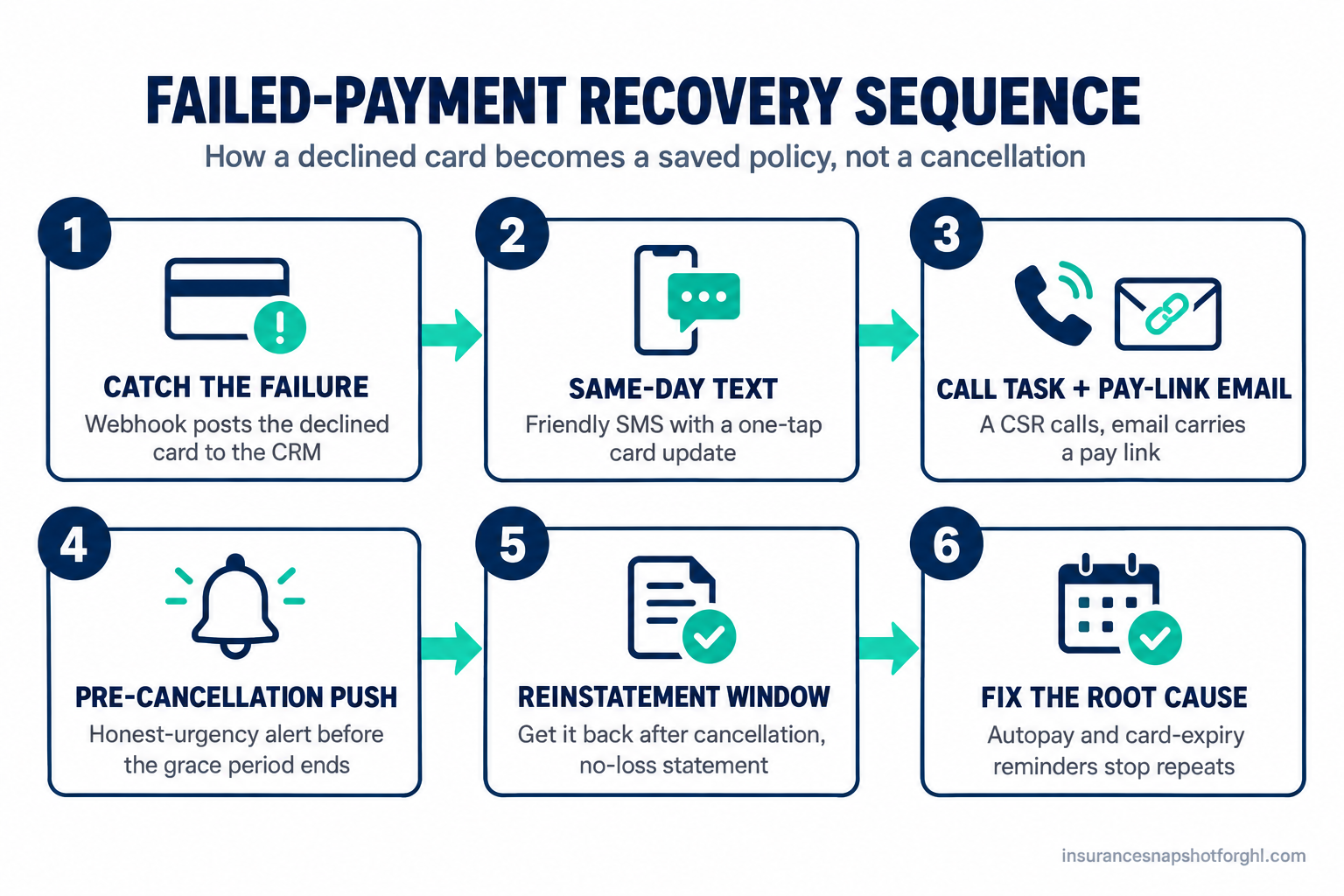
Table of contents
- What a nonpay cancellation costs you
- Why failed payments are different from renewals
- Stage 1: Catch the failure the moment it happens
- Stage 2: The same-day text
- Stage 3: The call task and the pay-link email
- Stage 4: The pre-cancellation push
- Stage 5: The reinstatement window
- Stage 6: Fix the root cause
- Steal these messages
- Solo, five-producer, and large: who runs what
- The compliance layer you cannot skip
- Objections
- The payment that does not become a cancellation
- FAQ
What a nonpay cancellation costs you
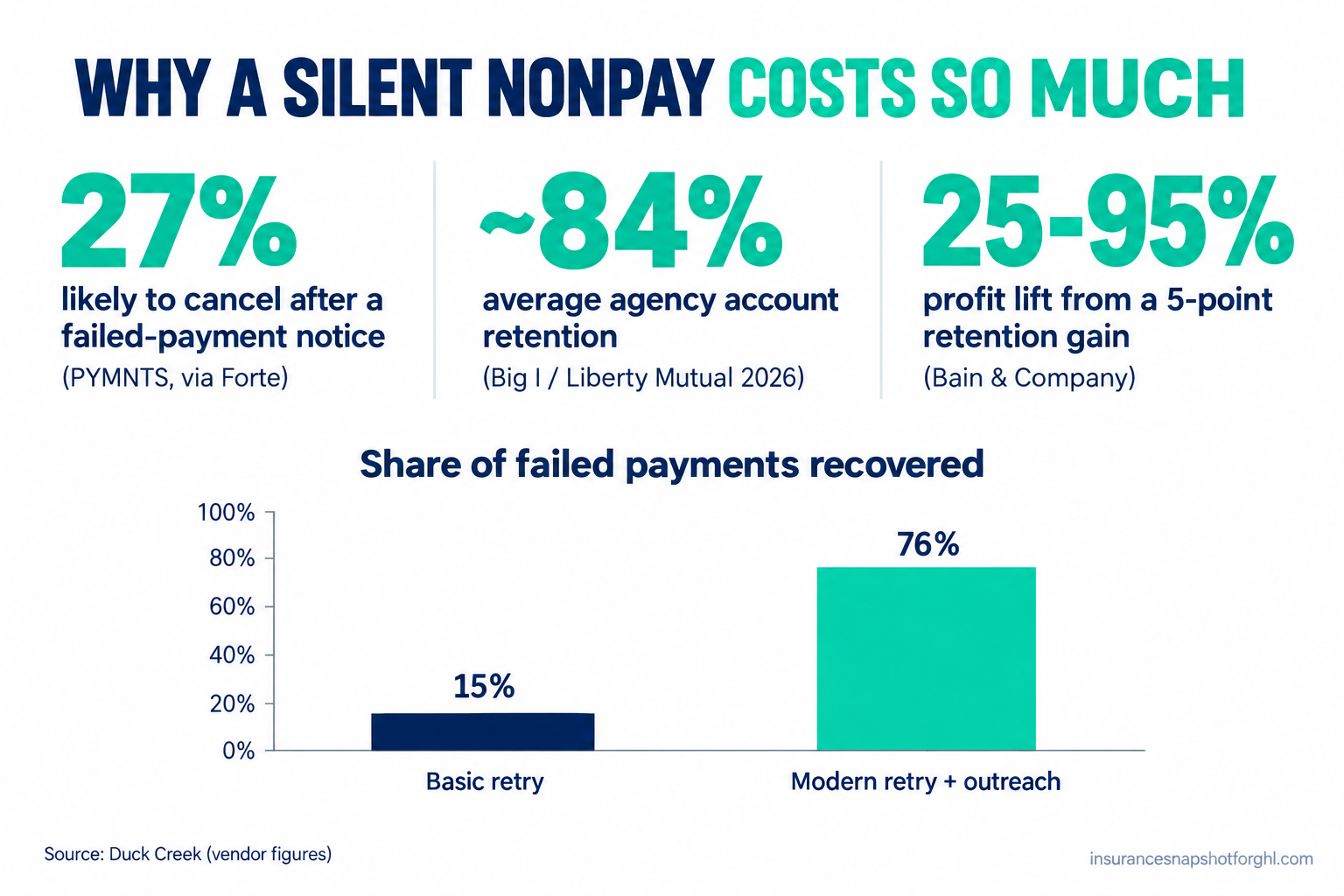
A nonpay cancellation hits retention in the worst possible way. The classic Bain & Company work by Fred Reichheld found that raising retention by five points can lift profit by 25% to 95% (Bain & Company). In insurance the math is sharper: a renewed policy carries almost no acquisition cost, so the commission pays again every year it stays.
The average agency account retention rate sits around 84%, with top agencies at 93 to 95 percent (Liberty Mutual’s 2026 Independent Agency Growth Study via IA Magazine, Agency Performance Partners). A big slice of that gap is not clients who shopped and left. It is clients who meant to stay and fell off the books because a card expired, a draft bounced, or a bank flagged a recurring charge. The client did not fire you; your billing process did. Independent agents placed 61.5% of U.S. property and casualty premium written in 2024 (Big “I” via Insurance Journal), so the channel is not short on premium; the winners just stop the quiet leaks, and a nonpay is the quietest. It shows up as nothing, until it surfaces as a problem, sometimes an E&O claim when a client who never knew a payment failed has a loss on a lapsed policy.
Why failed payments are different from renewals
A renewal is a known date you can see 120 days out, and a renewal cadence that runs on autopilot handles it. A failed payment is unscheduled, silent, and on a countdown you do not control.
Three things make it its own problem. First, the clock: once the carrier issues a nonpay notice, the grace period starts, and auto grace periods commonly run from a few days up to about 30 depending on carrier and state, some far shorter (MoneyGeek). You are beating a deadline. Second, the signal is buried inside carrier billing or a payment processor, not your agency management system, which may never flag it. Across recurring-revenue businesses, 20 to 40 percent of churn is involuntary, caused by a failed payment rather than a decision to cancel (Duck Creek); insurance fares better, but its share is still real households you can mostly recover. Third, it compounds: 27 percent of subscribers say they are likely to cancel after a failed-payment notice (PYMNTS via Forte), so recovery has to be fast and feel human.
The six-stage sequence below assumes GoHighLevel, but ports to any tool that takes a webhook and sends SMS, email, and tasks. The first two stages fire automatically; the rest keep a human in the loop.
Stage 1: Catch the failure the moment it happens
You cannot recover a failure you do not know about, so the trigger is everything. Most carrier billing portals and payment processors can send a webhook or email on a failed draft or declined card; point it at your CRM. In GoHighLevel, an inbound webhook updates the contact, stamps a custom field like payment_status = failed with the date and amount, and drops it into a “Payment Recovery” stage. If your carrier gives you nothing programmatic, the fallback is a daily report: a CSR or virtual assistant exports the nonpay list each morning and bulk-tags those contacts. Same-day matters because an expired card gets fixed in two minutes on day one, while a week later the talk is about a bigger balance and a late fee.
Failure mode: the trigger that never fires. A webhook pointed at the wrong URL or silently rejected is the common break. Test it with a real failed transaction, then add a backstop: a daily automation that flags any payment_status = failed contact with no outreach logged in 24 hours.
Stage 2: The same-day text
Text is the right first touch because it gets read. Say who you are, what happened without alarming the client, and make the fix one tap away. Name the agency and the line of business so it does not read like a scam, give one clear action, and always put a STOP opt-out on an automated text. Do not fire it at 3am: respect the TCPA quiet-hours window and schedule overnight failures for a morning hour.
Failure mode: the message that reads like a phishing scam. A vague “your payment failed, click here” text trains clients to ignore or report you. Reference the specific policy and link to a known-good payment page or a callback, never a shortened mystery link.
Stage 3: The call task and the pay-link email
If the text does not resolve the payment within a day, a human steps in. The call task goes to the account’s servicing producer or a CSR: “Call [client] about returned [auto] payment, grace period ends [date].” It carries the failure date, amount, and deadline, so the caller has the full picture, and a two-minute call that ends with “I updated the card right now” beats any sequence. Alongside it, send an email that restates the situation with a working link to pay or update the card, routed to the carrier or processor page, for the clients who prefer to self-serve at 10pm without talking to anyone.
Failure mode: the pay link that goes nowhere. A link to a login the client cannot complete kills recovery, so test every link logged out, on a phone. If the only fix is a call to the carrier, say so plainly instead of faking a self-serve path.
Stage 4: The pre-cancellation push
If the payment is still unresolved as the grace period nears its end, the tone changes. This honest-urgency message most often saves the policy, because it finally tells the client what is about to happen. Trigger it a set number of days before the known cancellation date (three is a sane default). It names the deadline, names the consequence in plain terms (coverage ends, the car or home is uninsured, the lender may force-place expensive coverage), and gives the fastest fix. A client who has ignored two touches needs a human voice, so prefer a call over a link here.
Failure mode: guessing the cancellation date. Fire this on an assumed date rather than the carrier’s actual cancellation date and you cry wolf early or miss the window. Pull the real date from the carrier notice and drive the timing off that field.
Stage 5: The reinstatement window
Sometimes it cancels anyway: the client was traveling, the notice went to an old email, the call went to voicemail. A cancellation is not the end of recovery. It is the start of a shorter one, because many carriers allow reinstatement within a window after cancellation (commonly up to about 30 days), usually by paying the overdue premium plus a reinstatement fee and signing a no-loss statement confirming no claims happened during the gap (MoneyGeek). Rules vary sharply by carrier and state, so the carrier is the authority on each case, and your job is to move before the window closes.
The moment a policy flips to cancelled, automation moves the contact to a “Reinstatement” stage, fires a reassuring message (the policy cancelled, but we can likely get it back if we act in the next few days, call us now), assigns an urgent call task, and surfaces the no-loss-statement requirement. If reinstatement is off the table, the contact rolls into a re-quote and database reactivation flow so you keep the household.
Failure mode: treating a cancellation as a dead record. Agencies write off cancelled policies and move on, throwing away their most recoverable client, one who wanted coverage three weeks ago. Keep cancelled nonpay accounts active for at least the carrier’s reinstatement window before you let them go cold.
Stage 6: Fix the root cause
Stopping the same card from failing every month beats recovering it repeatedly, because involuntary churn clusters on the same accounts. Two durable fixes: push autopay and card-on-file enrollment during the recovery conversation; and get ahead of expirations with a light “your card on file expires soon, update it in 30 seconds” touch. Duck Creek reports basic retry recovering about 15 percent of failed payments versus up to 76 percent for a modern retry-plus-outreach approach (Duck Creek), so treat the ceiling as aspirational but the direction as right.
Reported share of failed payments recovered: basic automatic retry versus a modern retry-plus-outreach approach. Vendor figures, directional only. Source: Duck Creek, “Silent Policy Churn”.
Payment failures are only a single-digit share of insurance churn (Churnkey), but you win them back cheaply, the best dollar-for-dollar retention work in the agency.
Steal these messages
Copy these and change the bracketed fields. They assume prior express consent and an opt-out already in place.
Same-day text (Stage 2):
Hi [First Name], this is [Agency] about your [auto] policy. Your recent payment didn’t go through, so I wanted to catch it early before anything changes on your coverage. Easiest fix is a quick card update: reply here or call us at [phone] and we’ll sort it in two minutes. Reply STOP to opt out.
Pay-link email (Stage 3), subject “Quick fix needed on your [auto] policy”:
Hi [First Name], a heads-up that your last payment on your [auto] policy was returned. This happens all the time, usually an expired or replaced card, and it’s a fast fix. Update your payment here: [secure carrier link]. Prefer the phone? Call [phone] and we’ll handle it while you’re on the line. Thanks, [Producer], [Agency].
Pre-cancellation push (Stage 4):
[First Name], important one: your [auto] policy is set to cancel for nonpayment on [date], which means you’d be driving uninsured after that. We don’t want that. Please call us today at [phone] so we can keep it active. Reply STOP to opt out.
Solo, five-producer, and large: who runs what
The sequence is the same. Who answers the call changes.
Solo operator. You are the only backstop, so lean hardest on automation for Stages 1 and 2 and email for Stage 3. Set the call task to yourself and batch recovery calls into one daily block. The autopay push in Stage 6 matters most for you: every prevented failure is a call you never had to make.
Five-producer agency. Route the call task to the account’s servicing producer or a dedicated CSR, not a shared queue, so ownership is clear, and add an escalation that pings a team lead if a recovery contact has no logged outreach in 24 hours. This is the size where a returned payment falls between people. Pair it with your renewal reminder system so one dashboard shows both the scheduled and the surprise risk.
Large agency. You have the volume to see patterns, so report nonpay failures by carrier and payment method; a spike from one carrier’s billing change is systemic, not a client issue. Give one team member the recovery pipeline, track recovery rate as a KPI next to retention by line, and push repeat offenders onto autopay.
The compliance layer you cannot skip
Recovery outreach runs under the same rules as any other contact. Texting clients requires A2P 10DLC registration, prior express consent, and a working opt-out (STOP/HELP) on every automated message. Respect the calling-time window, generally 8am to 9pm in the client’s time zone, and schedule overnight failures to send in the morning. Follow the TCPA as the FTC and FCC apply it; the mechanics are in our TCPA field guide. Do not build your consent process around the FCC’s one-to-one consent rule, which the Eleventh Circuit vacated on January 24, 2025 in Insurance Marketing Coalition v. FCC, so it never took effect (Morrison Foerster).
A returned-payment text is usually on solid ground, because it concerns an existing policy the client bought from you, which is servicing, not cold marketing. Keep the content about the policy, not a cross-sell bolted onto a billing problem. If a message touches a life or annuity product, the NAIC’s advertising model requires accuracy and disclosures. And do not sweeten a recovery with a gift: state anti-rebating laws cap client gifts (Florida about $100 a year, Texas $25), so a “sorry, here’s a gift card” can quietly break the rules.
Objections
“Won’t clients find an automated payment text annoying?” Not if it is specific and helpful. A message that says “your auto payment bounced, here is the two-minute fix” is a favor, because the alternative is a cancelled policy they did not want. It fires only on an actual failure, and the opt-out is always visible.
“My carrier already sends nonpay notices. Why duplicate it?” Because the carrier’s notice is generic, buried in spam, and from a number the client does not recognize. You are the trusted name: a text from their agency, about their specific policy, gets read and acted on when a form letter does not.
“Do I need technical skills to build this?” You connect the pieces once: a trigger from billing into your CRM, a few messages, a task rule, and a pipeline. That is a setup task, and it ships pre-built if you would rather not wire it yourself.
“We only lose a few policies this way. Is it worth it?” If payment failures are even a single-digit share of your churn and your book is a few thousand policies, that is dozens of households a year you recover for the cost of some texts and a call, and it doubles as E&O documentation. No retention work is cheaper.
The payment that does not become a cancellation
Go back to that card that declined at 2:14am. In the agency that runs this sequence, the failure posts to the CRM by 2:15, the client gets a friendly text from their agency by name at 8:05am, replies “oh, I got a new card,” a CSR updates it in two minutes, and the policy never skips a beat. No grace-period countdown, no spam-folder notice, no furious call after a fender bender.
That is the difference between an 84 percent agency and a 94 percent one: not a better pitch or a bigger ad budget, but a failed payment someone caught, the same day, every time. Build the catch, keep a human in the close, and the quietest leak in your book stops costing you policies.
What is the fastest way to recover a failed insurance payment?
Catch it the same day and reach the client with a specific, friendly text that names the agency and the policy and offers a two-minute card update. Most failures are an expired or replaced card, fixed fast before a late fee accrues.
How long is the grace period on a car insurance policy?
It varies by carrier and state, commonly from a few days up to about 30, and some are far shorter. Pull the carrier's actual cancellation date into the client's record and drive your pre-cancellation outreach off that date, not a generic assumption.
Can a cancelled insurance policy be reinstated after nonpayment?
Often yes, within a window after cancellation (commonly up to about 30 days), usually by paying the overdue premium plus a reinstatement fee and signing a no-loss statement. Rules vary by carrier and state, so confirm each case and move before the window closes.
Is it legal to text clients about a failed payment?
Yes, with the right setup: A2P 10DLC registration, prior express consent, and a working STOP opt-out on every automated message, within the 8am to 9pm calling window. A text about an existing policy the client bought from you is servicing, not cold marketing. Do not build your process around the FCC one-to-one consent rule, which was vacated in January 2025.
How do I stop the same card from failing every month?
Push autopay and card-on-file enrollment during the recovery conversation, and send a reminder before a card on file expires so you prevent the decline instead of chasing it. Involuntary churn clusters on the same accounts, so fixing the root cause beats recovering the same failure repeatedly.
Related reading: