
Short-form video is the single highest-leverage marketing channel an Austin insurance agency can run right now — and almost none of your local competitors are doing it well. A 30-second Reel that explains “do you actually need flood coverage in Central Texas” costs nothing but your phone and ten minutes, yet it reaches more of the buyers shopping right now than any post format on Instagram. The problem isn’t whether video works. It’s that most agents don’t know what to film, freeze on the first take, and quit after four posts. This playbook fixes that.
Below is the exact operator process: what to shoot on your phone, how often to post, the hook that decides whether anyone watches, and — the part most “make Reels!” advice skips — how to wire a comment or DM into a GoHighLevel funnel so a view turns into a booked quote instead of a vanity like.
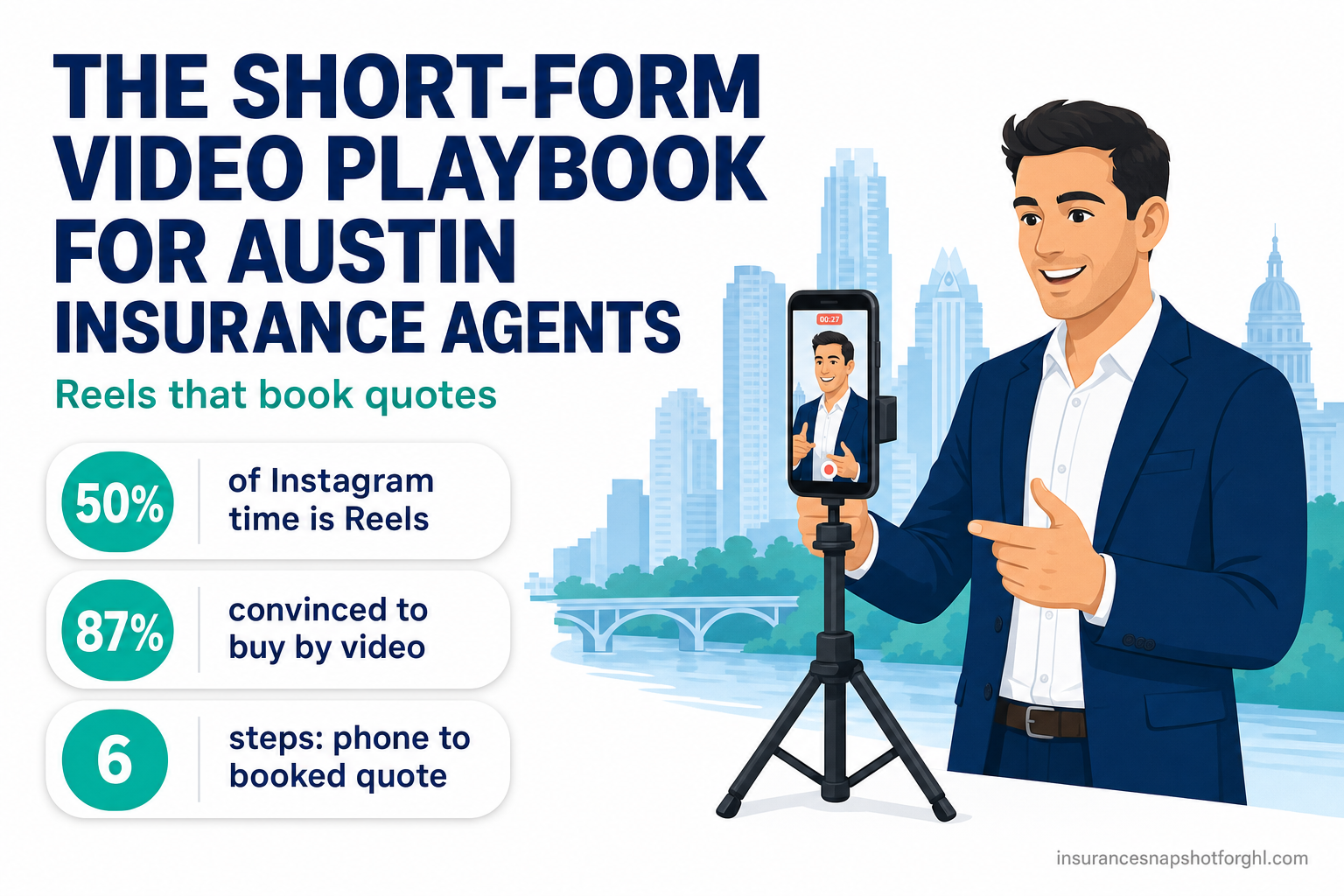
Table of contents
- Why short-form video is the best bet for an Austin agency
- What to film: 7 Reels an insurance agent can shoot on a phone
- The 6-step playbook: from phone to booked quote
- How often to post (and why consistency beats polish)
- The hook: winning the first three seconds
- Turning views into booked quotes
- Keep it compliant: TCPA and CMS lines
- Do it yourself or hand it off
- FAQ
Why short-form video is the best bet for an Austin agency
Austin is one of the best insurance markets in the country to be in — and one of the most crowded. The Austin–Round Rock–San Marcos metro passed 2.5 million residents and is the fastest-growing major metro in Texas, now the 25th largest in the U.S. (Community Impact, on Census data, 2025). Every one of those new arrivals needs auto, renters, home, and eventually life coverage — and they’re choosing an agent the way they choose everything else: by looking them up on a phone first.
Here’s what’s changed about that first look. Buyers don’t land on your website anymore; they land on your feed. And the feed is now dominated by video: Meta reports that Reels account for roughly 50% of all time users spend on Instagram (Meta Q1 2024 earnings), and in the U.S. that share climbed from 37% to 46% between 2024 and 2025. Short-form video isn’t a content type you can add later — it’s where the attention already is.
The reason it works so well for insurance specifically is that your best content is explanatory, and video is what makes explanation stick. 87% of people say a video has convinced them to buy a product or service, and 89% of businesses use video as a marketing tool (Wyzowl, 2025). Insurance is a low-trust, high-confusion category. A calm 30-second face-to-camera clip that clears up one confusing thing — a deductible, a T65 deadline, why a renters policy is $15 a month — does more to earn a stranger’s trust than any billboard on MoPac.
What to film: 7 Reels an insurance agent can shoot on a phone
The most common reason agents stall is “I don’t know what to say.” You don’t need a studio, a script writer, or a viral idea. You need to answer the questions your clients already ask you every week. Here are seven repeatable formats — each is a phone video you can shoot in one take.
- The “myth vs. fact” clip. “Red cars cost more to insure.” “Your credit doesn’t affect your rate.” Bust one small myth per video. These earn shares because people love correcting a friend.
- The one-term explainer. Deductible. Actual cash value vs. replacement cost. Umbrella policy. Liability limits. Pick one confusing term and explain it in plain English in 30 seconds.
- The local hook. Austin-specific coverage questions: hail and windstorm after a Texas spring storm, flood zones near Onion Creek, why a home rebuild costs more here than it did five years ago. Local relevance is a ranking and trust signal at once.
- The “three things that spike your rate” list. Fast, listicle-style, one point per beat. List formats are easy to script and easy to watch.
- The life-event trigger. “Just bought a house?” “New teen driver?” “Turning 65 this year?” Each targets a buyer at the exact moment they need you — and doubles as a cross-sell prompt to your existing book.
- The behind-the-desk moment. A 15-second “here’s what actually happens when you file a claim” builds the human trust insurance is starving for. People buy from a face.
- The client-question answer. Literally answer the last question a client texted you. If one person asked, a hundred are wondering. This is an infinite content well you already own.
The 6-step playbook: from phone to booked quote
Here’s the repeatable loop. Run it weekly and it compounds. The first three steps are content; the last three are the part that actually produces revenue — and the part most agents never build.
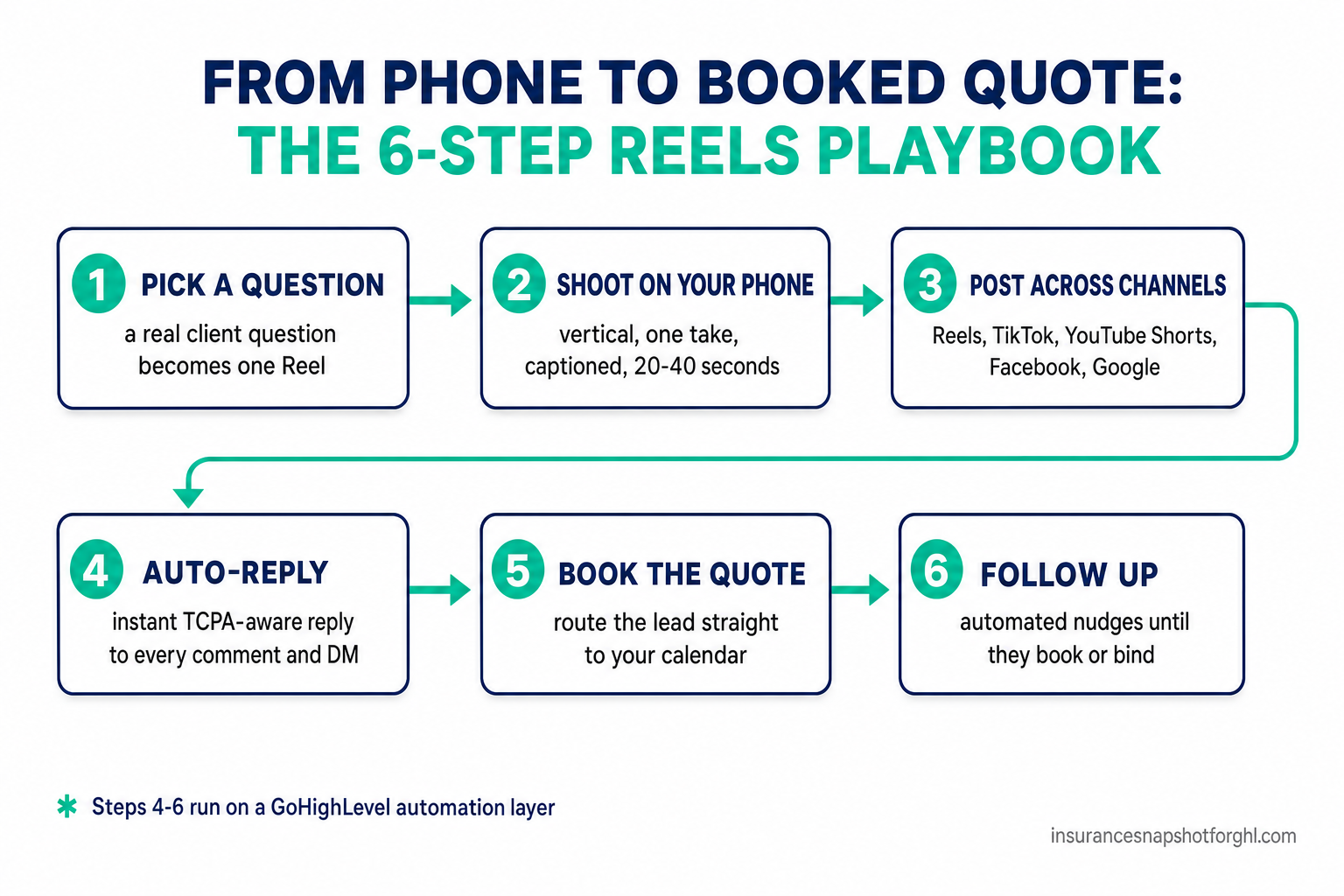
- Pick a question. Start from the seven formats above. One real client question = one Reel. Batch five in a single sitting so you’re never staring at a blank camera on a busy day.
- Shoot it on your phone. Vertical, good light, one take. Caption it on-screen (most people watch on mute). Aim for 20–40 seconds.
- Post across channels. The same clip is a Reel, a TikTok, a YouTube Short, a Facebook Reel, and a Google Business post. One shoot, many placements — that’s how a solo agent competes with a marketing department.
- Auto-reply to comments and DMs. The moment someone comments “how much for a 2021 F-150?” or DMs “do you do renters?”, they get an instant, TCPA-aware reply that starts the conversation. This is where most agencies leak — a comment left for two days is a quote gone cold.
- Book the quote. The reply routes an interested viewer straight to your calendar link and books a quote call — no phone tag, no “I’ll get back to you.”
- Follow up until bound. An automated sequence nudges the no-shows and the “let me think about it” leads, so the interest the video created doesn’t evaporate.
Steps 1–3 are what everyone means by “make Reels.” Steps 4–6 are why our clients’ videos produce booked appointments instead of just views — they run on a GoHighLevel automation layer that catches every comment and DM and turns it into a calendar event. We break the phone-and-web side of that same speed problem down in our speed-to-lead playbook.
How often to post (and why consistency beats polish)
The honest best-practice answer is three to five short videos a week, every week. Not because a magic number unlocks the algorithm, but because short-form platforms reward accounts that show up regularly and punish accounts that go quiet. A steady three-a-week beats a burst of ten followed by a month of silence — every time.
This is also the exact place in-house effort tends to collapse. Writing a caption is quick; scripting, filming, editing, and captioning several Reels a week is real, recurring production work that competes with quoting and servicing — the work that actually pays your bills. So the feed starts strong and goes dark by the first heavy renewal cycle. If you want the full build-vs-buy breakdown, we covered it for a neighboring Texas market in in-house vs done-for-you social for Houston agencies.
Read that chart the right way: even in a “digital-first” market, about 52% of buyers still finish through a human — an agent or a call center. Your video’s job isn’t to close the sale in 30 seconds; it’s to earn enough trust that a shopper picks your agency to have that human conversation with. Video builds the trust; the agent binds the policy.
The hook: winning the first three seconds
If a viewer scrolls past in the first three seconds, nothing else in your video matters. The opening line is 80% of the result. Weak openings sound like introductions (“Hi, I’m an insurance agent and today I want to talk about…”). Strong openings state the payoff immediately:
- Name the mistake: “You’re probably overpaying for auto insurance, and here’s the one reason why.”
- Ask the question they’re already asking: “Do you actually need flood insurance in Austin? Quick answer: maybe — and here’s how to tell.”
- Promise the number: “Three things that quietly raise your home insurance rate.”
- Bust the myth: “No, red cars don’t cost more to insure. But this does.”
Then deliver on it fast, add on-screen captions so the muted 80% can follow, and close with a specific next step: “Comment ‘QUOTE’ and I’ll send you the details” or “DM me your ZIP.” That closing line is the bridge from a view to the funnel — which is where the money actually is.
Turning views into booked quotes
This is the section that separates a hobby from a growth channel. Views, likes, and follows are not revenue. A booked quote call is revenue. The bridge between them is response speed and routing — and it’s precisely where a solo agent, doing this by hand, loses.
Picture a good Reel doing its job: forty comments and a dozen DMs overnight, half of them real buyers asking “how much for me?” If those sit until you finish your morning binds, they’re cold — the shopper already messaged two other agencies. The fix is an automation layer that treats every comment and DM like the inbound lead it is:
- Instant reply to every comment and DM, day or night, in your agency’s voice and TCPA-aware.
- Qualify with two or three quick questions (line of business, ZIP, timeframe).
- Route to your calendar and book the quote call automatically.
- Follow up on no-shows and maybes until they book or bind.
That’s the difference between “we post Reels” and “our Reels book quotes.” The content earns the attention; the GoHighLevel system behind it makes sure the attention converts. If you want the deep dive on catching those conversations the moment they land, our Facebook & Instagram DM automation playbook covers the routing in detail.
Keep it compliant: TCPA and CMS lines
Short-form video is marketing, so the same rules that govern the rest of your agency apply. Three lines to keep clean:
- Don’t quote or bind on camera. Video builds trust and books the conversation; a licensed producer runs the actual quote. Keep claims general (“renters coverage often starts around $15/month”) rather than promising a specific rate to a specific person.
- Handle DMs and texts the TCPA way. Any automated follow-up needs proper consent, clear identification, and working STOP/HELP handling. This is baked into a well-built GoHighLevel system; if you’re rolling your own, read our TCPA-safe SMS field guide first.
- Mind CMS rules if you touch Medicare. Any Medicare Advantage or Supplement content falls under CMS marketing rules — no misleading benefit claims, and follow current disclaimer requirements. When in doubt, keep Medicare Reels educational and route to a compliant enrollment conversation.
None of this should scare you off video. It just means the follow-up system behind the video has to be built correctly — which is a big part of why agencies hand this to a team that already knows the insurance lines.
Do it yourself or hand it off
You have two honest paths. Do it yourself if you (or someone on staff) will genuinely shoot three-to-five clips a week, edit and caption them, post across channels, and answer every comment and DM fast — through busy renewal weeks, indefinitely. Plenty of agents can; if that’s you, use this playbook and start today. Your phone is enough.
Hand it off if your real job is quoting, binding, and servicing — and video keeps landing in the “when things slow down” pile that never comes. A done-for-you social system treats the weekly Reel as a standing deliverable and pairs it with the automation that books the quote, so the channel actually compounds instead of stalling in month two. For most Austin agencies, that’s the difference between “we tried Reels once” and a steady source of booked quotes.
Either way, the takeaway is the same: short-form video is where your Austin market is looking, video is what earns their trust, and a booked quote — not a view — is the only metric that pays. Build the loop, keep it consistent, and connect it to a system that converts. If you’d rather have it handled, see the done-for-you social media service or book a quick call and we’ll map it to your agency.
FAQ
Do Austin insurance agents really need short-form video?
For most agencies, it's the highest-leverage channel available. Reels now make up about half of all time spent on Instagram (Meta, 2024), 78% of Gen Z and Millennial consumers use social media in connection with financial products (LIMRA 2024 Insurance Barometer), and 87% of people say a video convinced them to buy (Wyzowl, 2025). In a fast-growing, competitive market like Austin, a consistent short-video presence is how a new shopper decides your agency looks open, local, and trustworthy — usually before they ever call.
What should an insurance agent film if they don't know what to say?
Answer the questions clients already ask you. Seven repeatable formats: bust a small myth, explain one confusing term (deductible, umbrella policy), tackle a local coverage question (Texas hail, Austin flood zones), list 'three things that spike your rate,' hit a life-event trigger (new home, teen driver, turning 65), show a behind-the-desk moment, or answer the last question a client texted you. Each is a one-take phone video, 20–40 seconds, captioned on screen.
How often should an insurance agency post short-form video?
Three to five short videos a week, consistently, is the widely cited best-practice cadence. The exact number matters less than consistency — short-form platforms reward accounts that show up regularly and lose reach for accounts that go quiet. A steady three-a-week beats a burst of ten followed by a silent month. Batch-filming five clips in one sitting is the easiest way to sustain it.
How does a Reel actually turn into a booked quote?
Content earns the attention; an automation layer converts it. When someone comments or DMs asking 'how much for me?', they get an instant, TCPA-aware reply that qualifies them with a couple of quick questions and routes them straight to your calendar to book a quote call, with automated follow-up on no-shows. Without that layer, comments and DMs go cold within hours. This is exactly what a GoHighLevel-based system automates, and where most agencies leak leads.
Is it compliant for a licensed agent to post insurance videos?
Yes, with sensible guardrails. Don't quote or bind a specific person on camera — keep claims general and let a licensed producer run the actual quote. Any automated DM or text follow-up must meet TCPA requirements: proper consent, clear identification, and working STOP/HELP. If your content touches Medicare, CMS marketing rules apply, so keep it educational and use current disclaimers. A well-built follow-up system handles most of this for you.
Should I do it myself or hire a done-for-you team?
Do it yourself if you'll genuinely shoot, edit, post, and reply three-to-five times a week through busy weeks — the playbook and your phone are enough. Hand it off if your day is spent quoting and servicing and video keeps slipping. A done-for-you service treats the weekly Reel as a standing deliverable and pairs it with the automation that books the quote, starting around $397/month white-label — far less than hiring a writer, editor, and community manager in-house.
About the author
Priya Raman is an Insurance Agency Growth Strategist at Insurance Snapshot for GHL, based in Austin, TX. She came up running marketing for a multi-line agency, so she thinks in terms of premium written, retention by line, and producer capacity rather than vanity metrics. She writes about the strategy layer of agency growth — which marketing actually pays for itself, how to sequence content so it converts, and how to measure whether any of it is working. Editorial byline only — Priya is not a licensed agent and does not quote, bind, or sell insurance.
Want your agency’s short-form video handled without hiring a team? See the done-for-you Social Media service, book a quick call, or talk to a real person. Prefer to build your own organic engine? Start with our social media marketing playbook for insurance agents and the YouTube playbook.