
Most Scottsdale insurance agencies aren’t short on leads — they’re short on hours, because their team spends the day answering the same routine calls: “Can you resend my auto ID card?”, “I need a certificate of insurance for a job today,” “Did my payment go through?” None of those is a sale, and every one of them pulls a producer or CSR off the work that actually grows the book. A client self-service portal fixes it by letting policyholders pull their own documents, make payments, request certificates, and upload paperwork 24/7 — so your team handles the exceptions, not the errands. The economics are lopsided: a live service contact costs roughly 80 times more than a self-service one, and the majority of your clients would rather help themselves anyway. This is the operator’s breakdown of why the phone won’t stop, what each call really costs a Scottsdale agency, and how a portal built into your GoHighLevel account takes the load off.
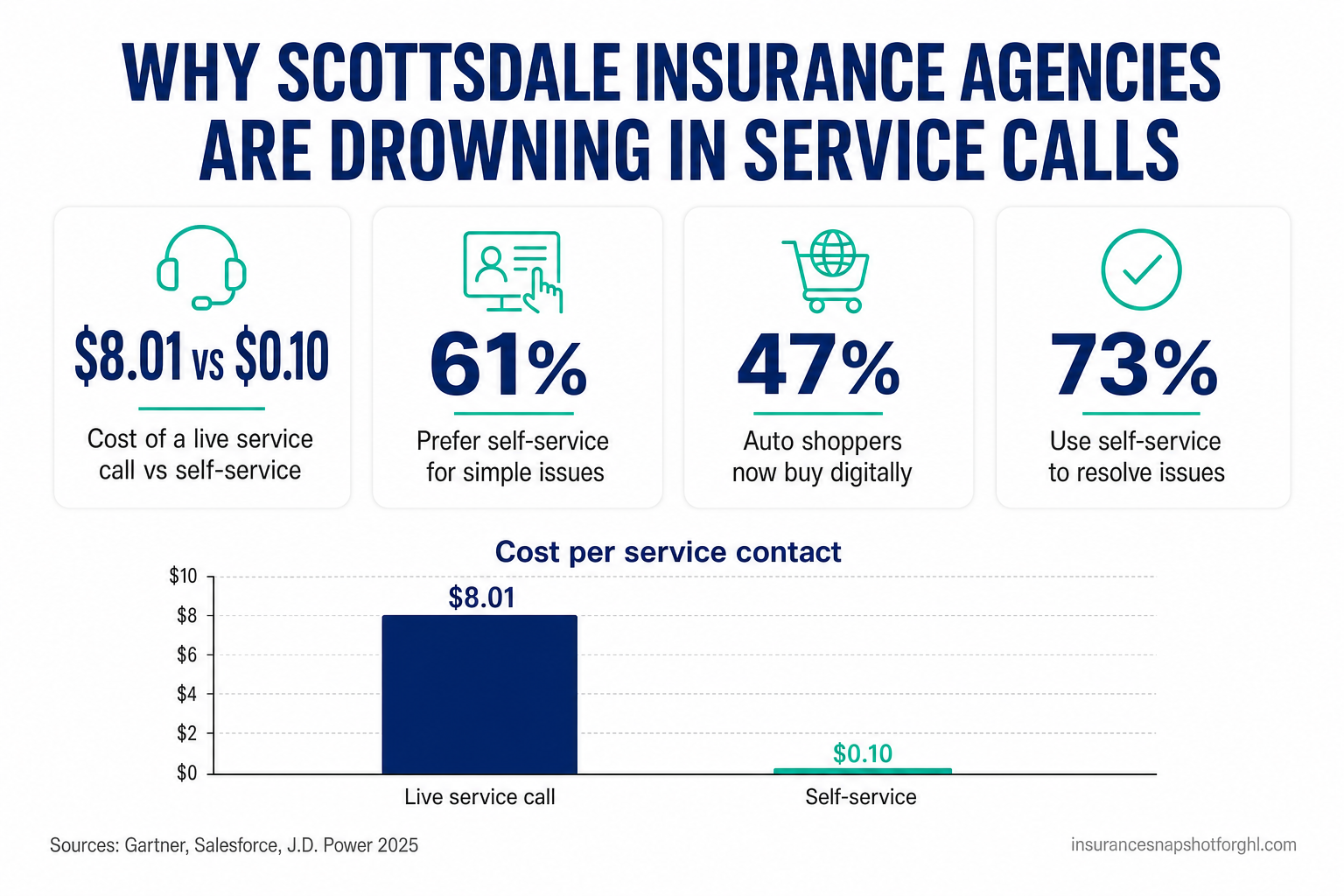
Table of contents
- The service-call trap Scottsdale agencies fall into
- What every routine service call actually costs
- Why Scottsdale’s growth makes it worse
- What your policyholders actually want
- What a client self-service portal is (and isn’t)
- The 6 requests a portal takes off your team’s plate
- Phone-first agency vs. portal-first agency
- Build it so it hands off to a human
- How to roll one out without disrupting your book
- FAQ
The service-call trap Scottsdale agencies fall into
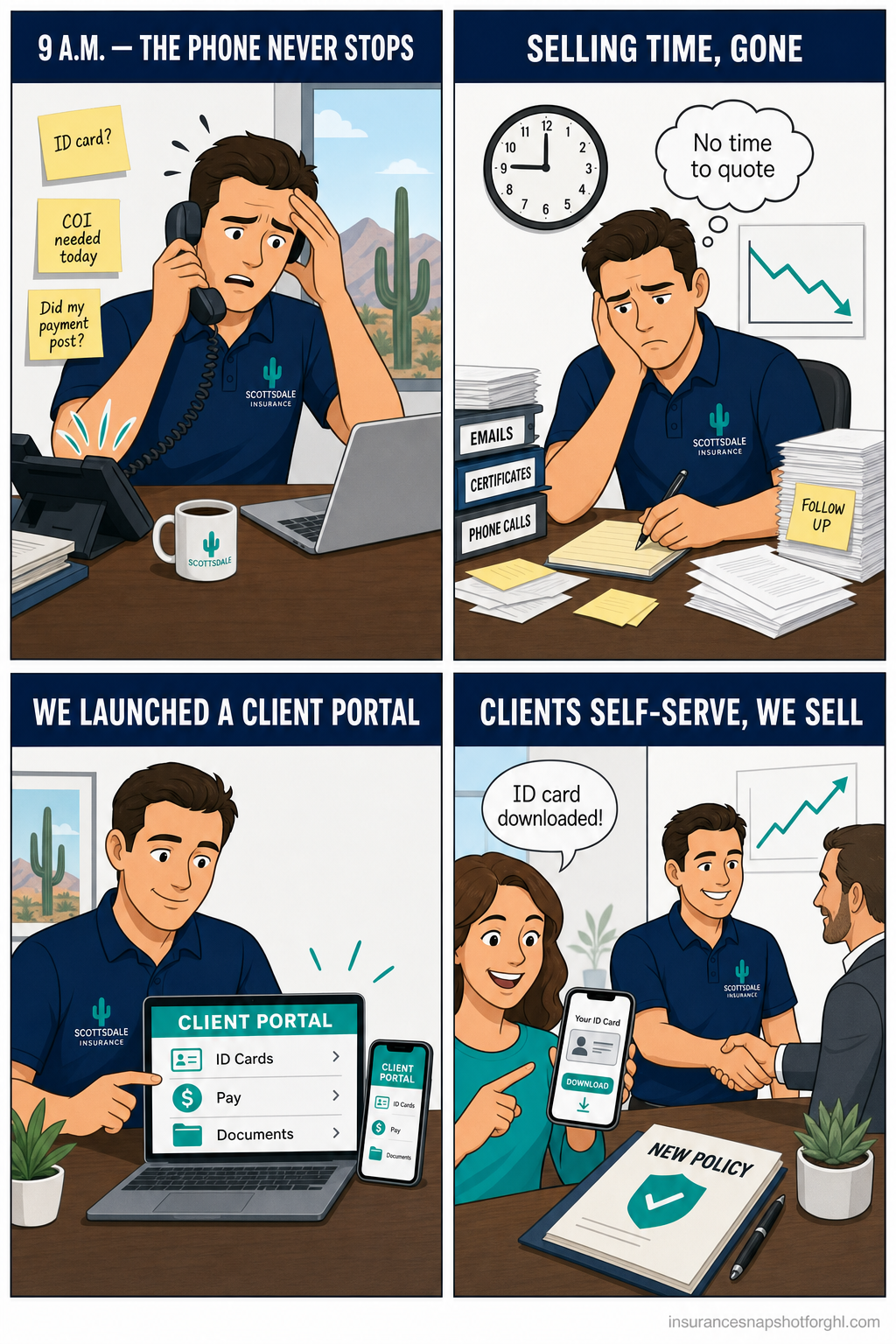
Here’s the pattern almost every independent agency in Scottsdale hits somewhere between five and fifteen producers: the book grows, so the service volume grows, so your best people spend more of every day on tasks that don’t earn a dime of new commission. A licensed producer who should be quoting a commercial package or reviewing a household for cross-sell is instead re-emailing a dec page, reissuing an ID card, or walking a client through where to click to pay.
None of that is optional work — a policyholder who needs a certificate of insurance to start a job today is a real, urgent request. The problem is the channel. Every one of those tasks arrives as a phone call or a one-off email that a human has to stop and handle synchronously. Multiply it across a book of a few thousand policies and the “service tax” quietly becomes a full-time role you never intended to hire for — or worse, it’s smeared across your producers, capping how much new business the agency can actually write.
This is the trap: you can’t grow the book without growing the service load, and you can’t grow the service load without stealing the exact hours you need to grow the book. The way out isn’t working faster. It’s moving the routine, repeatable requests to a channel that doesn’t require a human at all.
What every routine service call actually costs
The cost of a service call isn’t the two minutes on the phone. It’s the interruption, the context-switch, the task that got dropped, and — measured across a year — the raw price difference between a human channel and a digital one.
Gartner’s benchmark is blunt: a live service contact (phone, email, live chat) costs an organization about $8.01, while a self-service interaction costs roughly $0.10 — a difference of about 80 times (Gartner). That gap is the whole argument for a portal in one number.
Average cost per customer service contact by channel (USD). A live contact runs about 80× the cost of a self-service one. Source: Gartner, Rethink Your Customer Service Strategy to Drive Self-Service.
Put that against a Scottsdale agency’s real day. Say routine requests — ID cards, COIs, billing questions, address changes, document resends — add up to a modest 40 touches a day across the team. At roughly $8 of loaded labor per live touch, that’s about $320 a day, or on the order of $80,000 a year in staff time spent on tasks that a well-built portal would absorb for pennies. Even if your number is half that, it’s a full producer’s worth of capacity you’re pouring into errands instead of premium written.
And the opportunity cost is worse than the labor cost. Every hour a producer spends resending a dec page is an hour not spent on the quote that binds, the annual review that surfaces a cross-sell, or the renewal conversation that saves an account. In a competitive market, that’s the difference between a book that grows and one that just churns in place — the same reason we harp on protecting selling time in customer retention.
Why Scottsdale’s growth makes it worse
Scottsdale sits inside one of the fastest-growing metros in the country, and that’s a double-edged sword for a local agency. Maricopa County — home to Scottsdale, Phoenix, Tempe, and Chandler — added 57,471 residents between mid-2023 and mid-2024, the third-largest numeric growth of any county in the nation, and remains the fourth most-populous county in the U.S. at about 4.67 million people (U.S. Census figures via ABC15).
More residents and more small businesses mean more policies. Arizona is home to 706,640 small businesses — 99.5% of all businesses in the state, employing about 1.2 million people (U.S. Small Business Administration) — a deep well of commercial-lines demand on top of auto, home, and umbrella for the area’s higher-net-worth households. That’s great for growth and brutal for service load. Every new policy is a future stream of ID-card, billing, and certificate requests. An agency that services those requests one phone call at a time doesn’t scale linearly with the market; it hits a wall the moment its people are maxed out.
A self-service portal breaks that link. It lets the service load grow with the book without forcing headcount to grow in lockstep — which is exactly what you want in a market that keeps handing you new business.
What your policyholders actually want
The comforting part of this problem is that the fix is also what your clients prefer. Scottsdale skews digital-first, and the research on service expectations is one-sided.
Salesforce finds that 61% of customers prefer to use self-service for simple issues rather than talk to a live agent (Salesforce, State of the Connected Customer), and Gartner reports that 73% of customers use self-service at some point during issue resolution (Gartner, 2024). People don’t want to call you for an ID card — they call because it’s the only option you gave them.
Insurance specifically has crossed the digital line. J.D. Power’s 2025 U.S. Insurance Digital Experience Study found that 47% of auto insurance shoppers now purchase through digital channels, and that when insurers deliver a good digital experience, customers stay on that channel — producing “a better all-around experience at a lower administrative cost” (J.D. Power).
Customer self-service demand vs. the resolution gap (%). Most people reach for self-service, but few fully resolve there today — the gap a well-built portal closes. Sources: Gartner, 2024; Salesforce, State of the Connected Customer.
The takeaway for a Scottsdale agency: giving clients a portal isn’t making them do your work. It’s meeting them where they already are — and freeing your team at the same time.
What a client self-service portal is (and isn’t)
A client self-service portal is a secure, branded area — reachable from your website and a link in every text and email — where a logged-in policyholder can handle their own routine needs without waiting on a person. Done right for an insurance agency, it connects to the same GoHighLevel account and CRM your team already runs on, so a client’s request updates the record instead of landing in someone’s inbox.
What it is: a place to view policies, download ID cards and dec pages, make or update payments, request a certificate of insurance, upload documents (photos of a new vehicle, a signed form, a loss run), update contact details, and book a review — with everything logged against the contact automatically.
What it isn’t: a replacement for your licensed team. It doesn’t quote, bind, underwrite, or give coverage advice, and it shouldn’t try to. This split is exactly what the data recommends: McKinsey finds that for routine account changes about half of insurance customers prefer digital, while for complex journeys like buying or resolving a claim more than 70% still prefer a human agent (McKinsey). A portal handles the transactional 80% so your producers can own the high-value 20% — the coverage conversations, the exceptions, and the sales. If you’ve read our take on the real cost of off-the-shelf tools for Atlanta agencies, this is the same principle applied to service: buy or build the plumbing, keep the judgment human.
Because it lives inside your GoHighLevel workspace rather than as a disconnected third-party app, a portal like this is really a custom software layer on top of GHL — one that speaks to your pipelines, your workflows, and your existing system integrations.
The 6 requests a portal takes off your team’s plate
Not every service task belongs in a portal, but a handful of high-frequency ones almost always do. These six are the errands that ring your phone most — and the ones a portal absorbs cleanly.
- ID cards and dec pages on demand. The single most common “quick” request. In a portal, the client logs in and downloads the current document themselves — no callback, no re-email.
- Certificate of insurance (COI) requests. Commercial clients need certificates constantly, often urgently. A portal can let them request (and, for standard holders, self-generate within your rules) a certificate, routing anything non-standard to a human for approval.
- Payments and billing questions. “Did my payment post?” and “I need to update my card” are pure self-service. A portal shows status and takes the update without a phone call.
- Document upload and collection. New-vehicle photos, signed applications, loss runs, driver’s licenses — clients upload straight into the record instead of emailing attachments that someone has to file.
- Policy and contact updates. Address changes, phone numbers, adding a driver or vehicle to the queue for a producer to review — captured cleanly, not scribbled from a voicemail.
- Booking a review or a callback. Instead of phone tag, the client picks a time. This is where a portal feeds your calendar and pairs naturally with an AI receptionist that catches the calls you still get.
Phone-first agency vs. portal-first agency
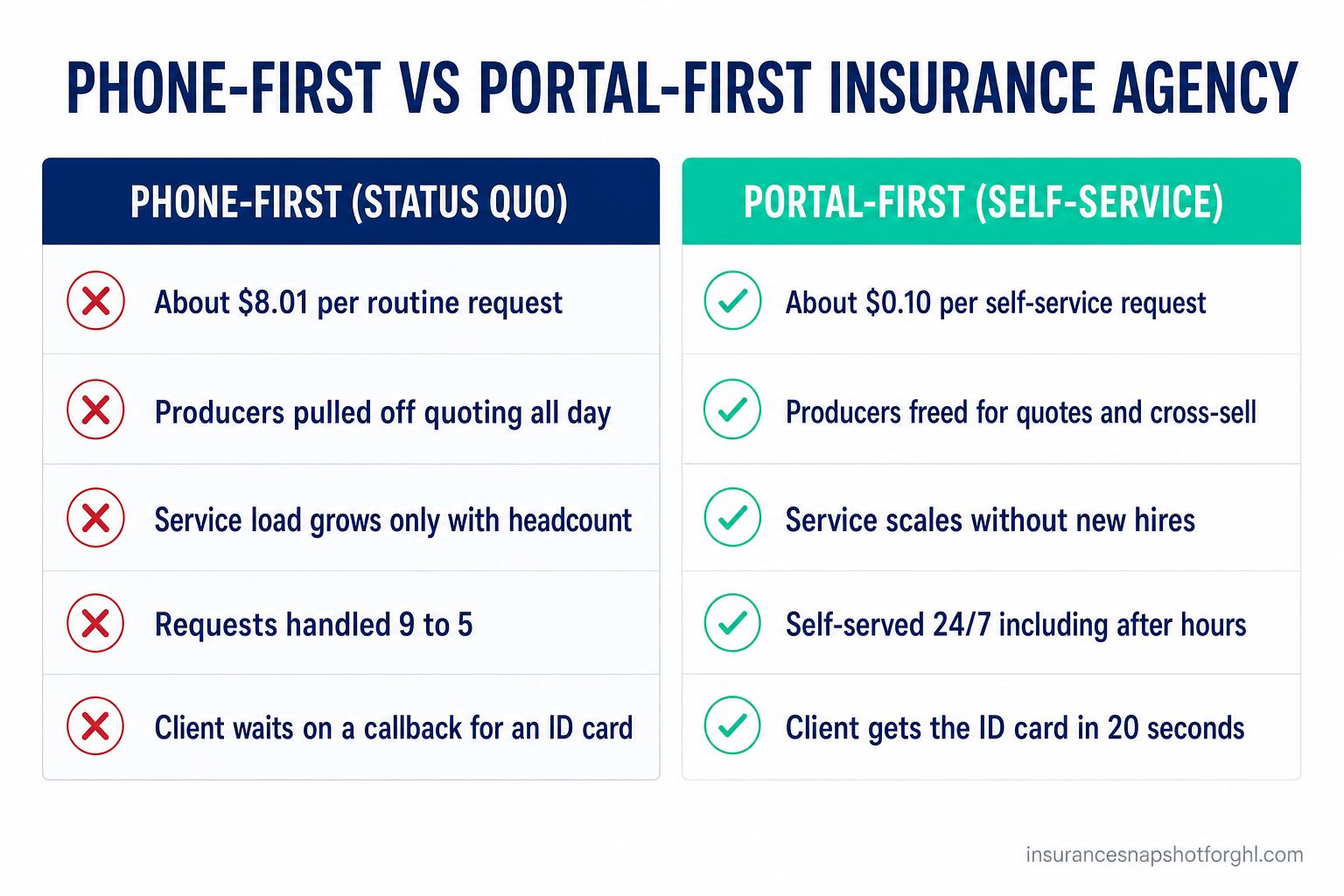
The difference isn’t cosmetic — it changes what your team does all day and how far your headcount stretches.
Two ways to run agency service
| Plan | Phone-first (status quo) | Portal-first (self-service) recommended |
|---|---|---|
| Price | Hidden cost | ~$0.10 per request |
| Feature 1 | ~$8 in loaded labor per routine request | ~$0.10 per self-service interaction |
| Feature 2 | Producers pulled off quoting all day | Producers freed for quotes, reviews, cross-sell |
| Feature 3 | Service load grows with headcount only | Service load scales without new hires |
| Feature 4 | Requests arrive as calls/emails, handled 9–5 | Requests self-served 24/7, incl. after hours |
| Feature 5 | Documents re-sent manually, easy to lose | Documents pulled by the client, logged to CRM |
| Feature 6 | Client waits on a callback for an ID card | Client gets the ID card in 20 seconds, alone |
| Build my portal |
Here’s the same shift from the client’s side of the glass:
The 3 p.m. certificate scramble
A contractor calls needing a certificate of insurance to start a job today. A CSR stops mid-quote to pull the policy, format the ACORD, and email it — while the client waits by the phone. The interrupted quote gets finished late, or not at all.
The contractor logs into the portal and requests the certificate himself. For a standard holder it generates instantly within your rules; anything non-standard routes to a producer with one click to approve. Your CSR never breaks focus on the quote that binds.
Build it so it hands off to a human
A portal is a lever, not a wall — and the data is a useful warning. Gartner found that while 73% of customers use self-service, only 14% fully resolve their issue there (Gartner, 2024). The lesson isn’t “portals don’t work.” It’s that a portal that traps people in a dead end is worse than a phone number.
That’s also why the compliance layer matters. Any payment, document upload, or messaging in the portal has to respect the same guardrails your agency already follows — secure handling of client data, TCPA-safe consent on any texts the portal triggers, and clear records of who did what. Build it into your GoHighLevel environment and those controls live in one place instead of scattered across a stack of disconnected apps — the same reasoning behind migrating an agency’s operations onto GHL.
How to roll one out without disrupting your book
You don’t rebuild your agency overnight. A sane rollout looks like this:
- Measure the baseline. Count last month’s service tickets by type. You need to know your two loudest requests and roughly how many live touches you’re spending per week — that’s your before number.
- Ship the top two requests. Launch ID-card/dec-page downloads and COI requests first. These alone typically remove the largest slice of call volume.
- Drive adoption from your existing channels. Add the portal link to every renewal email, every payment reminder text, and your website header and footer. Adoption is a distribution problem, not a build problem — and speed-to-lead automation already gives you the message templates to slot the link into.
- Add the next tier. Once the first two stick, layer in payments, document upload, and self-scheduling. Watch the call volume, not the feature count.
- Keep the human exit visible. Every step from day one has a one-tap path to a person, so the portal deflects the routine without deflecting the relationship.
Done this way, the portal earns trust with your team (it removes their most annoying work first) and your clients (it never strands them). And because it’s built on the GoHighLevel account your agency already runs — not bolted on as another login — it fits the workflows you have instead of forcing new ones.
The bottom line for Scottsdale agencies
Your agency’s growth ceiling isn’t leads — it’s the hours your best people burn on errands. A client self-service portal moves the routine, repeatable requests to the channel your clients already prefer, at roughly a hundredth of the cost, so your producers get their selling hours back. In a metro adding tens of thousands of new residents a year, that’s not a nice-to-have. It’s how you keep growing the book without drowning in the service that comes with it.
FAQ
What is a client self-service portal for an insurance agency?
It's a secure, branded area where a logged-in policyholder can handle routine needs on their own — download ID cards and dec pages, make payments, request a certificate of insurance, upload documents, update contact details, and book a review — 24/7, without waiting on a call back. Built into your GoHighLevel account, each action updates the client's CRM record automatically.
Will a portal replace my producers or CSRs?
No. A portal handles the transactional, repeatable requests — the roughly 80% of service that doesn't need judgment. Your licensed team keeps the high-value work: coverage conversations, exceptions, and sales. The goal is to free selling hours, not remove people. Every screen keeps a one-tap path to a human for anything that stops being routine.
How much does a service call really cost my agency?
Gartner benchmarks a live service contact at about $8.01 versus roughly $0.10 for a self-service interaction — about 80 times more. Across a book generating dozens of routine requests a day, that difference adds up to a full producer's worth of capacity spent on errands instead of premium written.
Do insurance clients actually use self-service?
The majority prefer it. Salesforce reports 61% of customers prefer self-service for simple issues, Gartner found 73% use self-service at some point when resolving an issue, and J.D. Power's 2025 study found 47% of auto insurance shoppers now buy through digital channels. People don't want to call for an ID card — they call because it's the only option most agencies offer.
Is a client portal secure and TCPA-compliant?
It can and must be. A portal built into GoHighLevel handles client data securely, respects TCPA-safe consent on any texts it triggers, and keeps clear records of every action. Keeping it inside one system — rather than a stack of disconnected apps — is what makes those controls manageable.
How long does it take to launch one for a Scottsdale agency?
Start narrow. Launching your two loudest requests — usually ID-card/dec-page downloads and COI requests — is a fast, scoped build, and it removes the largest slice of call volume first. From there you layer in payments, document upload, and self-scheduling as adoption grows. Book a walkthrough and we'll scope your first two requests.
About the author
Andre Bellamy is the GHL Automation Lead for the Insurance Practice at Insurance Snapshot for GHL. He builds and tunes the GoHighLevel workflows, portals, and integrations behind the snapshot — mapping how a request actually moves from a client’s first tap to a resolved record, then turning that into automation an agency can trust without babysitting. He writes about the operational mechanics of running an insurance agency on GoHighLevel.
Related reading: The real cost of off-the-shelf tools for Atlanta agencies · Missed calls are costing agencies real quotes — an AI receptionist fixes it · Insurance customer retention playbook · Connecting GoHighLevel to your agency’s other tools